How VR, digital twins and AI can strengthen industrial training, process safety
Key Highlights
- Immersive technologies like VR, digital twins, and AI are transforming process safety training by providing realistic, risk-free environments for practice.
- These tools help bridge the gap between written procedures and physical plant understanding, enhancing situational awareness and hazard recognition.
- Combining VR, digital twins, and AI creates interactive, data-rich training scenarios that improve decision-making and operational readiness.
- Starting with small, targeted pilot projects allows facilities to demonstrate value and refine immersive solutions effectively.
- Robust governance, validation, and measurement are essential to ensure accuracy, trust, and safety in immersive training environments.
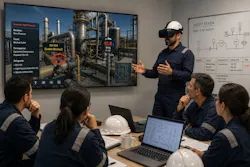
Process industries depend on people making correct decisions in complex, high-consequence environments. Operators, maintenance teams, engineers and supervisors must understand equipment behavior, plant layout, abnormal situations, alarms, emergency procedures and the consequences of incorrect actions. Traditional classroom instruction, manuals and two-dimensional drawings remain essential, but they do not always show how a process area feels, how equipment is physically arranged or how a deviation develops in real time.
Virtual reality (VR), digital twins and artificial intelligence (AI) are beginning to change that. Used correctly, these tools can create safer and more practical ways to prepare personnel before they enter the field, participate in a start-up, perform maintenance, respond to an alarm or join a process hazard review. The goal is not to replace engineering judgment or established safety management systems. The goal is to make complex process information easier to understand, rehearse and retain.
For processing facilities, the most valuable use of immersive technology is not entertainment or visual novelty. It is operational readiness.
Why conventional training can leave gaps
Process safety training often requires personnel to understand information from many sources: piping and instrumentation diagrams (P&ID), operating procedures, equipment data sheets, alarm philosophies, cause-and-effect charts, plot plans, emergency response procedures and previous incident lessons. Each document has value, but the learner must mentally connect these sources to the physical plant.
That connection is not always easy. A new operator may understand a procedure in the classroom but still struggle to recognize the exact valve, pump, line or access point in the field. A maintenance technician may know the isolation steps but may not fully appreciate nearby hazards, difficult access conditions or the relationship between upstream and downstream equipment. A young engineer may read a HAZOP worksheet but not clearly visualize the node, safeguards and consequences being discussed.
These gaps matter because process safety depends on both knowledge and situational awareness. OSHA’s Process Safety Management standard includes requirements related to operating procedures, training, process hazard analysis, pre-startup safety review, mechanical integrity and emergency planning. In other words, safe operation is not only a matter of documentation; it also requires people to understand the process, its hazards and the procedures connected to their tasks [1].
Immersive tools can help close the gap between written information and real operational context.
Virtual reality as a practical training environment
VR allows workers to enter a simulated process area and practice tasks without exposure to live hazards. A VR module can reproduce a pump skid, compressor area, reactor platform, packaging line, tank farm or utility system. Learners can walk through the environment, identify equipment, follow a procedure, recognize hazards and respond to abnormal scenarios.
The strongest applications are usually task-specific. For example, a VR training scenario may ask an operator to locate a pump, identify suction and discharge valves, verify local pressure indication, check for leakage, and follow a start-up sequence. Another scenario may simulate a blocked outlet, rising pressure, high-pressure alarm and relief-valve activation. The trainee can see the relationship between the deviation, the equipment response and the safeguards.
This type of learning is especially useful for situations that are difficult, expensive or unsafe to reproduce in real life. Emergency shutdown response, toxic release response, confined-space awareness, line-breaking preparation, hot-work risk recognition and abnormal start-up conditions can all be rehearsed in a controlled environment. The trainee can make decisions, observe consequences and repeat the exercise until the required behavior becomes more familiar.
Research on VR safety training has also grown. A systematic review and meta-analysis in Safety Science reviewed 52 articles on VR safety training across industries and found evidence that VR safety training can outperform traditional safety training in knowledge acquisition and retention, while also noting the need for stronger theory-based design and long-term retention measurement [2]. For processing facilities, this means VR should not be treated as a gimmick. It should be designed around clear learning objectives, measurable outcomes and realistic job tasks.
Digital twins add operational context
A digital twin is more than a 3D model. In industrial use, it is a digital representation that can be connected to process information, engineering data, operating states or simulation logic. ISO 23247 provides a digital twin framework for manufacturing, including general principles, terms, definitions and requirements [3]. While many process facilities will not implement a full real-time digital twin immediately, even a partial digital twin can support training and process safety.
For example, a digital training environment can link equipment models to tag numbers, process descriptions, operating limits, maintenance instructions and safety information. A pump in the virtual plant can show its P&ID tag, associated instruments, isolation points, relief path, typical failure modes and relevant operating procedures. A vessel can show level control, pressure protection, venting routes and inspection requirements.
This connection between physical layout and technical data is where digital twins become useful. A trainee is no longer just reading a drawing or watching a video. They are moving through a realistic plant environment while seeing the relevant process information in context.
Digital twins can also support management of change. Before a new skid, line modification or equipment replacement is installed, operators and maintenance teams can review the change virtually. They can examine access, isolation, valve orientation, lifting constraints, escape routes and potential human-factor issues. This can reveal practical problems before they become field problems.
AI can support preparation, not replace engineering judgment
AI has a growing role in industrial training and process safety, but it must be used carefully. AI can help organize technical information, identify patterns, suggest training scenarios, summarize procedures, extract information from P&IDs or support hazard-identification preparation. However, AI-generated outputs must be reviewed by qualified engineers and subject matter experts.
One promising area is AI-assisted hazard identification. In a process safety workflow, AI may help prepare for HAZOP or similar studies by reviewing previous worksheets, identifying repeated deviations, suggesting possible causes and consequences, or highlighting safeguards that should be verified. Research presented through IChemE Hazards 34 analyzed AI-assisted HAZOP tools and noted both opportunities and challenges, including automation features, use of libraries and AI integration, as well as concerns such as hallucination, reduced accuracy and the need for better predictive capability [4].
This is an important distinction. AI can improve preparation and consistency, but it should not independently approve hazards, safeguards or risk rankings. A responsible AI-assisted workflow keeps humans in control. The AI may suggest that a blocked outlet could lead to overpressure, but engineers must verify the design intent, relief protection, alarms, operating procedures and actual plant conditions.
The same principle applies to AI-generated training scenarios. AI can help convert incident lessons, operating procedures or HAZOP findings into learning modules. But the final scenario must be technically validated. In high-hazard industries, a realistic-looking but incorrect training scenario can create false confidence. Accuracy is more important than visual sophistication.
Combining VR, digital twins and AI
The strongest future workflow combines all three technologies.
A digital twin provides the structured plant environment and technical context. VR provides the immersive training interface. AI helps organize information, suggest scenarios and personalize learning. Together, they can turn static engineering data into interactive operational learning.
Consider a pressure-relief training scenario. The digital twin contains the vessel, outlet line, pressure transmitter, relief valve, flare or vent path, alarm information and operating limits. VR allows the trainee to stand near the equipment, observe the alarm, inspect the affected line and identify safeguards. AI helps generate scenario variations: blocked outlet, control-valve failure, external fire case, incorrect isolation, delayed operator response or instrument malfunction.
The trainee can then practice decision-making. What is the deviation? What are the possible causes? What is the consequence if pressure continues to rise? Which safeguards are available? Which actions are allowed by procedure? When should the operator escalate?
This is not only training. It is also a way to strengthen process understanding.
Applications across processing operations
The value of immersive training is not limited to oil and gas or petrochemicals. Chemical plants, food and beverage facilities, pharmaceutical manufacturing, water treatment, power generation and materials processing all involve equipment, procedures and hazards that benefit from better visualization.
In food and beverage processing, VR can support sanitation procedures, line changeover, equipment access and lockout/tagout awareness. In pharmaceutical manufacturing, it can support cleanroom behavior, equipment familiarization and deviation-response training. In chemical processing, it can support pump operation, tank-farm safety, emergency response and process hazard awareness. In batch operations, immersive scenarios can show the consequences of wrong sequence, wrong material, wrong valve alignment or delayed intervention.
The common theme is that workers learn best when procedures are connected to the real operating environment.
Implementation should start small
Many facilities hesitate to adopt immersive technology because they imagine a large, expensive digital twin of the entire plant. That is not always necessary. The most practical approach is to start with a high-value pilot.
A good pilot may focus on one unit, one recurring hazard or one high-risk task. Examples include pump start-up, line breaking, confined-space entry preparation, chemical unloading, emergency shower use, compressor trip response or tank overfill prevention. The pilot should have a clear purpose, such as reducing training time, improving procedure compliance, improving hazard recognition or preparing new personnel before field exposure.
The development process should include operations, process safety, maintenance and training teams. These stakeholders should define what the trainee must learn, what mistakes are commonly made and what the correct performance looks like. The VR or digital twin team should then build around those learning outcomes.
Measurement is essential. Facilities should evaluate whether trainees can identify equipment faster, follow procedures more accurately, recognize hazards more reliably or demonstrate better retention after training. Without measurement, immersive technology risks becoming an impressive demonstration rather than a safety tool.
Governance and validation matter
As AI becomes part of industrial training and process safety workflows, governance becomes more important. The NIST AI Risk Management Framework emphasizes risk management across the AI lifecycle, including governance, mapping, measuring and managing AI risks [5]. For processing facilities, this means AI tools should be controlled, validated and documented like any other support tool used in safety-related work.
Practical controls may include approved data sources, expert review of AI outputs, version control, audit trails, defined limitations, user training and clear rules on where AI may or may not be used. AI should not generate final operating procedures, risk rankings or safety-critical recommendations without formal engineering review.
The same applies to digital twins and VR scenarios. A virtual plant must match the approved design or clearly state its limitations. If a valve location, tag number or safeguard is incorrect, the model should be corrected. If the model is simplified, users should know what has been simplified. Training environments must build trust by being accurate.
The future: human-centered process safety
The future of industrial training is likely to be more visual, interactive and data-connected. But the purpose remains human-centered. Process safety still depends on competent people, disciplined procedures, strong leadership, effective maintenance and a culture that respects hazards.
VR, digital twins and AI can support that culture by making hazards easier to see, procedures easier to practice and abnormal situations easier to understand. They can help new personnel learn faster, help experienced workers refresh critical skills and help teams discuss hazards with a shared visual reference.
The most successful facilities will not adopt immersive technology simply because it is new. They will adopt it where it solves a real operational problem: a task that is difficult to teach, a hazard that is often misunderstood, a procedure that is often performed incorrectly or a scenario that cannot be safely practiced in the field.
For process industries, the opportunity is clear. Immersive technology can move training from passive instruction to active readiness. When connected to sound engineering, validated data and strong safety governance, it can become a practical tool for improving how people understand, operate and protect complex processing systems.
References
- Occupational Safety and Health Administration. “29 CFR 1910.119 — Process Safety Management of Highly Hazardous Chemicals.” OSHA.
https://www.osha.gov/laws-regs/regulations/standardnumber/1910/1910.119 - Scorgie, D., Feng, Z., Paes, D., Parisi, F., Yiu, T. W., and Lovreglio, R. “Virtual reality for safety training: A systematic literature review and meta-analysis.” Safety Science, 2024.
https://www.sciencedirect.com/science/article/pii/S0925753523003144 - International Organization for Standardization. “ISO 23247-1:2021 — Automation systems and integration — Digital twin framework for manufacturing — Part 1: Overview and general principles.” ISO, 2021.
https://www.iso.org/standard/75066.html - Elhosary, E., Moselhi, O., and Bucur, C. “Evaluation of AI-assisted HAZOP Software Tools.” IChemE Hazards 34, 2024.
https://www.icheme.org/media/27631/hazards-34-paper-175-elhosary-revised.pdf - National Institute of Standards and Technology. “Artificial Intelligence Risk Management Framework — AI RMF 1.0.” NIST, 2023.
https://www.nist.gov/publications/artificial-intelligence-risk-management-framework-ai-rmf-10
About the Author
 Amirsoleiman Esfandiari
Amirsoleiman Esfandiari
Founder of Techcopter Ltd,
Amirsoleiman Esfandiari is the founder of Techcopter Ltd, a UK-based immersive technology company specializing in virtual reality, digital twins, LiDAR scanning and industrial 3D visualization. With a background in aerospace engineering and process safety, he leads the development of immersive solutions that help organizations improve technical training, hazard awareness, operational readiness and digital communication across industrial, education, tourism and real estate environments. His work focuses on bridging engineering knowledge with practical immersive technologies to make complex systems easier to understand, evaluate and communicate.