Controlling dust in bulk solids mixing and blending processes
Key Highlights
- Capture dust at the source, such as charging points and mixer openings, to reduce airborne migration and improve containment efficiency.
- Use strategically designed enclosures and local exhaust hoods tailored to process needs and dust characteristics for optimal control.
- Select dust collection technology based on dust behavior, reactivity, and process requirements.
- Engineer airflow and filtration capacity carefully, considering particle size, process intermittency, and static pressure to maintain consistent performance.
- Address fire and explosion risks by conducting a dust hazard analysis and implementing safeguards such as venting, suppression, and grounding.

Across industries such as food and beverage, chemical processing, and specialty materials manufacturing, dry powders are routinely transferred, agitated and discharged as part of normal production. These activities make dust generation unavoidable, but the degree of risk depends on how well dust is managed at the point of generation and throughout the system.
A disciplined, engineering-led approach to dust control considers material characteristics, process design and airflow behavior together. When these factors are addressed early, dust collection systems can protect workers, preserve product integrity and support compliance without disrupting production. When they are not, dust becomes a recurring operational problem that is difficult and costly to correct.
Dust control challenges in mixing and blending operations
Mixing and blending operations present a unique set of dust control challenges because they combine material transfer, mechanical agitation and frequent operator interaction within a single process. Dust is generated not only when dry materials are introduced into mixers, but also as particles collide, fracture or are displaced during blending and discharge. These mechanisms make dust generation continuous rather than episodic, increasing the likelihood that fine particles will escape into the surrounding environment.
Containment is a persistent challenge. Many mixing and blending processes require open or partially open vessels to accommodate ingredient charging, sampling, or cleaning. Even small openings can allow fine dust to escape, remain airborne and migrate beyond the immediate work area. Once dispersed, dust can settle on equipment, structural surfaces, and floors, where it becomes a housekeeping burden and, in some cases, a secondary safety hazard.
While these challenges are common across industries, the risk profile varies by application:
Food and beverage processing: Airborne dust introduces allergen cross-contamination risks, sanitation challenges, and organic combustible dust hazards.
Chemical processing: Toxic, corrosive or reactive powders elevate concerns around worker exposure, environmental containment, and system durability.
Pharmaceutical and specialty materials: Very low exposure limits and potent compounds require precise containment and airflow control to protect operators and product integrity.
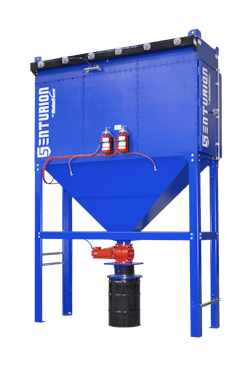
Combustible dust further complicates mixing and blending environments across many sectors. Fine particulate generated during blending can form explosive atmospheres inside equipment, ductwork, or dust collectors if ignition sources are present. Dust accumulation on horizontal surfaces increases the risk of secondary explosions, making effective capture and housekeeping essential considerations in system design.
These challenges underscore why dust control in mixing and blending operations cannot rely on generic solutions. Material properties, process configuration and operational demands all influence how dust is generated and how it must be managed, requiring a systems-level approach to design and engineering of dust collection solutions.
Dust collection system design for mixing and blending: key questions to ask
Effective dust control in mixing and blending operations depends on understanding how materials, processes and airflow interact. Before selecting equipment or finalizing system layouts, several foundational questions help define the scope and performance requirements of the system.
What are the characteristics of the material?
Particle size and shape, bulk density, moisture content, and agglomeration tendencies all influence how dust behaves once it becomes airborne. These characteristics affect capture requirements, filtration needs and the level of safety protection required. A clear understanding of material behavior is essential before system design begins.
Where and when is dust generated?
Dust is produced at multiple points during mixing and blending, including material charging, agitation, discharge, and cleaning. Identifying when dust is released — and whether generation is continuous or intermittent — helps determine where control measures will be most effective. Processes with frequent operator interaction require particular attention.
How is the process configured?
Open, partially enclosed, and fully enclosed mixing operations present very different dust control challenges. Access requirements for charging, sampling, and maintenance often dictate how much containment is feasible. Process layout also affects how airflow can be introduced without disrupting production.
What level of capture is required?
Some applications focus primarily on reducing visible dust, while others must meet strict exposure or contamination limits to meet regulatory requirements (including those for worker health and safety, environmental compliance, and product contamination). The required level of control influences capture strategy, airflow volume, and filtration efficiency. Defining performance expectations early helps prevent under- or over-designed systems.
Are there fire or explosion risks?
Many powders handled in mixing and blending operations are combustible under the right conditions. Identifying ignition risks and explosion potential is critical to determining whether additional safeguards, such as isolation, venting, or suppression, are required. This evaluation is often guided by a formal dust hazard analysis (DHA) conducted in accordance with applicable NFPA standards for combustible dust.
Best practices in dust control system design for mixing and blending operations
Effective dust control in mixing and blending operations relies on integrating capture, containment, and filtration into the process rather than treating them as isolated components. While specific solutions vary by material and industry, several best practices consistently define high-performing systems.
Capture dust at the source
The most effective dust control strategies focus on capturing dust as close as possible to the generation point. In mixing and blending operations, this typically includes material charging points, mixer openings, discharge locations, and cleanout areas. Capturing dust before it disperses reduces airborne migration, lowers required airflow, and minimizes reliance on general ventilation.
Source capture is especially important during ingredient addition, where free-falling powders and bag dumping can release large volumes of fine particulate. Integrating capture points into mixer lids, charging hoppers, or adjacent workstations improves containment without interfering with normal operation.
Use enclosures and hooding strategically
Enclosure design plays a critical role in dust control effectiveness. Fully enclosed mixers with dedicated vent connections offer the highest level of containment and allow systems to operate with lower airflow. Where full enclosure is not practical, partial enclosures or local exhaust hoods can still provide effective control when properly designed.
Slotted hoods, backdraft plenums, extraction arms, and custom capture openings are often more effective than overhead canopy hoods for heavier dusts, which do not reliably rise with thermal airflow. Hood placement, opening size, and airflow direction should be engineered to pull dust away from operators and into the capture zone rather than allowing it to escape laterally.
Select dust collection technology based on dust behavior
For most mixing and blending applications involving dry, fine powders, cartridge dust collectors are well-suited to the task. These systems use pleated filter cartridges to provide a large filtration surface area within a compact housing, allowing them to efficiently capture fine particulate at the airflow rates typical of source-capture applications. This makes cartridge collectors particularly effective for the light, airborne dust commonly generated during powder charging, agitation, and discharge.
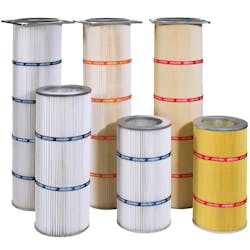
Cartridge collectors also perform well under variable dust loading, which is common in batch mixing and blending operations. Because filtration occurs primarily at the surface of the media, dust is easier to release during cleaning cycles, helping maintain consistent airflow and pressure drop. Their compact footprint allows collectors to be located closer to the process, reducing duct length, pressure losses, and overall system complexity.
Wet collectors may be considered for certain high-risk combustible dusts or materials that are difficult to handle in dry filtration systems due to stickiness or reactivity. Baghouse collectors may be appropriate for applications involving very high air volumes or coarser materials. Regardless of technology, collector selection should consider airflow requirements, dust characteristics, maintenance access, available space, and long-term operating conditions.
Engineer airflow and filtration capacity correctly
Dust collection system performance depends on balancing airflow, filtration capacity and system resistance. In mixing and blending operations, where dust generation can be intermittent but intense, proper sizing is essential to maintain consistent capture and avoid performance degradation over time.
Key sizing considerations include:
Airflow (CFM): Airflow must be sufficient to achieve the capture velocity needed at each dust generation point, such as charging ports, mixer openings, and discharge locations. Fine, lightweight powders common in blending operations require steady airflow to remain entrained and be pulled into the capture zone before dispersing.
Air-to-cloth ratio: The air-to-cloth ratio defines how much airflow passes through a given area of filter media. Fine or cohesive powders typically require lower air-to-cloth ratios — meaning more filter media per CFM — to prevent rapid filter loading, excessive pressure drop, and reduced cleaning effectiveness. Proper air-to-cloth selection supports stable filtration and longer filter life.
Static pressure: Static pressure represents the total resistance to airflow created by hoods, ductwork, filters and other system components. As filters load or production conditions change, static pressure increases. Fans must be selected to deliver the required airflow at expected operating pressures, not just under clean or ideal conditions.
Properly engineered systems balance these factors to maintain reliable airflow, predictable pressure drop, and consistent dust capture.
Match filter media to the application
Filter media selection should be driven by material properties and operating conditions. Fine powders often benefit from surface-loading media such as nanofiber or membrane-coated filters, which improve capture efficiency and ease of cleaning. Hygroscopic or sticky materials may require PTFE-coated or oleophobic media to reduce blinding and buildup.
For combustible dusts, conductive or anti-static filter media help dissipate static charge and reduce ignition risk. Abrasive materials may require more durable media to extend filter life. Selecting the appropriate media improves system reliability and reduces maintenance frequency.
Address fire and explosion risks where applicable
Most mixing and blending operations involve combustible dusts, making explosion risk a central consideration in dust control system design. A DHA provides the structured framework for identifying where combustible dust hazards exist, how the dust may be ignited, and what consequences could result. Conducted in accordance with applicable NFPA standards, the DHA evaluates materials, processes, and operating conditions to determine whether additional safeguards are required and where they should be applied.
Findings from a DHA inform the selection and placement of protective measures such as explosion venting or suppression on dust collectors, isolation devices on ductwork, and proper grounding and bonding of equipment. The analysis also addresses dust accumulation outside the collection system, where secondary explosions often present the greatest risk. Aligning dust collection system design with DHA findings, along with compliance with applicable OSHA requirements, helps ensure combustible dust risks are addressed systematically rather than reactively.
Plan for safe dust handling and maintenance
Dust control does not end at capture and filtration. Collected material must be discharged, transported, and disposed of or recycled safely. Enclosed hoppers, sealed discharge devices, and containment during filter changes reduce the risk of reintroducing dust into the work environment.
Maintenance access should be considered during system layout to ensure that filters and components can be serviced without exposing personnel to hazardous dust. Systems designed with maintenance in mind are more likely to remain effective over the long term.
Work with a qualified engineering partner
Because dust behavior in mixing and blending operations varies widely by material and process, effective dust control systems require more than equipment selection alone. A qualified industrial dust collection engineering partner should be able to evaluate capture strategy, airflow requirements, filtration capacity, and safety considerations as an integrated system rather than as individual components.
When selecting a partner, facilities should look for experience with bulk solids processes, a solid understanding of airflow and filtration principles, and familiarity with applicable safety standards. The ability to account for real-world operating conditions (such as access, maintenance needs, and future process changes) helps ensure that dust control solutions remain effective and reliable over time.
About the Author

Rick Kreczmer
Rick Kreczmer is President of RoboVent, a supplier of industrial dust, fume, and mist collection and industrial ventilation equipment to a wide range of industries.