Where experienced engineers go wrong when designing high-velocity dust collection systems — Part 1: Critical resources for effective industrial dust collection system design.
Key Highlights
- High-velocity dust collection systems require a different engineering approach than conventional HVAC systems due to increased pressure drops and duct erosion at higher velocities.
- Applying HVAC design rules of thumb to dust systems can lead to significant errors; specialized standards and software are essential for accurate design and safety.
- Creating custom spreadsheets based on industry standards allows engineers to evaluate duct velocities, pressure losses, and system performance more precisely than relying on generic software or shortcuts.
- While AI and cloud-based tools can assist in finding information, engineers should critically evaluate and validate data before applying it to high-velocity dust collection system designs.
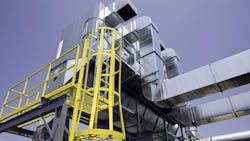 Dust collection system
Designing high-velocity industrial dust collection systems requires a fundamentally different engineering approach than that used for conventional heating, ventilation, and air conditioning (HVAC) systems. Even experienced engineers can overlook critical factors that influence system performance and safety.
The most egregious design errors usually occur when an engineer who is astute at designing HVAC systems that operate at internal duct velocities around 1,200 feet per minute (fpm) applies HVAC design standards and “rules of thumb” to an industrial dust collection system, where duct velocities may approach the 5,800-fpm range. System pressure drop and duct erosion increase with the square of the velocity. This means that increasing the duct velocity from 1,200 fpm to 5,800 fpm increases pressure drop by a factor of 23 (5,8002/1,2002). As a result, small layout and calculation shortcuts that are acceptable in low-velocity HVAC can create large errors when applied to higher velocity dust collection systems.
This article is the first in a series of articles highlighting the most common and costly design oversights I’ve encountered in real-world dust collection system engineering. Topics will include misapplied HVAC rules of thumb, improper fan inlet and outlet duct arrangements, inadequate corrections for elevation and temperature, velocity mismatches at branch entries, and problematic “grasshopper-leg” duct concepts. Additional sections will address hopper inlet design, can-velocity evaluation in competitive equipment reviews, pitfalls of returning collected dust to the process, bin vent fan selection for pneumatically filled silos, and fan sizing considerations such as cold-start capability and high inlet vacuum effects.
Throughout the series, I will emphasize the importance of understanding system behavior, accounting for air leakage, pneumatic conveying surge conditions, abrasive dust properties, and real-world constraints. The intent of the series is not to teach fundamentals, but to help experienced plant and consulting engineers design robust, predictable, and maintainable dust collection systems.
In this first article, I’ll discuss useful design references, software, spreadsheets, and field-validated velocity criteria.
Essential industrial ventilation reference books
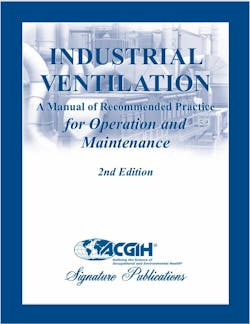
Reference books for designers of industrial ventilation systems typically rely on the standards and designs applied in the book Industrial Ventilation: A Manual of Recommended Practice for Operation and Maintenance, published by the American Conference of Governmental Industrial Hygienists (ACGIH). The design standard book is very comprehensive in presenting the design basis of collection hoods and calculating duct system losses. Sections include how to conduct a pitot tube transverse and how to correct air density for elevation (pressure) and temperature. The book also discusses fan performance and how to calculate additional pressure drop when duct elbows are applied close to the fan inlet or outlet.
The book Fan Engineering is a historical textbook originally written and formally published by the Buffalo Forge Company. This book not only covers fan design and fan laws but also has extensive sections on most topics related to fan selection/application as well as fan construction.
Fan Engineering is a valuable engineering reference that also contains useful reference information such as dimensions and physical properties of structural steel shapes, heat transfer, psychometric charts, Stokes’ law equations, steam tables, and statistics. This would be a true contender if you needed to choose one engineering reference book to be stranded with on a deserted island. The book was initially published in the 1940s as a thin reference book, but what you should look for is the larger, thicker version that was produced beginning in the 1960s and was last published in 1999.
The American Society of Heating, Refrigerating, and Air-Conditioning Engineers (ASHRAE) has a series of design books that are more than 90% about HVAC. These books are published in four volumes, with one volume updated each year on a rotating basis. The physics of air presented in the “Fundamentals” volume do not change. There are useful sections on the physics of air as well as unique formulas for determining such values as the heat dissipation and HVAC load of an operating indoor fan motor.
Useful information that can be applied in conjunction with industrial ventilation design are the sections on determining pressure drops through unique duct arrangements such as rectangular Z-elbows, exhaust through wall mounted grating, elbows at fan inlets or outlets, and non-symmetrical duct expansions or contractions.
ASHRAE offers a very valuable Duct Fitting Database tool as part of its online subscription-based Technology Portal for evaluating duct and fittings of all types. ASHRAE also offers a similar Duct Fitting Database Lite app that is available through the iOS app store.
Sheet Metal and Air Conditioning Contractors National Association (SMACNA) books on duct construction standards provide the design and selection basis for duct design for determining duct wall thickness, along with required duct stiffener selection and spacing. Standards are available for round, square and oval duct, as well as exhaust stack design. Light nuisance dust venting applications with small diameter duct can usually be fit with ‘snap band-connected’ duct from many suppliers.
For heavy abrasive dusts and larger diameter duct systems, refer to the SMACNA standards, which advise duct thickness of construction based on the abrasive nature of the dust while considering the worst-case scenario of a duct needing to support itself if filled with dust. SMACNA publications can also help with designing support structures for your duct system.

Scientific Dust Collectors of Alsip, Illinois, issues a free publication called The Real Dirt on Dust, which describes the design basis of most dust collection air-media separator designs along with a history of dust collection. This publication provides a good foundation for understanding various types of dust collectors and filter media options, provides a system commissioning check list, and addresses issues such as moisture within the collector.
Now that we have entered the age of artificial intelligence, cloud-based public AI platforms are being developed and trained to assist users in finding engineering design information. At present, Google and other AI search engines may not adequately answer specific engineering questions but will point you to useful internet content related to the topic. Prudent professionals will still want to evaluate and test the information and calculation relations derived through an AI search before accepting them and applying them to their designs.
Software limitations in high-velocity dust collection system design
I have applied system design software intended for dust collection system design as well as software that was really only intended to be used for HVAC designs. CAD add-on ‘apps’ for determining the pressure drop through a CAD-defined duct system are also available. As a ‘black box’ concept, I do not fully trust such pressure drop determinations, which are more than likely based on HVAC design principles rather than high-velocity dust collection system design principles. In my experience, software dedicated to dust collection system design is most beneficial when the work involves repeatedly designing systems that are similar to each other.
Building transparent dust collection system spreadsheets
I find it is typically easiest for an experienced designer to create their own design spread sheet, applying the formulas in Industrial Ventilation and ASHRAE publications. The designer can then break down the system into duct sections and calculate basic information such as duct velocity, velocity pressure, and pressure drop in each section. For inlet hoods, losses can be included as pressure drops based on multipliers to the velocity pressure. Inputs for elbows and their radius/diameter ratio, as well as branch entry losses (at 30° and 45°), can easily be included.
The designer can then evaluate the losses in duct sections to determine the airflow path with the highest pressure requirement from collection point to dust collection device, which defines the ‘dirty duct side’ total system static pressure requirements. The spread sheet can also be applied for evaluating the pressure losses through the ‘clean side’ of the duct system.
The spreadsheet can also carry explicit corrections for temperature and altitude as well as airlock sizing based on grain loading. Note that the ACGIH/ASHRAE calculations, tables, and pictorials are based on systems operating at under 500° F. For systems operating at 500° F and higher, you must hand calculate pressure drops, applying actual specific heats for air corrected to temperature, and calculate the resultant mixed temperature (and density) for any mixing of ‘hot’ and ‘cold’ airflows.
In Part 2 of this series, I’ll discuss common duct system design errors that inhibit dust collection system performance.
About the Author
 Greg Black
Greg Black
Gregory J. Black, P.E. (Mechanical) has extensive experience in the design, application, and maintenance of industrial ventilation and dust collection systems, including applications engineering roles alongside the original patent holders for Venturi-based compressed-air filter cleaning (MikroPul) and with the Air Pollution Equipment Control Division of FLSmidth. For more than two decades he has operated Golden Eagle Technologies, LLC (Golden, Colorado), supplying equipment for granular material processing. Under the service mark, Baghouse Duct Design dot Com, he provides advisement services to plant engineers and engineering firms on industrial ventilation system design, troubleshooting, and retrofits.