Dust collection duct manifolding: Common errors and best practices
Key Highlights
- Poor duct manifolding is a primary cause of airflow imbalance and dust buildup.
- Maintaining 4,000–5,000 fpm velocity is critical to prevent dust accumulation.
- Balanced energy at duct junctions ensures consistent airflow across all branches.
- Proper branch angles and tapered fittings reduce turbulence and energy loss.
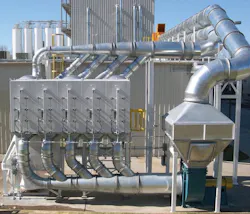
Dust collection systems fail to provide the required dust emissions control for numerous reasons, including improper hood design, incorrect equipment selection, lack of instrumentation, and poor maintenance, among others. Although these reasons are vital to creating a successful dust collection system, just as important is proper design of the ducting system used to convey the collected dust from the hoods to the dust collector (also called the air-material separator).
Dust collection duct manifolds play a critical role in system performance
The ducting in a dust collection system is also called the duct manifold. Duct manifolding can be generally defined as a method of grouping individual ducts into a single larger duct. Proper duct manifolding is crucial to a successful dust collection system.
To understand the correct methods of designing a duct manifold, it is important to recognize methods of manifolding that are not correct and why. The four most common manifolding errors are plenum manifolds, tapered manifolds, random branch connections, and Christmas tree manifolds. The following will provide multiple actual examples of these manifolding errors and explain why they are incorrect. While there are other types of manifolding mistakes, the four discussed here (and variations of them) are the most widespread.
Plenum manifolds create dust accumulation and airflow problems
A plenum manifold consists of a single large duct (without size change) with multiple branch connections. This approach ensures dust accumulation in at least part of the larger duct and typically causes problems with air distribution to the branches and subsequently to the dust sources.
As material accumulates in the plenum, it tends to effectively create an artificial internal duct size where velocities can be maintained. However, the accumulations of material can eventually increase and plug portions of the plenum manifold and/or represent a significant combustible dust hazard.
Examples are shown in Figure 1. The top left image shows a large plenum manifold with multiple connections (airflow right to left). The collected material is a high-hazard combustible dust, and the plenum required removal of accumulations at least once a day.
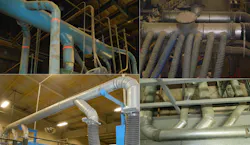
The images in the bottom left and bottom right of Figure 1 show similar plenum manifolds where multiple connections are made without a duct size change. The main difference is that the duct size is the same as the first connection/elbow rather than a large diameter with multiple inlets. This type of plenum manifold results in very poor air distribution and causes dust accumulation due to low internal velocity.
The top right image in Figure 1 shows a plenum manifold with multiple hose connections. The airflow is left-to-right. In this configuration, the airflow will come from the far (left) end due to the tendency of the air to come from the path of least resistance. The 90-degree T connections to the plenum add to this problem. The result is uneven air distribution and poor overall performance.
Tapered manifolds can fail without proper airflow control
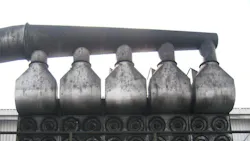
A tapered manifold uses a custom main duct that transitions continuously from a small diameter to a larger diameter to provide proper air distribution for multiple, closely connected, sources. This method can be used if done properly but is often improperly utilized.
Figure 2 shows an attempt to distribute the airflow into a large, modular downflow dust collector (airflow is left to right). This method, however, results in biased airflow, as the incoming airflow wants to remain straight rather than making the initial abrupt 90-degree turns. Instead, the air tends to flow toward the furthest point, resulting in more dust going to the furthest downstream filters than the upstream filters. This will effectively reduce filter life and cause material (in this case combustible) to build up in the “dead end” of the manifold.
Random branch connections lead to severe airflow imbalance
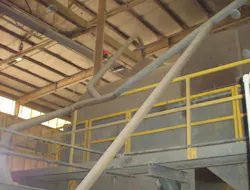
Figure 3 shows two 4-inch ducts connecting to another 4-inch duct, which has a third 4-inch duct connecting to it before eventually connecting to a larger duct. Maintaining adequate airflow in all three 4-inch ducts is nearly impossible due to the extreme energy requirements. The result is higher (but still not adequate) airflow from the closer 4-inch connection and progressively lower airflow from the other two. This approach never works.
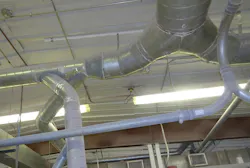
In Figure 4, one branch enters in the wrong direction just upstream from another, then there is a double Y connection (which creates high turbulence and energy loss), with more problems further down the duct run. In this system, there is no common sense, logic, or consideration for proper air distribution in the assembly of branches into a main duct, which is sure to cause problems.
Christmas tree manifolds increase turbulence and energy loss
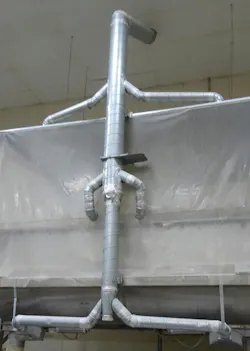
Christmas tree manifolding is when two ducts join another, larger duct at the same point, as shown in Figure 5. This results in high turbulence and excessive energy loss. And if the two branches are of differing lengths, etc., the added result is poor air distribution. In the manifold shown, the use of spiral ducting and slide gates exacerbate the problems. Also, the duct expands before the second set of entries, creating additional turbulence, but the final entries have no size change in the duct, which negatively affects the previous connections. The overall result is poor performance and air distribution.
Having discussed the most common manifolding errors, now let’s look at the critical aspects of proper duct manifold design.
Proper duct sizing ensures adequate velocity and prevents dust buildup
Throughout a properly designed ducting system, the airflow and resulting duct velocity must be sufficient to prevent dust accumulation in the duct system. For dust collection purposes this velocity typically ranges from 4,000 fpm to 5,000 fpm. I do not recommend duct velocities below 4,000 fpm for dust collection purposes. For proper design, the junction of any two ducts in the system must result in a continuing duct size that maintains that velocity.
For example, refer to the manifold shown in Figure 6. Moving from right to left (the flow direction) and assuming a minimum velocity of 4,000 fpm, the two 6-inch ducts join to create an 8-inch duct. At 4,000 fpm, the flow in each of the 6-inch ducts is (based on o.d.) a minimum of 786 cfm. The combined flow of the two 6-inch lines is 1,572 cfm. The combined flow in a 7-inch line would result in a velocity of nearly 6,000 fpm, while in a 9-inch line, the velocity would be only 3,600 fpm. The first is excessive; the second too low. The 8-inch line results in a duct velocity of approximately 4,500 fpm (Note: Use standard duct sizes and not fractional sizes such as 6.5-inch, 7.5-inch, etc.). The 8-inch size is the proper selection in this case.
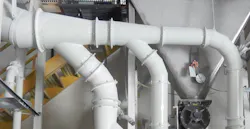
Another method for the above is to consider the combined cross-sectional area of the two 6-inch lines (approximately 0.4 sq. ft.) compared to the 8-inch line (0.35 sq. ft.). Although the 9-inch line (at 0.44 sq. ft.) is closer to the combined 6-inch lines, the resulting velocity is below the accepted minimum, which is why the 8-inch line should be used.
The next junction of Figure 6 is the combination of two 8-inch lines. The combined cross-sectional area is approximately 0.7 sq. ft. An 11-inch line is 0.66 sq. ft. The volume of the “straight” duct is 1,572 cfm and, at 4,000 fpm, the volume of the other 8-inch line is 1,400 cfm, for a total of 2,972 cfm. In an 11-inch line, the velocity would be approximately 4,500 fpm, making that the logical selection for the combined duct size.
Balancing energy requirements is key to proper air distribution
Proper dust collection system design would be without complications if duct manifolding only required the previous discussion, but there is also the problem of ensuring proper air distribution. Just providing duct sizes that maintain duct velocity throughout the system is rarely sufficient to ensure proper air distribution for each dust emission source.
The duct manifold must also be sized to ensure the energy requirement (e.g., differential pressure or static pressure) at the junction point are the same for each branch line.
For example, if one of the 6-inch branches in Figure 6 requires 3.2 inches w.g. of energy to reach that junction and the other requires only 2.3 inches w.g. at the same junction, then using 6-inch ducts for each of the two branches may or may not be acceptable. Unless the system is designed to match the energy at the junction for each branch line, there will be problems with airflow distribution. Fortunately, there are solutions to this dilemma.
The first possible solution is to decrease the airflow in the higher energy requirement branch to the point where the resulting energy requirements match. In this case it would be in the range of 660 cfm. However, this level of airflow is not acceptable, as the duct velocity would fall well below 4,000 fpm. Therefore, the next possible solution is to increase the airflow in the lower energy line to approximately 930 cfm. This is often the best option.
However, a third option is to use a smaller line size on the lower energy branch line (such as 5-inch instead of 6-inch) and determine the required airflow to achieve the matching energy requirement at the junction.
This approach can work but has pitfalls. First, the reduced airflow (e.g., 5-inch duct verses 6-inch duct) may not be acceptable for the hood design and dust emission control requirements. Second, it may still require further adjustment in the other 6-inch line (e.g., increased airflow) to match the energy at the junction.
Resolving this situation (i.e., matching energy requirements at the junction) is critical to maintaining the air distribution of the system based on Balanced-by-Design methods. The most common solution is to increase the airflow of the lower-energy branch. The other methods are only feasible if the reduced airflow is acceptable for proper dust control at the dust emission source.
Correct branch fittings reduce turbulence and improve efficiency
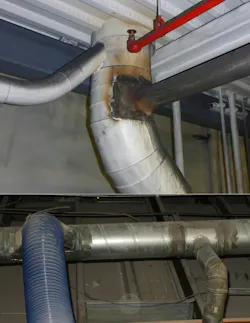
The fitting (often called a branch or Y fitting) used for the junction of the two branches must be tapered and use a 30-degree or 45-degree angle for the joining line (i.e., the branch not in the same direction as the main duct run). Using 90-degree, T-type connections, as shown in Figure 7, results in high turbulence, and the energy requirements for those junctions will be significantly higher (up to 5 times).
The balanced-by-design method ensures long-term dust collection performance
The proper duct manifolding methods I’ve described are part of the balanced-by-design method, which is used to ensure long-term, effective air distribution throughout the dust collection system. No other method will produce a system that reliably controls dust emissions.
About the Author
 Jack Osborn
Jack Osborn
Senior Project Engineer
Jack Osborn is senior project engineer at Airdusco EDS and a member of Processing’s editorial advisory board. He has more than 50 years of experience in dust collection systems, centralized vacuum cleaning systems, pneumatic conveying systems, and all types of bulk handling systems. He has either designed or evaluated (e.g., engineering studies/audits, performance testing, etc.) more than 2,000 dust collection systems during his career and is a participating member of all six NFPA combustible dust committees.