Static pressure: The foundation of effective industrial ducting design
Key Highlights
- Static pressure determines whether industrial ventilation systems deliver the required airflow.
- Accurate pressure calculations improve fan sizing, energy efficiency, and equipment reliability.
- Friction, fittings, filters, and duct design all contribute to total system static pressure.
- Accounting for filter loading and system effects helps maintain long-term ventilation performance.
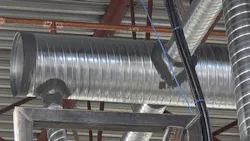
In industrial ventilation, static pressure is one of the most critical yet frequently misunderstood design parameters. Most engineers and operators are familiar with airflow, but airflow alone doesn’t tell the whole story. Static pressure represents the resistance that must be overcome to move air through hoods, ducts, filters, dampers, air cleaners, and discharge points throughout a system. Commonly measured in inches of water gauge (in. w.g.) or Pascals (Pa), static pressure indicates how hard a fan must work to move air from one point to another. Airflow tells you how much air is moving; static pressure tells you how hard the fan has to work to move it.
Understanding static pressure in industrial ventilation
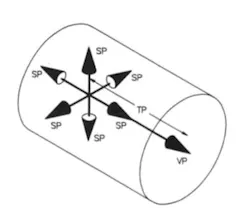
In industrial ventilation design, pressure is usually described in three parts: static pressure, velocity pressure, and total pressure.
Static pressure (SP) is the pressure exerted equally in all directions by air within a duct, enclosure, or vessel.
Velocity pressure (VP) is the kinetic energy associated with moving air.
Total pressure (TP) is the sum of static pressure and velocity pressure.
SP + VP = TP
Think of a garden hose. When the nozzle is closed, water pressure builds inside the hose. Although the water is not moving, it pushes equally in all directions against the walls of the hose. That is static pressure.
When the nozzle is opened, water begins to flow and some of the pressure energy is converted into motion. The faster the water leaves the nozzle, the greater its kinetic energy. This is similar to velocity pressure, which represents the energy associated with moving air/water.
Together, static pressure and velocity pressure make up the total pressure within the system, as shown in Figure 1.
Why static pressure is critical for ventilation performance
Proper static pressure design affects nearly every aspect of an industrial ventilation system, but ultimately it affects the sizing and design of the system’s fan. As airflow increases through a fixed duct system, the pressure required to move that air increases rapidly. This relationship is shown by the example fan curve in Figure 2.
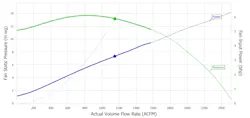
The actual operating point is where the two curves intersect. If system static pressure increases because a dust collector filter is dirty, a damper is closed, or ductwork is partially blocked by material, the operating point shifts and airflow drops.
There are three main reasons why static pressure is important. First, it ensures that adequate airflow reaches every pickup point, hood or process area. If a system is designed with balanced static pressure, then proper airflow will be achieved at each of the collection points.
Second, static pressure directly impacts energy consumption. Fan power requirements increase with airflow and pressure. Overestimating system pressure can result in oversized fans that consume unnecessary energy, while underestimating pressure often leads to insufficient system performance.
Third, static pressure influences equipment life. Operating a fan far from its design point can increase vibration, noise, bearing wear, and maintenance costs.
How friction and dynamic losses increase static pressure
Static pressure losses within industrial duct systems generally fall into two categories: friction losses and dynamic losses.
Friction losses. As air moves through a duct, it encounters resistance from the duct walls. This resistance creates friction, causing a gradual pressure drop along the length of the duct.
Several factors influence friction loss:
- Air velocity
- Duct diameter
- Duct length
- Surface roughness
- Air density
Higher velocities create greater friction losses. Likewise, smaller ducts produce more resistance than larger ducts carrying the same airflow. This relationship explains why duct sizing is one of the most important aspects of system design.
For dust collection systems, it is important to strike a balance between minimizing pressure loss and maintaining transport velocity, while not using wacky ducting sizes.
Ducts that are too large may reduce pressure losses but allow particulate to settle due to low transport velocity.
Ducts that are too small may maintain transport velocity but create excessive pressure requirements, causing material to travel too fast or even scour the ducting creating holes.
Think of this as drinking a milkshake through the correct straw. If the straw is too small, the milkshake is impossible to drink, if the straw is too big you drink it too fast and get a brain freeze. But if the straw is just right, the milkshake goes down perfectly.
Dynamic losses. Dynamic losses occur whenever airflow changes direction, changes speed, or encounters an obstruction.
Obstructions include elbows, branch entries, transitions, dampers, cyclones, filters, and hoods.
Fittings and equipment account for a significant portion of total static pressure loss and should be used sparingly. When they are used, they should be long-radius elbows, 30- or 45-degree branch entries, and smooth transitions. Poorly installed or improper fittings can create turbulence and pressure losses far greater than most straight sections of duct.
Calculating total system static pressure
The total static pressure requirement of a system is determined by identifying the most demanding airflow path, often called the critical path.
To calculate total static pressure, add the following:
- Friction losses through straight duct sections.
- Dynamic losses through fittings and transitions.
- Equipment losses through air-material separators or other components.
- Hood entry losses and discharge losses.
The sum of these values equals the total static pressure the fan must overcome. The fan must be capable of delivering the required airflow at this pressure. More information on the intricacies of calculating static pressure loss can be found in ACGIH Industrial Ventilation: A Manual of Recommended Practice.
Common static pressure design mistakes to avoid
As previously stated, it is important to get the static pressure of the system correct, or the entire system might not work. When calculating the static pressure, it is important to take all items into account, but too often, common things are overlooked or forgotten.
Underestimating filter loading
Dust collectors rarely operate in clean-filter conditions. As filters accumulate dust, pressure increases. Designs based solely on clean-filter pressure drops will function correctly for a very short time, but as the filter media gets dirty and the pressure increases across the filter media, the airflow will decrease. The static pressure must account for the filter media not only in its clean state but also in its dirty state before the filter media is cleaned and/or changed out.
Poor fitting design
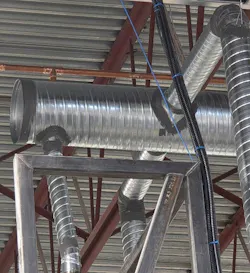
Sharp elbows, sudden duct size changes, and poorly designed branch connections, as shown in Figure 3, create turbulence that increases pressure loss. Optimized fitting design can significantly reduce system resistance without increasing airflow requirements.
Ignoring system effect
Fans require uniform airflow entering and leaving the fan housing. Poor inlet conditions, abrupt transitions, or nearby elbows can reduce actual fan performance. This phenomenon, known as system effect, often results in airflow levels significantly lower than expected.
Designing industrial ventilation systems for long-term performance
Effective industrial ducting design is not simply about moving air from one location to another, it is the art of moving material in an air stream. It requires balancing airflow, velocity, and pressure loss and considering future operating conditions.
Every duct size, elbow configuration, filter selection, and fan choice ultimately affects the pressure required to move air through the system.
When static pressure is properly understood and accurately calculated, reliable airflow is achieved, improving contaminant and dust capture. Conversely, when static pressure is overlooked or underestimated, even a well-intentioned design can fail to achieve its objectives.
Mastering static pressure calculations is not just a technical exercise; it is the basis of successful ducting design.
About the Author
 Diane Cave
Diane Cave
Regional manager of Eastern Canada at Element6 Solutions
Diane Cave is Eastern lead at Element6 Solutions. She has more than 20 years of experience working with the design, installation and retrofitting of dust collection systems in industries ranging from sawmills and grain installations to food and beverage and specialty chemicals. Her expertise covers all aspects of dust collection systems, from troubleshooting system issues to upgrading systems to meet current codes and standards. Diane has also assessed hundreds of dust collection systems for combustible dust hazards using the latest NFPA codes and standards and conducted her fair share of DHAs. She can also provide advice and design experience for explosion protection systems, vessel retrofits, Pred verification, static bonding/grounding, and vessel strength analysis. Diane has a degree in chemical engineering from Dalhousie University in Halifax, Nova Scotia.