How hazardous area classification helps facilities reduce combustible dust ignition risks
Key Highlights
- Hazardous area classification identifies where combustible dust creates electrical ignition hazards.
- Good housekeeping and dust control can reduce hazardous area classifications and equipment costs.
- Dust hazard analysis and hazardous area classification work together to improve facility compliance.
- Updated hazardous area classification drawings support safer maintenance, inspections, and future projects.
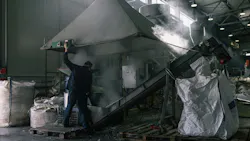
An all-too-common result of a Dust Hazard Analysis (DHA) is a recommendation to complete an “electrical classification” or Hazardous Area Classification (HAC). An HAC is an assessment used to identify and document areas within a facility where there may be a flammable or explosible atmosphere susceptible to electrical ignition sources. Many facilities were constructed when industry awareness regarding combustible dust hazards was limited, including in relation to electrical ignition sources. Due to these factors, many facilities handling combustible dust have no or limited electrical classification areas. As companies approach time to revalidate their previous DHA reports, the issue of completing an HAC is a frequent topic of concern.
Electrical classification is the common term referring to the designation of hazardous (classified) locations where fire or explosion hazards might exist due to the presence of flammable gases/vapors or combustible dust. In the context of combustible dust, these areas tend to exist surrounding equipment where combustible particulate solids are produced, processed, or handled. One very common combustible dust hazard identified in a DHA is a dust-cloud release environment in which there is concern that electrical equipment such as motors, lighting, enclosures, receptacles and plugs, and other electrified devices could serve as an ignition source that triggers a fire or explosion event.
In many cases, facilities already have properly rated equipment for their situation. For instance, in plants with dust handling operations, TEFC (totally enclosed fan-cooled) motors are already installed to improve the motor’s reliability and to reduce replacement costs, but the totally enclosed feature of the motor also makes it dust tight and suitable for Class II, Division 2 locations.
The same benefits could apply to electrical enclosures such as controls cabinets, in which NEMA 4 or similar enclosures are common to ensure that dust and water do not impact the integrity of the wiring and that programmable logic controllers (PLCs) are maintained. This dust-tight nature of NEMA 4 enclosures makes them suitable for Class II, Division 2 locations without the need for specific markings on the enclosure.
In other instances, maintenance, housekeeping, and dust control practices that a facility already has in place may actually reduce or eliminate the need for electrical classification. For example, a facility that operates an extraordinarily clean and well-maintained closed-system process may be processing large amounts of combustible dust within its systems while maintaining a largely unclassified area surrounding the systems. Each facility may have different electrical classification needs or may simply need to keep its documentation updated to maintain compliance.
The purpose of this article is to provide facility plant managers, operation managers, safety managers, engineering staff, and others an introduction to electrical classification, specifically regarding combustible dust hazards and the role HACs, which are often required by a DHA, play in a facility that deals with dust and the hazard it can pose as a fire, flash fire, or explosion risk.
It is important to note that additional classification requirements exist for the handling of flammable vapors/gases and combustible or ignitable fibers/flyings, and those material types are not addressed in this article. Therefore, the scope of information provided here pertains directly to Class II, Divisions 1 and 2, Groups E, F, and G materials.
How combustible dust locations are classified
When handling solid particulates (dust, powders, granules, or flakes) with a mean particle size smaller than 500 microns that present a fire or explosion hazard, the electrical classification is relatively straightforward. Three factors dictate how to correctly classify a particular location within the facility: the material properties of the particulate solid being handled, the operating conditions and equipment specifications, and present dust control/housekeeping conditions.
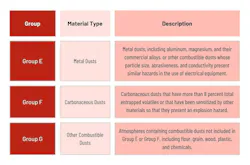
As described by NFPA 499 and NFPA 70, materials are broken down into various material groups determined by the properties they hold, as shown in Table 1.
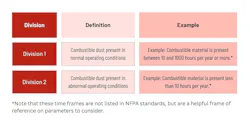
For Class II environments, although some material groups drive specific classification requirements, what typically drives equipment specification requirements in terms of classification is the division. Classification divisions are categorized by operating conditions, which relate to the likelihood of dust clouds being present within a process, as shown in Table 2.
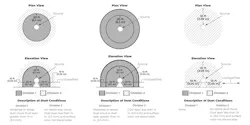
As pictured in NFPA 499, the implication of Division 1 or 2 classification is the direct driving factor that determines the classified area’s radius distances from a dust-generating source. Simply put, a Division 2 environment requires that all electrical equipment be properly rated within a 10-foot radius of the source point.
Note that per NFPA guidelines, properly rating this area can be determined using sound engineering judgment. Division 1 requires a 20-foot radius and an additional 10-foot Division 2 radius. In the case of metal dust, that additional 10-foot radius should be classified Division 1 or classified using sound judgment.
See Figure 1 for reference on how different material groups may be classified and appear in both plan view and elevation view in a way that can be understood by staff or others needing to review location boundaries. [Note: These figures are adapted from examples shown in NFPA 499, Recommended Practice for the Classification of Combustible Dusts and of Hazardous (Classified) Locations for Electrical Installations in Chemical Process Areas (2017).]
Housekeeping's role in hazardous area classification
Housekeeping plays a critical role in the classification of hazardous areas. Although variable by industry, the general acceptable layer depth criterion as defined within NFPA 660, Chapter 25, is 1/32” or alternative thickness as determined by the Mass Method A and B. The impact of housekeeping on classification is detailed in NFPA 660, Table A.6.3.2(a), which can be broken down Division 1, Division 2, and Unclassified as follows:
Division 1: Combustible dust present throughout building on horizontal surfaces, both at ground level and on elevated surfaces.
Division 2: Combustible dust visible in less than 5% of the surface area of the operation and less than 1/32” thick, maintained by housekeeping efforts. Risk of equipment failure that could result in large amounts of dust being released.
Unclassified: Combustible dust visible in less than 5% of the surface area of the operation and less than 1/32” thick, maintained by housekeeping efforts. Risk of equipment failure resulting in dust release is incapable of posing a hazard (as determined by DHA).
The accumulation of dust and calculation in the previous descriptions’ classification categories relies on a 24-hour timeframe, so keep that in mind when reviewing dust levels in your facility. It is important to note that NFPA 70 permits that facility areas may be entirely labeled as unclassified if strict dust control and housekeeping methods are used and adequate dust removal is maintained.
Lastly, within NFPA standards, no Division 2 electrical classification exists for Group E metal dusts. As stated in NFPA 70 and NFPA 660, where metal dusts may be present in quantities sufficient to be hazardous, they are always classified as Division 1.
The hazardous area classification assessment process
An HAC can be conducted before or after a facility has conducted a DHA, and many companies will do the two assessments simultaneously. The hazard areas and equipment identified as requiring action to prevent a combustion incident as a result of a DHA can drive the scope of an HAC.
As with the DHA process, the individual conducting the HAC should have a skillset that matches the task. Qualifications can include a recognized degree, certificate, or professional standing, or relevant skill, knowledge, and experience with combustible dust standards and other relevant NFPA standards, such as NFPA 70, NFPA 497, NFPA 499, NFPA 33 as well as International Electrotechnical Commission (IEC) standards.
The owner/operator of a facility may conduct an HAC, but this is not common due to requirements around familiarity with HAC-specific subject matter. As a result, facilities typically hire third-party consulting firms to conduct HACs. The HAC process can be broken down into three phases: documentation review, site visit, and drawing creation.
If you’ve completed a DHA, the report should be provided to your HAC lead. This report should include many critical aspects such as material properties (in particular explosibility), housekeeping methodologies, existing electrical classification, and identified hazard areas.
Drawings such as physical layouts and process flow drawings help significantly in gaining an understanding of the operations prior to the site visit. Plan and elevation drawings are crucial, as the result of an HAC is the modification of such drawings that dictate the hazardous classified areas using color-coded overlays showing the location and type of hazardous area.
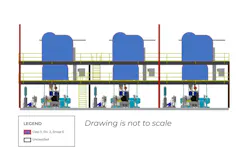
Figure 4 shows an elevation-style drawing of a facility with overlays in blue denoting classified areas. Often, physical landmarks or building compartment barriers make for a more practical demarcation of the boundaries between classified and unclassified locations. This helps communication with on-site personnel, contractors, and visitors.
When on-site, the HAC lead will conduct a walkthrough of the entire operation. During this time, the lead will further evaluate dust control, housekeeping, building design, and present electrical systems. It is important to note that, although the HAC lead may review the existing electrical systems’ compliance with such classified areas, it is not in the scope or purpose of the HAC to determine if existing systems comply with designated classification environments.
After documentation has been provided and a site visit has been conducted, the HAC lead will draft a report that includes marked-up drawings designating the classified areas. These drawings are the primary deliverable of an HAC and should be maintained and filed with the DHA report. Such drawings provide a quick reference for maintenance and contractor activities and establish baseline engineering specifications for future projects.
Using hazardous area classification to specify electrical equipment
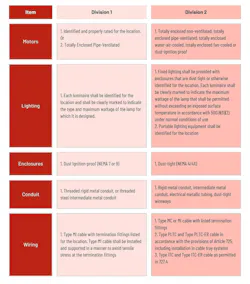
Note that Table 3 does not include all electrical items. When designing and specifying systems, it is important to review all electrical systems per local codes, NFPA, NEC, and other authorities having jurisdiction.
For many facility owners/operators, the largest implication of electrical classification is budget. There is a significant cost difference between Unclassified and Class II, Division II equipment. The cost can vary greatly between Division 1 and Division 2 compliant equipment options. These considerations can amount to significant cost differences during initial facility and process line design and construction and can be even more impactful when retrofitting systems.
Given this context, it is important for facilities to understand the impact of engineering controls and housekeeping methods on electrical classification designations. In many cases, consulting companies will recommend actions to reduce classified area designations to the greatest extent possible using dust control, housekeeping improvements, other equipment upgrades.
Managing compliance, documentation, and future facility changes
Although electrical classification may seem to be only one small task identified in a DHA as a recommended action, the HAC is often a critical component to completing recommended tasks for full compliance. Facility compliance and operations can depend on HAC assessments to properly maintain the safety and continuity of operations within a facility, particularly if an inspection or incident requires that documentation be presented to authorities having jurisdiction.
Upon completing an HAC, you will have drawings and a document that establish and describe your facility’s specific hazardous areas along with information on what electrical equipment is suitable for each area. If requested, a gap analysis can be performed during an HAC to identify if any current electrical equipment is unsuitable for a location and whether that equipment is properly installed for safe operation. This can help to establish whether replacement or repair is needed to conform to safety requirements. As a bonus, the HAC process can also identify over-protected locations with equipment rated beyond what is necessary. In these cases, a simpler, less expensive option could be used, resulting in cost savings and economical, but still safe, operations.
The tasks and necessary changes that can be identified in an HAC require facility staff to take action and properly store and upkeep documentation. Remember that, whenever a process undergoes changes, the management of change process must be performed and HAC (and DHA) documentation should be updated accordingly.
About the Author
 Timothy Heneks
Timothy Heneks
Timothy Heneks is Director of Engineering Services at CV Technology. He is a credentialed professional engineer and serves on various NFPA Technical committees where he helps to ensure that fire and explosion hazards are managed with proper prevention and mitigation solutions through industry-accepted standards. His professional engineering experience includes designing explosion protection systems and leading a team of safety consultants specializing in combustible dust hazard identification, evaluation, and control through dust hazard analyses (DHAs), hazardous area classifications (HACs), or other process safety-related assessments. In his current role, he focuses on helping clients navigate the complexities of combustible dust safety, ensuring practical, effective, and compliant solutions to protect employees and facilities.