What is meant by “combustible dust compliance” and how to achieve it
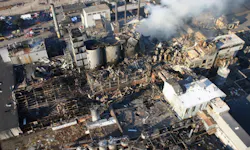
On February 7, 2008, a series of catastrophic explosions killed 14 workers, injured 38 others, and caused extensive property damage at the Imperial Sugar refinery in Port Wentworth, Georgia. Since that incident, the National Fire Protection Association (NFPA) has been involved in a major ongoing effort to provide meaningful and effective methods for minimizing and/or eliminating the possibility of fires, flash fires, and explosions.
This is not to say the NFPA was dormant or neglectful prior to 2008, but the Imperial Sugar disaster provided a renewed national recognition that something needed to be done to render the likelihood of such disasters as remote as feasible. The NFPA has responded admirably to this challenge.
It is important to note that, after the 2008 Imperial Sugar explosion and due to multiple other explosions, the Occupational Safety and Health Administration (OSHA) sought to establish a nationwide set of regulations regarding combustible dust safety in industry. However, after years of hearings and little progress, OSHA abandoned this effort in 2017. The official reason was “resource constraints and other priorities,” but it is likely that the real reason was that the scope of the task was beyond the government’s willingness to complete it. Like any such task involving governmental regulations, the politics of massive regulation, the associated costs to industry, and the cost of implementation became unpalatable.
This does not mean that OSHA abandoned the requirement that industry properly address combustible dust issues, it means they decided to let that task fall to others. As a result, the NFPA became the go-to source for standards to eliminate, or at least mitigate, combustible dust hazards and their associated risks.
This further led OSHA to issue its National Emphasis Program (NEP) of 2008 and 2023 on combustible dust enforcement. The stated purpose of the 2023 NEP is: “This instruction contains policies and procedures for inspecting workplaces that generate or handle combustible dusts, and for determining whether such workplaces have addressed fire, flash fire, deflagration, and explosion hazards associated with combustible dusts.”
The 2023 NEP provides instruction for OSHA enforcement personnel regarding combustible dust issues. The basis for the NEP relies heavily on the NFPA 61, 484, 652, 654, and 664 standards during that period (the current NFPA 660 standard was not available until December 6, 2024).
Why regurgitate all this history? Not to fill space, but to ensure readers understand the background facing the NFPA’s effort to provide meaningful and effective standards for combustible dusts.
Defining combustible dust compliance under NFPA 660
The current standard for combustible dusts is NFPA 660 Standard for Combustible Dusts and Particulate Solids (2025). This single, voluminous standard now contains all the requirements previously covered by the following separate NFPA standards: 61, 484, 652, 654, 655, 664, and appendices. The new, consolidated standard represents an evolution regarding combustible dust that transpired over 18 years of significant effort by the NFPA and the associated committee members to provide clarity, definition, and effective standards.
NFPA 660 is not and will never be perfect. But that does not stop the NFPA or its unpaid committee members from making every effort to reach perfection. In fact, the 2025 version of NFPA 660 is undergoing its second detailed cycle of improvement. This will lead to a (likely) 2028 version. Such a revision will be done every three years in an effort to continuously improve the standard.
Ever since the NFPA became the de facto source for information about eliminating and/or mitigating combustible dust hazards, industry has been asking the question: How do we know we have fully complied with these combustible dust standards?
I have used the following as a reasonable definition for combustible dust compliance: “The conditions or situations where combustible dust hazards (as determined by a Dust Hazards Analysis (DHA) and applicable NFPA standards) have been either eliminated or mitigated to a level where the resulting combustible dust hazards and associated risks are now acceptable and meet or exceed the requirements of the relevant NFPA standards.”
Using the Imperial Sugar example to illustrate compliance
It is one thing to have a wordy definition, but it is another to truly understand what combustible dust compliance means. Perhaps the best method to clarify the meaning of combustible dust compliance is to provide a detailed example of the steps involved in achieving it.
For our hypothetical example, let’s use the assumed circumstances (per available internet data and my own direct sources) surrounding the 2008 Imperial Sugar incident. (Please keep in mind that this is hypothetical.) Let’s also assume that we are aware of the circumstances before the actual explosion. Our goal is to achieve combustible dust compliance resulting in the elimination and/or mitigation of the conditions that led to this catastrophic event.
So, hypothetically, what could have been done to prevent this disaster and achieve combustible dust compliance? The first step is to recognize that a combustible dust hazard exists. This involves two parts of NFPA 660: Chapter 5 and Chapter 7.
Determine combustible dust explosivity characteristics
Chapter 5 concerns establishing the explosivity characteristics of our suspected combustible dust (or dusts). First, is the material explosive? Historical data has fully proven that sugar dust is indeed combustible and can lead to explosions under certain circumstances and conditions.
Second, either by proper testing methods or by using proven historical data, we must establish the material’s specific explosivity characteristics. At a minimum, this should include the material’s dust deflagration index (Kst), maximum explosion pressure (Pmax), minimum explosive concentration (MEC), and minimum ignition energy (MIE).
Kst and Pmax are used to determine the degree and type of prescriptive explosion protection required for equipment and systems, such as dust collection, etc. MEC and MIE are the more important values for determining the hazards and risks involved in processing or handling this material. Ironically, the lower the MEC and MIE values, the more hazardous the material.
Conduct a comprehensive Dust Hazards Analysis
The next step is to perform a DHA examining the facility’s processing and handling of the combustible dust. DHAs are covered in Chapter 7 of NFPA 660. In our hypothetical case, the DHA would involve the entire sugar milling facility and its various processes.
A viable DHA would first identify the hazards associated with each part of the processing of the sugar, including all the bulk handling, storage, milling, dust collection, etc., from when the unprocessed material is received through packaging and all the various steps and methods in between. Any activity that creates a possible combustible dust hazard must be included.
Once all the hazards are identified, the next step is to determine both the probability of each hazard occurring (as best as can be determined) and the likely consequences if each hazard did occur. Some hazards exist but their likelihood is so infinitesimal as to be nearly non-existent. Other hazards are highly likely and/or may have already occurred.
The likelihood of an occurrence is not the same as the consequences. The occurrence of a hazard may be highly likely but the consequences (to personnel and property, etc.) may be insignificant. On the other hand, an event that is very unlikely to occur may result in such a catastrophic result that it must be eliminated. An example is an event that would shut down a facility for an extended time and result in possible injuries, loss of life, and extensive property damage.
Once both these activities have been completed, each hazard should be ranked in comparison to the other hazards evaluated.
The final step in the DHA is multifold. It requires determining what steps must be taken to eliminate or mitigate the hazards to an acceptable level. It also involves determining priorities for those steps. Lastly, it involves establishing a complete, definitive, and realistic timetable for completing those steps to eliminate or mitigate the hazards. It is important to note that this last step is only meaningful if the timetable is followed.
Prioritize mitigation based on combustible dust risks
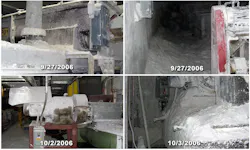
In our hypothetical case, for example, the DHA determined that the current system using a belt conveyor to transport the sugar to a bucket elevator and eventually to the mills created multiple explosion hazards. One of those hazards was the significant accumulation of sugar in the enclosed area below the silos. It was determined that, under current circumstances, this situation was common and, if an ignition event were to occur in the area, would cause significant damage and create a major personnel hazard. Therefore, eliminating and/or mitigating this hazardous condition should be a high priority. The solution involves a major project to contain the material, and the project must be completed in the near future (with dates established).
So far, we have established that the material is a combustible dust, that major hazards exist in the plant processes, that solutions are required, and that some hazards require immediate attention. Our hypothetical situation is one of those high-priority projects.
Implement engineering and operational controls
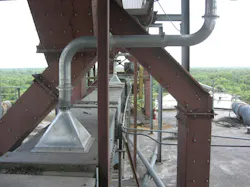
- Provide a method to control the feed rate and discharge onto the belt conveyor below the storage silo. This will inherently minimize dust emissions, spillage and waste. Minimizing “fuel” for an explosion is a priority.
- Provide partial containment of the belt conveyor. This is not full containment as it allows access for housekeeping, inspections, etc.
- Provide dust collection for the silo discharge locations.
- Establish a viable housekeeping plan for the area.
- Establish a plan to inspect the area at set intervals.
- Provide necessary instrumentation and monitoring.
Some of these changes will also require an additional, specific DHA and explosion mitigation, etc., such as the dust collection system for the silo discharge locations. Keep in mind that this situation represents only a part of the facility’s processes but serves to illustrate how combustible dust compliance can be achieved for a specific hazardous situation.
The cost of compliance versus the cost of failure
As this example shows, combustible dust compliance can be complex and expensive at times. Other times, however, compliance can be achieved by simpler and less costly actions, such as personnel training, proper and effective housekeeping, or adding an explosion vent or explosion isolation.
And as the Imperial Sugar example also shows, the costs of failing to achieve combustible dust compliance can be far greater than the costs of achieving compliance.
About the Author
 Jack Osborn
Jack Osborn
Senior Project Engineer
Jack Osborn is senior project engineer at Airdusco EDS and a member of Processing’s editorial advisory board. He has more than 50 years of experience in dust collection systems, centralized vacuum cleaning systems, pneumatic conveying systems, and all types of bulk handling systems. He has either designed or evaluated (e.g., engineering studies/audits, performance testing, etc.) more than 2,000 dust collection systems during his career and is a participating member of all six NFPA combustible dust committees.