Previewing Pack Expo International 2026 with Davide Gagliardo of Nilfisk
PACK EXPO International 2026 allows attendees to see the latest packaging and processing equipment and technologies up close and in person. But the show also provides an opportunity to take a broader look at the challenges and trends impacting the industry.
With that in mind, Processing asked PACK EXPO International 2026 exhibitors about the products and technologies they will have on display at the event, along with the biggest processing or operational challenges their customers are facing today. We’ll be publishing their responses in the weeks leading up to the show, which takes place October 18-21 at McCormick Place in Chicago. In this installment, we hear from Davide Gagliardo, senior business development manager - Industrial Vacuum at Nilfisk.
Q: What products, technologies, or live demonstrations will visitors be able to see at your booth during PACK EXPO International 2026, and which applications or manufacturing challenges do they address?

A: Nilfisk will demonstrate how manufacturers can control contamination throughout the entire production process, from receiving ingredients and raw materials to processing, packaging, warehousing, and distribution. After all, dust never takes a day off, and neither do the contamination risks that can impact worker safety, product quality, compliance, and operational efficiency. Visitors to North Hall Booth N-5446 will see solutions designed to help food, pharmaceutical, and industrial manufacturers protect workers, protect products, minimize downtime, support hygiene compliance, and improve operational performance.
Visitors will watch a live demonstration of the Nilfisk SC25 robotic floor cleaner, an autonomous cleaning solution increasingly used in pharmaceutical cleanrooms and controlled production environments. The SC25 provides consistent, repeatable cleaning that supports hygiene standards while reducing labor demands and increasing cleaning productivity without disrupting operations.
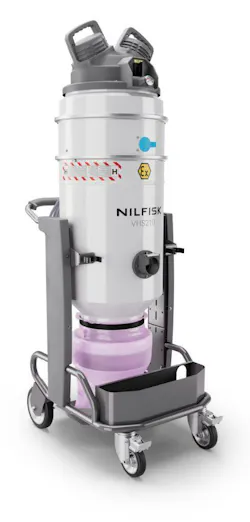
The booth will also showcase industrial vacuum and dust collection technologies designed to capture and contain contaminants at the source. Products on display include the VHS210 Class II, Division 2 industrial vacuum, engineered for classified areas and featuring a high-performance brushless motor and advanced filtration for safe dust collection; the VHS011 ACD industrial vacuum, a compact yet powerful solution for localized contamination control and housekeeping applications; and the T63 Class II, Division 1 industrial vacuum, a continuous-duty system designed for demanding dust collection, containment, and material recovery applications.
Visitors will learn how Nilfisk cyclone pre-separators help manufacturers improve yield calculations, recover valuable product, and safely collect powders and potentially hazardous materials while reducing operator exposure and the risk of cross-contamination. Nilfisk will also feature its pneumatic conveying solutions, which automate the transfer of powders and ingredients directly to process equipment, minimizing manual handling and helping improve worker safety, product quality, and process consistency.
Because effective contamination control extends beyond the production floor, attendees will also see Nilfisk's high-dusting cleaning kit paired with the VHS011 ACD industrial vacuum, enabling operators to safely remove dust from ceilings, rafters, overhead piping, ductwork, and other hard-to-reach surfaces. This ergonomic solution helps facilities address hidden contamination risks from floor to ceiling while reducing the need for ladders or lifts and improving cleaning efficiency. The compact yet powerful VHS011 ACD delivers the mobility and performance needed for overhead cleaning applications, helping manufacturers maintain cleaner, safer production environments.
Attendees can also experience the Nilfisk Dryft micro scrubber, which delivers a more hygienic alternative to traditional mopping. Compact enough to maneuver in congested production areas, corners, edges, and narrow spaces, Nilfisk Dryft helps facilities achieve a deeper cleanliness in areas where contaminants can accumulate and where conventional cleaning methods often fall short. Nilfisk also offers a full portfolio of industrial floor scrubbers and sweepers designed to help facilities maintain hygienic production environments, control dust and debris, improve worker safety, reduce water consumption, and support sustainability initiatives as part of a comprehensive contamination control strategy.
To further highlight the hidden impact of contamination in manufacturing environments, Nilfisk will host the Hidden Dust Challenge, an interactive booth activity that encourages attendees to identify contamination risks that may otherwise go unnoticed. Participants will be entered for a chance to win a Nilfisk VU200 Cordless Stick Vacuum.
Under the theme "A Cleaner Future," Nilfisk will demonstrate how a comprehensive contamination control strategy, from overhead cleaning and floor care to dust collection and material handling, can help manufacturers create cleaner production environments, safeguard product quality, improve workplace safety, support compliance initiatives, and keep production moving. Because while dust never takes a day off, neither does the need for contamination control.
Q: What are the biggest processing or operational challenges your customers are facing today, and how are your latest solutions helping manufacturers improve efficiency, product quality, flexibility, safety, or sustainability?
Today's food, pharmaceutical, and industrial manufacturers face a much larger challenge than simply cleaning up dust and debris. They are under constant pressure to maintain production schedules, protect product quality, improve worker safety, meet increasingly stringent hygiene and regulatory requirements, and control operating costs. At the same time, manufacturers must manage contamination risks throughout the production process, from receiving raw materials through processing, packaging, warehousing, and distribution.
Contamination control has become a critical operational priority because the hidden costs of dust and material buildup extend far beyond housekeeping. Airborne dust, powder residue, and product carryover can create worker exposure risks, contribute to cross-contamination, compromise product integrity, impact equipment performance, and lead to unplanned downtime. In highly regulated industries such as food and pharmaceuticals, even minor contamination events can have significant consequences for quality, compliance, and productivity.
As a result, manufacturers are increasingly looking for solutions that prevent contamination at the source rather than simply cleaning it up after the fact. Integrating industrial vacuum systems, pneumatic conveying technologies, floor cleaning equipment, and automated cleaning solutions into production processes helps address multiple operational challenges simultaneously. By capturing dust during material transfer, safely recovering valuable product, reducing manual handling, and improving cleaning efficiency, manufacturers can create cleaner production environments while keeping operations running smoothly.
Nilfisk's latest solutions support contamination control throughout the manufacturing lifecycle. High-efficiency industrial vacuums help contain dust and hazardous materials before they can impact workers, products, or equipment. Cyclone pre-separators enable manufacturers to recover products, improve yield calculations, and reduce waste while minimizing the risk of cross-contamination. Pneumatic conveying systems automate the transfer of powders and ingredients directly to processing equipment, helping protect both workers and products while reducing opportunities for contamination.
Manufacturers are also placing greater emphasis on floor care as part of a comprehensive hygiene strategy. Nilfisk scrubbers and sweepers help control dust, debris, and spills while maintaining cleaner, safer production environments. Designed for ease of use and productivity, these solutions can help facilities reduce labor requirements, improve cleaning consistency, and support worker safety. Many organizations are also prioritizing sustainability goals, making equipment that helps reduce water consumption, optimize resource use, and lower overall operating costs an increasingly important consideration in capital investment decisions.
Automation continues to play a growing role in helping manufacturers improve efficiency and hygiene. Solutions such as the Nilfisk SC25 robotic floor cleaner provide consistent, repeatable cleaning in production and controlled environments, helping facilities maintain hygiene standards while reducing labor demands. Similarly, tools like the Nilfisk Dryft micro scrubber enable more effective cleaning in tight and hard-to-reach areas where contaminants can accumulate, supporting a more thorough contamination control strategy.
Ultimately, manufacturers are looking for ways to protect workers, protect products, minimize downtime, support hygiene compliance, improve sustainability, and increase operational efficiency. By focusing on contamination control from start to finish, Nilfisk helps food, pharmaceutical, and industrial manufacturers create cleaner, safer, and more productive operations while positioning themselves for long-term growth and success.
Q: What technology or industry trends are having the greatest impact on processing equipment design and investment decisions today?
Food, pharmaceutical, and industrial manufacturers are increasingly evaluating processing equipment through the lens of contamination control, automation, labor efficiency, and sustainability. As regulatory requirements become more stringent and production demands continue to grow, companies are looking for solutions that do more than perform a single task. They want technologies that help protect workers, protect products, improve productivity, and support long-term operational goals.
One of the most significant trends is the shift toward proactive contamination control. Manufacturers are moving beyond traditional cleaning methods and investing in integrated solutions that help capture dust, powders, allergens, and other contaminants at the source. Industrial vacuum systems, pneumatic conveying technologies, and hygienic cleaning equipment are increasingly viewed as essential components of production processes rather than housekeeping tools. This approach helps reduce cross-contamination risks, protect product quality, improve worker safety, and minimize unplanned downtime.
Automation is another major driver of equipment design and investment decisions. Labor shortages and the need for greater consistency are accelerating the adoption of robotic and automated solutions throughout manufacturing facilities. Technologies such as robotic floor cleaning, automated material transfer systems, and centralized vacuum systems help manufacturers maintain hygiene standards, reduce manual labor requirements, and improve operational efficiency while keeping production running smoothly.
Sustainability continues to influence purchasing decisions as manufacturers look for ways to reduce resource consumption and lower total cost of ownership. Equipment that improves product recovery, minimizes waste, reduces energy consumption, and lowers water usage is receiving increased attention. Modern floor scrubbers and sweepers, for example, are designed to maximize cleaning performance while using less water and fewer resources, helping facilities meet environmental goals without compromising hygiene standards.
There is also growing demand for ergonomic and easy-to-use solutions that improve both safety and productivity. Manufacturers are seeking equipment that allows employees to clean more effectively while reducing physical strain and exposure to hazards. Solutions such as high-dusting systems paired with portable industrial vacuums enable operators to safely remove dust from overhead structures, ductwork, and hard-to-reach areas from ground level, supporting comprehensive contamination control while reducing the need for ladders and lifts.
Ultimately, the trend shaping investment decisions across the industry is a move toward comprehensive contamination control throughout the production process. Manufacturers are looking for technologies that help create cleaner production environments, safeguard product quality, improve workplace safety, support compliance initiatives, increase efficiency, and advance sustainability objectives. The most successful equipment investments are those that deliver measurable benefits across all of these areas while helping keep production moving.
Q: If a process engineer, operations manager, or plant executive visits your booth, what are one or two key insights, best practices, or innovations you hope they take away from the conversation?
First, contamination control is driving smarter equipment investments. Manufacturers are increasingly looking beyond basic cleaning and investing in solutions that help control contamination throughout the production process. This includes understanding the specific purpose of a vacuum solution, whether the application is to clean, collect, contain, or convey materials. Food, pharmaceutical, and industrial manufacturers are placing greater emphasis on selecting properly rated equipment with the right filtration, safety certifications, and performance characteristics for their environment. The goal is to capture contaminants at the source, protect product quality, reduce cross-contamination risks, improve worker safety, and minimize costly downtime.
Second, automation, sustainability, and labor efficiency are shaping equipment design. Manufacturers are investing in technologies that help maintain hygiene standards while reducing labor requirements and resource consumption. Automated solutions such as robotic floor cleaning, pneumatic conveying systems, and centralized vacuum systems improve consistency and productivity while supporting contamination control objectives. At the same time, sustainability initiatives are driving demand for equipment that reduces energy, water, and product waste. Modern scrubbers and sweepers are designed to maximize cleaning performance while optimizing water consumption, and ergonomic solutions such as high-dusting kits paired with portable industrial vacuums enable safer, more efficient cleaning of overhead areas without ladders or lifts. Together, these technologies help facilities create cleaner, safer, and more efficient production environments.
About the Author
 Jesse Osborne
Jesse Osborne
Chief Editor
Jesse Osborne is Chief Editor of Processing, a position he has held since 2019. Prior to joining Processing he served as editor for a publication covering the food manufacturing industry. He can be reached at [email protected].