Combustible dust explosion protection: Start with the hazard, not the equipment
Key Highlights
- Kst indicates how quickly pressure rises during a dust deflagration, while Pmax indicates the maximum explosion pressure.
- Pstat, Pred and vessel strength help determine whether an explosion protection system can protect the vessel effectively.
- Explosion isolation helps prevent flame and pressure from propagating between connected process equipment.
- Protection choices should begin with the hazard and process conditions rather than with a specific piece of equipment.
You’ve done a dust hazards analysis (DHA) and had your dust tested. The DHA told you to figure out if your dust is explosible and the dust testing confirmed that it is. Your DHA then recommended that you reduce the risk of a combustible dust explosion by installing explosion protection. Before you jump head-first into retrofitting equipment, buying gear, and spending a pile of time and money on explosion protection, it’s important to collect a few bits of information.
Understanding Kst and Pmax in dust explosion hazards
First, you’ll need the results of your dust testing, showing your material’s dust deflagration index (Kst) and maximum explosion pressure (Pmax). No matter what explosion protection you decide to install, you’ll need these numbers to pick the right equipment. So, what are these numbers and how do they factor into the equipment design?
Your dust’s Kst is a measure of the relative speed at which a combustible dust cloud reacts when ignited in a confined space — essentially, how quickly pressure rises within a volume.
Dusts are divided into three St classes based on their Kst.
- ST 1: greater than 0 and up to 200 bar·m/s
- ST 2: greater than 200 and up to 300 bar·m/s
- ST 3: greater than 300 bar·m/s
These categories are useful, but don’t fall into the trap of thinking that a low Kst means you don’t have a hazard. If your Kst is greater than zero, you have a combustible dust hazard. The way I like to think about Kst is that you have a pile of dynamite with a fuse. The larger the Kst, the shorter the fuse.
Your dust’s Pmax is the maximum pressure created by that explosion and is usually expressed in bar or psi.
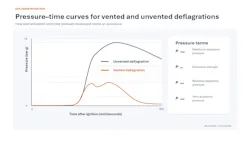
Two dusts can produce the same Pmax but reach that pressure at very different rates. The dust with the higher Kst produces the steeper pressure rise, leaving less time for explosion protection systems to respond.
How Pstat and Pred affect explosion protection
Now that we’ve discussed dust testing values, let’s talk about equipment parameters, specifically static activation pressure (Pstat) and reduced explosion pressure (Pred).
Pstat is one of the key ratings of an explosion protection system because it identifies the threshold at which the protection device activates. In this case, it is the pressure at which the equipment is designed to operate.
When you have a high Pstat value, more pressure builds up inside the vessel before the protection equipment fully deploys. If the pressure builds up to a point that is greater than the vessel strength, the vessel can rupture.
On the other hand, the lower the Pstat, the greater the potential for false activation from process pressure fluctuations, upset conditions, temperature cycles, weather or someone enthusiastically massaging the vessel with a mallet.
Pred is the pressure the vessel experiences after the explosion protection activates. Explosion protection does not make the pressure disappear. When the protection system activates, the vessel still experiences elevated pressure — just substantially less than the Pmax that could develop in an unprotected vessel. Pred is the maximum pressure expected during the protected deflagration and is determined by the design of the explosion protection system.
Matching explosion protection to vessel strength
Finally, we need to know the vessel’s strength (Pes). The vessel must be capable of withstanding the pressure produced after the explosion protection system activates. Otherwise, it can rupture and create a much bigger problem.
At this point, we’ve collected the information needed to begin:
- How severely can the dust react? (Pmax and Kst)
- When does the explosion protection activate? (Pstat)
- How much pressure remains after the explosion protection activates? (Pred)
- Can the vessel can withstand it? (Pes)
So, how do you put all this together?
Protecting inlets, outlets, and vessels
No matter what type of vessel it is, there are three basic things you need to consider: protect the inlet, protect the outlet, and protect the vessel. There are plenty of other interlocks, sensors, and odds-and-ends involved, but these are the basics.
Let’s break it down.
Passive and active explosion protection systems
The two types of explosion protection are: passive and active. Passive protection, which includes explosion venting, sits there waiting for its day to work. Active protection, which includes chemical suppression, uses sensors and controls to detect an event and activate the protection system.
Passive systems are generally cheaper and require less maintenance and OEM assistance but may not always be practical. For instance, if you need 25 ft² of explosion venting to safely relieve pressure but only have 20 ft² of area in which to install it, you may need to look at chemical suppression.
Explosion isolation prevents propagation
When an explosion occurs inside a dust collector, flame and pressure can travel (propagate) through connected ductwork, across material discharges and into other process equipment. If air is returned indoors, the flame and pressure may even find a path back into the building. The same connections that keep the process moving can also allow one explosion to become several. That is where explosion isolation comes in.
Comparing flap valves, rotary valves and chemical isolation
There are several options for isolation. The best choice depends on the material characteristics, how abrasive the material is, the concentration of material in the line, location, orientation and other application-specific factors.
Two of the most common passive options are flow-actuated isolation flap valves and rotary airlocks.
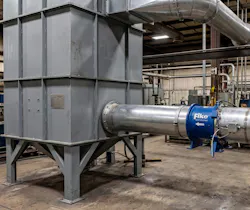
Flap valves are relatively low maintenance and are equipped with sensors to monitor valve position and dust accumulation. However, they have specific installation requirements, including minimum and maximum distances from the protected equipment, duct orientation and installation angle. High material loading or abrasive products can also foul or wear the internal components. As with any isolation device, the valve must be selected and installed for the specific application.
Rotary valves are one of the most common methods of discharge isolation. If a rotary valve is being used for explosion isolation, it must be designed for that purpose. The flame front cannot be allowed to pass between the rotor and casing, and the valve must be designed to withstand the pressure.
Rotary valves are common because they generally require less maintenance than active isolation systems. However, if you’re moving a large volume of material, or the material is sticky, prone to bridging or something you don’t want to break down, a rotary valve may not be the right choice.
Chemical isolation uses optical sensors, pressure sensors, controllers, backup batteries, and bottles of suppressant.
A chemical isolation system is designed to deploy suppressant extremely quickly and smother the event before it propagates. These systems work very well when properly maintained but are expensive and require significantly more maintenance than passive systems.
Choosing explosion venting and suppression
Once isolation is sorted out, the next question is how to protect the vessel.
The most common method is a passive explosion vent. Explosion vents are generally the lowest-cost and lowest-maintenance option. Basically, explosion vents are an engineered weak point in the vessel designed to open at a predetermined Pstat.
The vent allows the explosion pressure and flame front to escape, which is also its biggest limitation: you need a safe, unoccupied area for the vent discharge. If that isn’t available, a vent duct can sometimes be used to direct the discharge outside. However, the duct length and design are critical and must account for the resulting Pred.
If venting directly outside or using a vent duct isn’t practical, a flameless vent may be an option. A flameless vent uses a specially designed enclosure filled with metal mesh to absorb the energy from the flame front while still allowing the explosion pressure to be relieved.
This allows passive explosion protection to be used on vessels located inside a building.
If neither venting option is practical, chemical suppression may be the best solution.
As with chemical isolation, chemical suppression uses sensors, controls and suppressant, but the system is designed to protect the larger volume of the vessel.
Selecting protection based on the hazard
Once you have the dust testing, understand your process, and know the limitations of your equipment, the path forward becomes a lot clearer. You can work through the inlets, outlets, and vessel, look at the passive and active options, and figure out what combination makes sense for your particular application.
No single piece of equipment works for every vessel, and there isn’t always one correct answer. Sometimes the simplest passive solution is the best option. Sometimes the process or location requires something more sophisticated.
The important thing is to start with the hazard, not the equipment.
Understand what you have, understand where the explosion could go, and then put protection in place to control it. Explosion protection isn’t about buying a vent, installing a valve or checking a box on a compliance list. It’s about making sure that, if the day comes when that dust cloud ignites, the system knows what to do before anyone has to. That’s the difference between simply having equipment mounted on a vessel and actually having the hazard under control.
About the Author
 Diane Cave
Diane Cave
Regional manager of Eastern Canada at Element6 Solutions
Diane Cave is Eastern lead at Element6 Solutions. She has more than 20 years of experience working with the design, installation and retrofitting of dust collection systems in industries ranging from sawmills and grain installations to food and beverage and specialty chemicals. Her expertise covers all aspects of dust collection systems, from troubleshooting system issues to upgrading systems to meet current codes and standards. Diane has also assessed hundreds of dust collection systems for combustible dust hazards using the latest NFPA codes and standards and conducted her fair share of DHAs. She can also provide advice and design experience for explosion protection systems, vessel retrofits, Pred verification, static bonding/grounding, and vessel strength analysis. Diane has a degree in chemical engineering from Dalhousie University in Halifax, Nova Scotia.