Bridging the gap between fire and explosion protection in dust hazard analysis
Key Highlights
- Dust fires occur more frequently than dust explosions, yet DHAs often provide fewer fire mitigation recommendations.
- Fire can initiate a dust explosion and continue burning after a deflagration, linking the two hazards.
- Material testing can help DHA teams evaluate combustibility, explosibility and self-heating risks separately.
- Automatic firefighting can provide rapid, targeted protection where manual firefighting may be ineffective or unsafe.
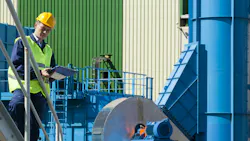
In industries where combustible dust is present, both fire and explosion hazards may exist, but these two types of hazards tend to be treated differently. A review of 16 third-party dust hazard analysis (DHA) reports found that, while the ratio of explosion hazards to fire hazards identified was nearly equal (1.08 to 1), only 20-30% of the mitigation recommendations focused on the fire hazards.1
Combustible dust fires and explosions are closely linked
This seems to indicate an issue translating fire hazard identification into recommendations for mitigation. It also discounts the fact that combustible dust fire and explosion hazards are strongly linked, as fire can be both an initiating event for a dust explosion as well as a lingering result of a deflagration event.
Prior to an explosion, heat generated by a fire can potentially disperse fine dust into the surrounding air. This could cause a small initial deflagration, which could in turn lead to a pressure wave and propagate one or more secondary dust explosions.
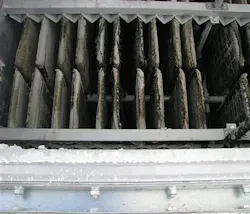
In situations where a deflagration event has already occurred, even if the deflagration has been adequately vented, a fire can remain burning and present unique challenges for firefighting and personnel safety.
In larger vessels such as silos, deep-seated fires can burn for extended periods of time. In 2015, a dust explosion occurred in a silo in Farmville, NC.2 The explosion vents on the silo opened, protecting the silo’s structure from the damaging pressure of the explosion, but the contents of the silo remained burning for 23 days. While the dust explosion hazard was adequately mitigated, no strategies were in place for fire mitigation. As this example shows, there is a clear need for dust explosion and fire protection recommendations to be made alongside one another.
Why fire hazards receive less attention
There are several potential reasons for the lack of adequate fire mitigation recommendations in DHAs. These include the background and knowledge base of the DHA team; the perceived hazard risk level; and a lack of prescriptive requirements in NFPA 660, Standard for Combustible Dusts and Particulate Solids.
DHA team background and knowledge. The first issue could be the DHA team’s background. Many who conduct DHAs come from dust explosion hazard backgrounds and understand that there is a lack of awareness of dust explosion hazards in industry. When conducting a DHA, teams may focus on the dust explosion aspect to make sure that absolutely every hazard is covered. This may reduce the amount of attention the DHA pays to mitigating the fire hazards of the dust.
Perceived hazard risk level. The second issue could be the perceived severity of fire hazards versus explosion hazards. Data shows that dust fires occur four times more frequently than dust explosions.3 However, some processors may see them as lower risk, leading both processors and DHA teams to neglect to include dust fire hazard mitigation strategies in their recommendations.
Lack of prescriptive requirements in NFPA 660. Another significant factor could be a lack of prescriptive requirements in NFPA 660. Within the standard, the guidelines are clear. The standard states that a DHA shall consider fires, flash fires, and explosions and includes prescriptive requirements for dusts in Section 9.8.2.2. The six different prevention/mitigation strategies listed each point to other NFPA standards that provide respective in-depth information.
In contrast, in Section 9.9.1.1, the language on prevention/mitigation strategies for dust fire hazards is less clear. The standard states, “Where a fire hazard exists in an enclosure as determined in Chapter 7, manual or automatic fire protection means shall be provided in accordance with Section 9.9.” Later, in Section 9.9.1.2, the standard recommends that if significant risk is posed or if manual fire protection is assumed to be ineffective, automatic firefighting should be used.
This portion of the standard contains the main reference to dust fire hazards and there are no prescriptive requirements given specifically for fire protection of combustible dust, making it less clear what recommendations should be made. For many readers trying to complete a DHA, it may appear as if manual fire protection is enough to deal with any dust fire hazard.
NFPA 660 does allow for the assumption of manual firefighting, but due to the lack of explicit definition of safeguards and methods, this could be a dangerous assumption. In situations like the one in Farmville, NC, manual firefighting can be ineffective.
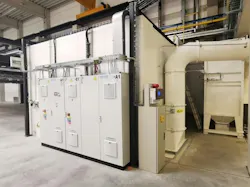
Preventative safeguards such as self-heating screenings and temperature/CO monitoring could have been in use alongside mitigative safeguards such as inerting or extinguishing within the vessel. Inerting agents would have extinguished the fire smoldering inside the silo after a certain residence time, rather than taking 23 days to burn out and requiring 25 million gallons of water.
Automatic firefighting systems provide near instantaneous response time, keep firefighters out of harm’s way, and ensure that the correct mitigation methods are being used. For example, deep-seated fires can easily be put out with denser inerting gases, such as CO2, that can’t practically be used in manual firefighting. This is also incredibly important when a vessel’s contents should not be introduced to air or water.
In May 2026, an oxygen-limiting silo at a lumber mill in Maine started burning from the inside.4 Unaware of the differences between typical silos and oxygen-limiting silos, firefighters employed basic tactics and directed water into the base of the silo. The rushing of air into the silo caused a flammable mixture to form inside, and the silo exploded, leaving two dead and many injured. An automatic inerting system could have potentially prevented this tragedy.
Bridging the gap in dust fire protection
The following key steps can help DHA teams ensure that DHAs include both adequate explosion and fire protection recommendations.
1. Understand the material properties. Effective recommendations for fire protection require an understanding of the dust’s material properties. NFPA 660 Section 5.4.1.3 allows for the assumption that if a dust is known to be explosible it shall be permitted to assume that the dust is combustible. This can lead to complacency when analyzing the fire and self-heating aspects.
For fire/combustibility screening and burn rate test methods, you can use the UN DOT Test 4.1 (UN Test N.1) and European BZ Test (VDI 2263 / EN 17077).
For self-heating, you can use tests such as the Grewer Oven Test, BS EN 15188 Oven Basket Test, and UN Test N.4, which provide a fuller understanding of the self-heating hazard.
A Go/No-Go test is a quick way to determine whether a dust is explosible, with a “Go” result meaning that the material is explosible under testing conditions and a “No-Go” result indicating that the dust is not explosible. There are times when a Go/No-Go test may be recommended as a basis for an explosibility analysis, but this is not how a Go/No-Go test should be used. A “Go” result means that further sensitivity testing should be done, and a “No Go” result requires a combustibility screening to determine whether the material is a fire hazard in a layer or pile.
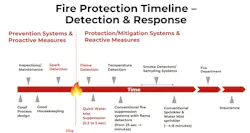
2. Apply recommended safeguards to both fire and explosion hazards. After obtaining the material properties, the DHA team should apply the same rigor to fire safeguards as it does to deflagration safeguards. In addition to the ignition control and explosion protection strategies, it is vital that the correct fire protection strategies are used to address every dust fire hazard as well. This includes considering manual and automatic firefighting strategies. DHA teams should also understand fire detection and response times, as shown in the timeline in Figure 1.
3. Find prescriptive fire protection recommendations. Applying equivalent rigor means that teams should consider all possible prescriptive requirements after thoroughly evaluating the hazards. This process leads to the third necessary action in filling the missing gap of fire protection recommendations for dust hazards. For the most part, these prescriptive requirements will be focused on automatic firefighting. Due to the nature of manual firefighting, it would be very difficult to have prescriptive safeguards in place that could be reliably replicated in the field. Automatic firefighting can be paired with specific scenarios and allows for exact applications. There are plans to add more prescriptive fire hazard guidance in future NFPA standard updates, but there is no specific timeline for those to be implemented.
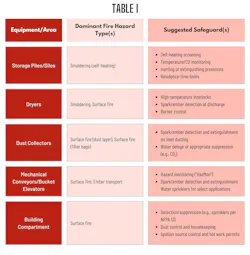
Table 1 shows some examples of how prescriptive requirements could be applied to specific dust fire scenarios.
Safeguarding industry and improving DHAs
Bridging the gap between dust fire hazard identification and preventative recommendations is critical to guarantee the highest level of protection for both the process and any persons involved. Implementing the changes discussed in this article could help with many situations across industry. Prescriptive requirements would offer a baseline not only to tackle the gap in recommendations, but also to help combat the differences in quality across hazard analysis.
This is especially important when considering the large amount of DHA work that needs to be done and the small number of qualified people to conduct it. When the gap is bridged and safeguards are being recommended at the same rate as fire hazards are being identified, DHA teams will be able to incorporate both fire and explosion hazards in their final reports and better protect the many industries that touch daily life.
References
1. Timothy Heneks, “CVT Review of 16 3rd Party DHA Reports, across all industries, variety of methodologies”, CV Technology, Jupiter, Florida, 2026
2. WXII, “Sweet potato silo in North Carolina town burning for 2 weeks”, https://www.wxii12.com/article/sweet-potato-silo-in-north-carolina-town-burning-for-2-weeks/2061763 (accessed September 14, 2026)
3. “Combustible Dust Incident Reports (2019-2023)”, Dust Safety Science, Halifax, Nova Scotia, B3P 2G4, Report 2023
4. NIOSH, “Lumber mill silo fire and subsequent explosion kills two firefighters and critically injures thirteen more – Maine”, National Institute for Occupational Safety and Health, Rep. F2026-07 ME, 2026
About the Author
 Philip Slavkovsky
Philip Slavkovsky is an application engineer at CV Technology.
 Timothy Heneks
Timothy Heneks is Director of Engineering Services at CV Technology. He is a credentialed professional engineer and serves on various NFPA Technical committees where he helps to ensure that fire and explosion hazards are managed with proper prevention and mitigation solutions through industry-accepted standards. His professional engineering experience includes designing explosion protection systems and leading a team of safety consultants specializing in combustible dust hazard identification, evaluation, and control through dust hazard analyses (DHAs), hazardous area classifications (HACs), or other process safety-related assessments. In his current role, he focuses on helping clients navigate the complexities of combustible dust safety, ensuring practical, effective, and compliant solutions to protect employees and facilities.