Basics of wet and dry granulation for pharmaceutical manufacturing
Key Highlights
- Granulation transforms fine powders into larger, uniform particles, improving flowability, compressibility, and reducing segregation and dust generation in pharmaceutical manufacturing.
- Dry granulation uses mechanical compression to form dense compacts, ideal for moisture- and heat-sensitive drugs, with advantages like fewer steps and continuous processing, but may produce less uniform granules.
- Wet granulation involves adding a liquid binder to create strong, uniform granules, suitable for formulations requiring precise control over drug release and mechanical strength, despite higher process complexity and cost.
- Advances such as process analytical technology (PAT) and continuous manufacturing have enhanced granulation efficiency, reproducibility, and scalability, supporting high-quality pharmaceutical production.
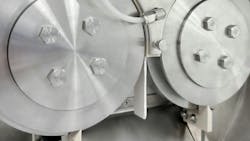
Granulation is a critical process in pharmaceutical manufacturing, serving as a fundamental step in the production of solid dosage forms, particularly tablets and capsules. It is a particle engineering process in which fine powders are turned into larger, more uniform particles, called granules. The resulting granules have improved flowability, compressibility and uniformity and, potentially, modified bulk density. These properties are essential for efficient downstream processing and for ensuring product consistency.
By modifying the formulation’s physical properties, granulation also reduces the risk of ingredient segregation and eases powder handling challenges. The formation of granules also reduces dust generation, improving both process safety and cleanliness.
Role of granulation in pharmaceutical solid dosage manufacturing
The pharmaceutical industry employs two primary granulation techniques: dry granulation, which uses mechanical compression to bind smaller particles together into larger ones; and wet granulation, in which a liquid (water or organic solvents) is added to the powder to form granules. Both methods aim to produce granules with optimal physical and mechanical properties, yet they differ significantly in methodology, equipment requirements, and applications. The selection between the two depends on the physicochemical characteristics of the active pharmaceutical ingredient (API), formulation requirements, and cost considerations.
From a manufacturing standpoint, materials suitable for direct compression into tablets are preferred. However, most small molecule APIs are produced as fine powders with poor flow and compression characteristics. These materials tend to be prone to segregation and difficult to process consistently at manufacturing scales. Granulation addresses these challenges by engineering the particle properties needed for reliable blending and compression.
Dry granulation process overview and operating principles
Dry granulation agglomerates powders under high pressure, forming dense compacts (slugs) or ribbons. This process relies on mechanical compression to force the powder together and form bonds between the particles, increasing particle size and density. The compressed slugs or ribbons are then passed through a mill screen to be broken down into granules of a desired particle size and size distribution.
Steps in dry granulation
Dry granulation begins with blending of the API and excipients into a homogeneous powder mixture. Lubrication may need to be incorporated at this stage to reduce adhesion to compaction surfaces and facilitate material release after compaction. The amount of lubricant added prior to compaction is typically limited to <50% of the total lubricant required in the formulation to avoid negative effects on interparticle bonding and tablet strength.

In slugging, the material is compressed into large tablets using a tablet press or a dedicated slugging press. In roll compaction, the powder is passed between counter rotating rolls with an applied force to form a continuous ribbon. Both approaches increase powder density and promote particle bonding.
Following compaction, the slugs or ribbons are milled through a specified screen size to produce granules with an appropriate particle size distribution. The milled material can be put through a screen separator to classify oversized, good and fine fractions.
In the final stage, the granules are blended with the remaining lubricants necessary for proper tablet press operation and tablet properties.
Advantages and limitations of dry granulation
Dry granulation is particularly suitable for moisture- and heat-sensitive materials, as it avoids the use of solvents and eliminates heat input entirely. Dry granulation requires fewer processing steps than wet granulation, which reduces both processing time and overall manufacturing costs. It can be run in continuous operation as opposed to batch processing, allowing for easier integration into automated manufacturing operations.
Granules produced by dry granulation may exhibit lower uniformity compared with those produced by wet granulation, and the resulting particle size distributions are often larger. The high compression forces required to achieve adequate granule strength may inhibit tablet formation for certain formulations. Additionally, the process can produce dust, presenting containment challenges for highly potent compounds, and it is generally less suitable for formulations that demand very fine dose uniformity.
Pharmaceutical applications suited for dry granulation
Dry granulation is used for drugs that are sensitive to moisture or heat, including metformin hydrochloride, aspirin, Ibuprofen, Vitamin C, etc.
Wet granulation fundamentals and process overview
Wet granulation involves the addition of a binding liquid, typically an aqueous solution but in certain cases organic solvents, to a powder mixture. The mixture forms a wet mass that is subsequently dried and milled into granules of the desired size that are more free flowing than the original powder. The liquid binder promotes adhesion between particles, resulting in the formation of strong, uniform granules.
Steps in wet granulation
Wet granulation begins with blending of the API with diluents, disintegrants, and/or other excipients to achieve a uniform dry mixture. Lubricants are not typically used at this stage as they can be overblended and adversely affect granule and tablet properties.
A granulating liquid consisting of water or an organic solvent, with or without a dissolved or dispersed binder, is then introduced into the powder blend via a metered spray system. Binders are commonly used as they promote uniform distribution and efficient particle bonding. However, binders can also be incorporated in the dry blend if their use in solution results in excessive granule growth or causes tubing or nozzle blockages.
Following liquid addition, the resulting wet mass is put through a wet massing step in which mechanical agitation promotes uniform binder distribution, particle adhesion, and densification. The wet mass is then passed through a mill to break up large agglomerates and form coarse granules. This wet milling step is not intended to establish the final particle size distribution but rather to ensure consistent granule size and uniform drying.
The granules are then dried in a fluid bed dryer to achieve a target residual moisture content. Vacuum drying, where a heating jacket on the mixer bowl, paired with a vacuum pump to lower the internal bowl pressure can be used to avoid the need for multiple machines and powder transfer equipment. After drying, the granules are milled to remove lumps and produce a controlled, consistent particle size distribution required for downstream stability and compressibility.
In the final stage, lubricants and/or glidants are blended with the dried granules to improve flow properties and reduce the likelihood of compression-related defects. The finished granules are ready for compression or filling into capsules.
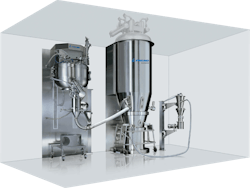
Fluid bed top-spray granulation is an alternative to high shear mixing that removes the need for multiple processing machines and provides a lower shear wet granulation that can be advantageous for shear-sensitive products. The resulting granules typically have a lower bulk density than those from a high shear process but are more porous and as a result are better suited for quick-dispersing tablets. The material’s bulk density can be modified more easily than with other granulation methods, making it easier to target a specific tablet size and dosage.
Rotary granulation is a small-batch, high-precision technique used to generate spherical granules with a very narrow particle size distribution and an adjustable bulk density, normally between that of high-shear and top-spray granulation. The spherical particle shape allows for more free-flowing powders at smaller particle sizes than other techniques.
Wet granulation equipment and process options
Wet granulation employs various types of equipment depending on formulation characteristics, process scale, and manufacturing requirements. Powder blending and granulation are commonly performed using a high-shear mixer or fluid bed granulation process, both of which allow for controlled incorporation of the granulating liquid and efficient wet massing. A fluid bed is also used as a dryer to achieve the desired residual moisture content. Granule sizing is accomplished using oscillating, rotary, or conical mills and sieving screens to produce a uniform particle size distribution.
Advantages and limitations of wet granulation
Wet granulation has several key advantages in the manufacture of solid oral dosage pharmaceuticals. The process produces granules with excellent flowability and compressibility to ensure reliable die filling in the tablet press and create robust tablets. Granules typically exhibit a narrow particle size distribution, which minimizes segregation and reduces dust generation during handling.
Wet granulation is effective for achieving uniform distribution of low-dose APIs and for improving the performance of poorly flowing or poorly compressible powders. More process parameters influence wet granulation processes and can be adjusted to target specific granule sizes and influence drug dissolution and release characteristics.
Wet granulation has a few limitations, the first of which is that it involves multiple process steps and sometimes multiple machines, increasing overall production time, energy consumption, and manufacturing cost. Also, exposing the material to moisture and subsequent heat can lead to hydrolysis or thermal degradation of moisture- or heat-sensitive APIs. Wet granulation is also predominately a batch process, which results in lower throughputs.
Pharmaceutical applications suited for wet granulation
Wet granulation is widely used in the pharmaceutical industry when formulation requirements cannot be met by direct compression or dry granulation. It is particularly beneficial for formulations requiring strong, uniform granules or powders with poor flowability and/or poor compressibility. Wet granulation is often used in the production of immediate-release tablets such as paracetamol and amoxicillin. It is also used in sustained-release tablets and capsules where controlled structures are required. Lastly, it is used for specialized products such as chewable and effervescent tablets, where uniformity, mechanical strength, and proper dissolution are critical to API performance.

Advances in granulation technology
Advancements in granulation technology have improved process efficiency, reproducibility and scalability through innovations in equipment manufacturing and design, process integration, and analytical monitoring. These developments have reduced processing time, energy consumption, and product quality.
Dry granulation enhancements have been made by using roll compactors and continuous manufacturing. Cantilevered roll designs paired with dynamic roll gap control and constant roll force enables high throughput and easy cleanability, while providing improved control over ribbon width and density.
The incorporation of Process Analytical Technology (PAT) such as near-infrared spectroscope (NIR) and laser diffraction measurements for in-line particle sizing, allow for real time monitoring of the process parameters to support consistent granule quality.
About the Author

Garrett Alfred
Garrett Alfred is the Technical Sales Manager at Freund and has been with the company since 2018. He works with customers in a variety of customized applications to ensure the machines they purchase are suited to their specific needs. Prior to sales, he worked in the lab as a process development scientist, working with customers in house and in the field on new process and product developments. He graduated from the University of Iowa with a BS in chemical engineering.

Mitch Crawford
Mitch Crawford has been with FREUND Inc. since 2012. He graduated from Iowa State University with a BS in Mechanical Engineering and started working for FREUND as a Technical Service Engineer. He joined the lab in 2018 and worked on many customer projects as well as R&D efforts, including four AAPS posters. In 2023 he became the laboratory manager.

Maren Treat
Maren Treat is a process development scientist at FREUND Inc. responsible for conducting research and development to drive cutting edge advancements and assist with optimizing customer processes.