What to consider when specifying magnetic separation equipment for chutes and other gravity feed applications
Key Highlights
- Different magnetic separator styles are suited to specific flow conditions, budgets, and maintenance needs, from simple grates to advanced continuous-cleaning units.
- Proper magnet selection depends on detailed knowledge of the product, including flow rate, particle size, moisture, and abrasiveness, to prevent bridging or missed metal fragments.
- Installation space, access for cleaning, and downstream process considerations are critical factors influencing magnet choice and placement.
- Budget constraints influence the choice between manual, self-cleaning, and continuous-cleaning magnets, with higher upfront costs potentially reducing long-term labor and downtime.
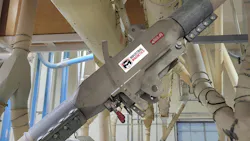
Gravity does a lot of quiet work in a processing plant. Long before product ever reaches a mixer, extruder, or packaging line, it is falling: out of a bin, down a chute, off a slide gate, into a bucket elevator. Wherever product moves by gravity, there is an opportunity for ferrous tramp metal to ride along with it. A stray bolt shaken loose from upstream equipment, wire fragments from a supplier's packaging, or fine metal material worn from a grinder or mixer can all end up in the flow. Left uncaptured, that metal can damage downstream equipment, contaminate finished product, and put a company's reputation and customers at risk.
Magnetic separation is one of the most reliable, cost-effective lines of defense against this kind of contamination. But chutes and other gravity feed applications are not one-size-fits-all. The right magnet for a 24-inch grain chute looks nothing like the right magnet for a pharmaceutical hopper or a plastics regrind line.
Here are questions your magnet supplier should be asking you:
- The equipment. How will the magnet be fed and which cleaning method matches your maintenance capability?
- The product. How does the product flow, what is the particle size, and what size tramp metal are you trying to capture? These questions help to determine the magnet spacing.
- The space. How much room, drop height, and access does the footprint allow for installation?
Matching the magnet to the application
Gravity feed lines can be protected by several different styles of magnetic separator, each suited to different flow conditions, budgets, and maintenance preferences.
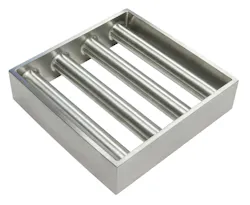
Grate magnets are the simplest and most economical option. A grate consists of rows of magnetic tubes set on fixed centers within a frame that drops into a chute, hopper, or bin opening. Product flows over and around the tubes, which capture ferrous metal. Grates can be built in round or rectangular configurations, sized to nearly any opening, and engineered to different gauss strengths depending on the contamination challenge Cleaning is manual (tubes are wiped or pulled by hand), which keeps cost down but adds labor and requires attention to proper PPE, since fine metal fragments and wire can be sharp.
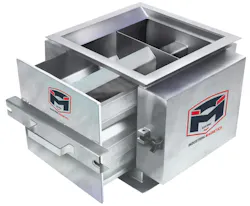
Drawer-in-housing magnets, often just called drawer magnets, take the same tube-and-frame concept and mount it inside an enclosed housing, with rows of tubes staggered so product zigzags through the unit and repeatedly contacts a magnetic field. This design captures more fine material than a simple grate.
- Manual clean units are the most economical, with the operator pulling the drawer by hand to wipe the tubes. These are typically best suited to smaller housings, since a fully loaded drawer on a larger unit can be heavy and awkward to remove safely.
- Manual self-cleaning models make for an easy cleaning option, adding wiper seals to each tube, so the operator still pulls the drawer manually, but the tubes largely clean themselves as they pass through the seal. That means less mess and less risk of leftover product.
- Self-cleaning units use pneumatic or electric actuators to open and close the magnet, either on a timer through a PLC or with the push of a button. They make sense where larger tubes, harder-to-reach installations, or more frequent cleaning cycles are involved.
- Continuously-cleaning units are the premium tier, built with two sets of tubes so that one is always in the product flow while the other is being cleaned. There is no interruption to production, and the unit can be run on an automated schedule. These are well suited to processes that cannot tolerate downtime.
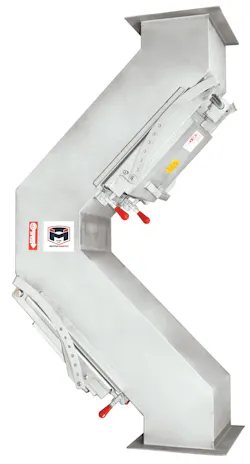
Plate and hump magnets solve a different problem: protecting downstream equipment and removing tramp metal in systems where the existing chute layout does not provide the straight run, installation height, or access required for a grate or drawer magnet. Plate magnets mount inside an existing chute, either above the flow to lift metal out, or below the flow with a diverter that channels product across the face of the magnet and protects captured metal from washing back off. Getting the right plate magnet built for an existing chute depends on knowing the product, the chute's angle and depth, and how fast material is moving through it.
When a chute is not already in place, a hump magnet is often the better answer. A hump introduces an engineered bend into an otherwise straight drop, forcing product to divert across a plate magnet before continuing on its way. A half hump works where the flow only needs to be diverted in one direction. A full hump is used when the chute changes direction partway through the drop. Standard hump housings are typically engineered for 45- to 60-degree chutes, with custom units available for other angles. Hump magnets tend to be the right call when product is moving quickly or when a chute does not offer enough depth for a plate magnet alone to do the job, and they are a common way to retrofit magnetic protection into an existing line without a major rebuild. Like drawer magnets, hump and plate magnets are available in manual, manual self-cleaning, or self-cleaning configurations.
Extractors and split-flow magnets round out the options for high-volume gravity and choke-flow applications. An extractor is a housing with parallel magnets positioned on either side of the flow, so product passes between them while ferrous metal is pulled to the surface. A split-flow magnet adds a center wedge magnet that divides the stream and directs it toward two additional magnets, creating three points of contact instead of one. That combination is often the right choice when purity requirements are especially strict.
Know your product
Each of these magnet styles performs differently depending on what is actually falling through it. Flow rate, bulk density, particle size, moisture content, and abrasiveness all shape how a product interacts with a magnetic field, and they all factor into how a magnet should be spaced and built.
Abrasive or dense whole products, such as grain, plastic pellets, or mineral aggregate, wear differently. Dropped from a tall, steep chute, they pick up speed and can accelerate wear on tubes and housing components. In these cases, diverters, wear-resistant liners, or heavier-gauge construction can extend equipment life considerably. A good supplier will ask about all of these characteristics up front. The more detail you can provide about your product, the faster and more accurate the recommendation will be.
Spacing, orientation, and what's up- and downstream
Chutes and gravity feed lines rarely exist in isolation, so it helps to think about the whole run, not just the drop itself. The device feeding material into the chute (such as a slide gate, screw conveyor, bucket elevator, or another chute) affects how the material enters and interacts with the magnet. What happens after the material passes the magnet matters too. If this is the last opportunity to catch ferrous contamination before packaging or further processing, the magnet needs to be sized and built to catch everything possible. If there is another separator downstream, expectations can shift accordingly.
The physical envelope available for the equipment is just as important as the process itself. How much vertical drop is there to work with? How wide or narrow is the opening? And, critically, how will the unit be accessed for cleaning? Can an operator safely reach it, or is it mounted somewhere that makes a manual-clean unit impractical or unsafe? Nobody wants to ask a team member to pull a heavy drawer over their head. Answering these questions early helps narrow down not just which magnet family makes sense, but which cleaning option is realistic for the location.
Where budget fits into the equation
Budget shapes every one of these decisions, and there is no getting around it. Manual-clean grates and drawers cost less up front. Self-cleaning and continuously-cleaning units cost more but reduce labor and downtime over time. Rare earth magnetic material offers stronger holding power for fine particles than ceramic but comes at a premium. Custom engineering (to fit an odd chute angle, a sanitary requirement, or a tight footprint) adds cost, but it is often the only way to solve an application properly.
This doesn’t mean that a lower budget necessarily results in reduced performance. Sharing budget parameters with your supplier early, alongside your process details, helps them recommend the right combination of magnet style, material, and cleaning method for the money, and keeps quoting and approval moving without unnecessary back-and-forth.
Partnering with the right supplier
Specifying magnetic separation equipment for chutes and gravity feed lines isn't about picking a part off a shelf. It's an engineering conversation. The type of equipment, the product's characteristics, and the physical space required all work together, and getting any one of them wrong can result in a magnet that underperforms, wears out early, or creates a maintenance headache.
A supplier who asks detailed questions about your process, not just your budget, is doing you a favor. And however specialized your application, don't be afraid to ask questions of your own. The right magnetic separation partner should be able to walk you through the tradeoffs in plain language, test their equipment before it ships, and stand behind it once it's installed and running.
Flow rate, bulk density, drop height, and sanitary grades may not be everyday topics for you, but they should be for your magnet supplier. Rest assured, the correct magnet for your process is out there and ready to be built for you.
About the Author
 Chris Waibel
Chris Waibel is Tramp Metal and Automation product coordinator at Industrial Magnetics a leading manufacturer of industrial magnets based in Boyne City, Michigan.
Related
 imiplhapproved_1
 Lead Image