Ask a Powder Pro: When should I use mechanical screening versus air classification?
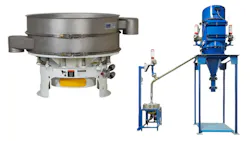
Mechanical screening (above left) is simple, energy-efficient, and easy to validate. It is generally preferred when particles are relatively coarse, narrowly distributed, free flowing, and not prone to blinding or agglomeration.
Mechanical screening uses gravity, motion, and mesh screens to accomplish separation. The screener is mechanically vibrated in a controlled manner to allow particles to flow across the screen. Oversized particles flow outward in a spiral pattern and discharge through a spout into a coarse collection container. Smaller particles fall through the mesh screens and continue to spiral until they are discharged into a fines collection container. A series of screens can be set up to allow for multiple size cuts in one pass.
By contrast, air classification (above right) becomes the better choice when working with fine particles (typically below ~75 µm), wide particle size distributions, or materials where density and shape matter as much as size. Because air classifiers separate based on aerodynamic behavior rather than physical apertures, they excel with cohesive powders and applications requiring sharp cut points at very fine sizes.
Particles are introduced into a turbulent dispersing zone between the outer edge and the periphery of the rotor. In this classification zone, particles are split into a coarse fraction and a fine fraction. The coarse particles are rejected outward and captured in a coarse collection container below a cyclone. The cyclone overflow is returned to the classifier through a recycle port. The fine particles leave the classifier with the primary airflow through the central fines outlet and are collected in a fines collection container below a filter receiver.
About the Author
 Benjamin Cirillo
Benjamin Cirillo
Benjamin Cirillo is Site Manager, AVEKA Cottage Grove. As Site Manager at AVEKA Cottage Grove, Ben is dedicated to ensuring customer satisfaction while aligning with the company’s objectives for safety, quality, and efficiency. Ben is responsible for overseeing the seamless progression of projects from production set-up to final delivery. With a strong foundation in operations, Ben brings 15+ years of experience in process optimization and equipment design to meet client expectations. Ben holds a degree in Mechanical Engineering from Marquette University.