The role of impeller diameter in mixing system performance
Key Highlights
- Impeller diameter directly affects fluid circulation, flow patterns, and mixing efficiency within the vessel.
- Small changes in diameter can significantly increase power consumption due to the fifth power relationship, impacting motor and gearbox performance.
- Accurate measurement of impeller diameter, especially for odd-bladed designs, is vital to prevent performance issues and mechanical overloads.
- Impeller size should be evaluated in the context of the entire mixing system, including motor capacity, gearboxes, and material properties.
- Selecting the correct impeller diameter helps optimize mixing performance, reduce mechanical wear, and extend equipment lifespan.
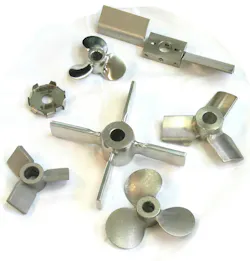 Selecting an impeller for a given application requires thorough consideration of several interrelated factors that influence how energy is transferred to the fluid and how material circulates throughout the tank.
Selecting an impeller for a given application requires thorough consideration of several interrelated factors that influence how energy is transferred to the fluid and how material circulates throughout the tank.
When it comes to ensuring that an industrial mixing process reliably produces the intended result, the mixing impeller plays a critical role. The impeller is the key component in direct contact with the batch contents. It is the primary driver that actually moves liquid, and it dictates the volumetric flow of material and the agitation intensity within the vessel. This is true whether the impeller design is a common marine-style propeller or hydrofoil used for liquid blending or one of many other widely used designs utilized in various industries.
Selecting an impeller for a given application requires thorough consideration of several interrelated factors that influence how energy is transferred to the fluid and how material circulates throughout the tank. These factors work together, and among them, the impeller diameter is critically important, directly affecting flow pattern, pumping capacity and the mechanical demands placed on the mixer drive system.
In practice, relatively small changes in the impeller diameter can have a disproportionate impact on system behavior. Increasing the diameter increases the volume of fluid influenced by the impeller and significantly raises the power needed to drive it. For this reason, impeller diameter must be evaluated in the context of the entire mixing system, including motor capacity, gearbox limitations and the specific objectives of the mixing process. In many cases, this dimension determines whether a mixer runs reliably below its limits or exceeds them.
What is impeller diameter?
In geometric terms, the diameter of a circle is the distance from any point on the circle straight across the center to the opposite side. The mixing impeller diameter is the distance across the circle traced by the outermost tips of the impeller blades as the impeller rotates, measured directly through the center of the bore. In a mixing system, this dimension defines the physical reach of the impeller within the vessel and determines how much fluid is affected during each rotation.
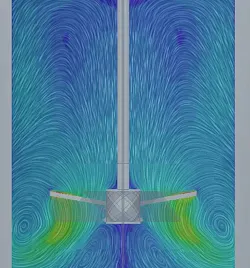
From a process standpoint, impeller diameter affects pumping capacity, flow development and the way material moves from the impeller zone and throughout the vessel. A larger diameter increases the volume of fluid engaged by the impeller and expands the circulation patterns established within the tank.
As a general guideline for lower-viscosity liquids, a common starting point for impeller diameter is approximately one-third the diameter of the mixing tank. For example, if a mixing tank has a diameter of 18 inches, a 6-inch diameter impeller is often suitable for many liquid blending applications. This relationship is commonly referred to as the impeller diameter to tank diameter ratio, or D/T ratio. Agitation intensity is then controlled by rotational speed variation.
Departures from this guideline are often driven by the properties of the material being mixed and the desired process outcome. Higher-viscosity fluids typically require larger impeller diameters to generate sufficient bulk movement and surface contact, while lower-viscosity liquids can often be mixed effectively with smaller impellers operating at higher rotational speeds. Although these combinations can be equivalent in terms of pumping capacity, they can result in very different flow patterns within the vessel. For this reason, impeller diameter should be considered an operating parameter that influences circulation behavior, and not simply a dimensional input for capacity calculation.
Accurate assessment and definition of impeller diameter is therefore essential when specifying new equipment or evaluating an existing system. Because this dimension governs the scale of fluid motion and interacts directly with vessel geometry, it becomes the starting point for subsequent decisions related to impeller design, mixer speed and drive system selection.
Why diameter has such a strong influence on power requirements
From a mechanical standpoint, impeller diameter is the primary determinant in drive system design and sizing for a mixing system. When calculating the power required to drive a mixer in a given application, the impeller diameter is raised to the fifth power. This single relationship explains why changes in diameter have such an outsized effect on mixer performance, exceeding the impact of mixer speed (raised to the third power) or impeller style.
Because of this exponential relationship, relatively small changes in impeller diameter can produce large increases in required power. Increasing the diameter expands the volume of fluid acted upon by the impeller and raises the resistance the drive system must overcome, which can overload a motor or exceed gearbox design limits even when the dimensional change appears minor. These issues often surface only after a change has already been made. This risk is especially significant when replacing an impeller or modifying an existing process without reevaluating the drive system. In mixers equipped with gear reduction, increases in diameter raise torque requirements at the shaft, and exceeding the allowable load range can accelerate wear, reduce equipment life or lead to mechanical failure.
It is also important to recognize that diameter and rotational speed are not interchangeable variables. A smaller impeller operating at higher speed and a larger impeller operating at lower speed may deliver similar overall pumping capacity, but they can impose different power and torque demands on the mixer, and can produce very different flow patterns within the vessel. For this reason, diameter changes should always be evaluated in the context of the complete mixing system rather than treated as a simple substitution.
Understanding how impeller diameter governs power and torque requirements provides a necessary foundation for reliable mixer design and modification. Careful measurement and verification of this dimension help ensure that motors, gearboxes and shafts operate within their intended ranges while delivering the flow and agitation required for the process.
Measuring the diameter of an impeller
Accurate measurement of impeller diameter is essential, particularly when replacing an impeller on an existing mixer. Because diameter directly influences power and torque requirements, measurement errors can lead to performance changes or mechanical overload.
For impellers with an even number of blades, such as two-bladed or four-bladed designs, diameter measurement is straightforward. The distance is measured from the outermost tip of one blade, across the center of the impeller bore, to the outermost tip of the blade directly opposite. This method provides a true diameter when the measurement passes through the centerline of the hub.
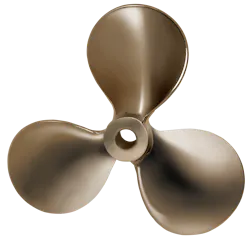
Added care is needed when measuring impellers with an odd number of blades, most commonly three-bladed marine-style or similar propellers. In these cases, no blade lies directly opposite another across the bore and attempts to measure straight across the impeller can often result in errors. This is where confusion tends to occur. The correct approach is to measure the radius rather than the diameter directly. This is done by measuring from the outermost tip of a blade to the center of the bore. Doubling this value yields the true impeller diameter. For example, an impeller with a measured radius of 3 inches from blade tip to bore center has a diameter of 6 inches. This approach provides a consistent and accurate diameter for impellers with odd blade counts.
When measuring existing impellers, wear and deformation should also be considered. Blade edges may erode over time, and damage can alter the effective diameter. For this reason, measured dimensions should be compared against standard impeller sizes whenever possible. If the measured diameter does not correspond to a standard size, further evaluation may be needed to determine whether the original impeller was custom-manufactured or has been modified due to service conditions.
Factors to consider when selecting or replacing an impeller
Measurement and selection of impeller diameter is particularly important when replacing an impeller on an existing mixer or specifying one for a new application. Because diameter governs power demand, torque requirements and flow behavior, changes in impeller size should be evaluated in the context of the entire mixing system rather than treated as a simple part swap.
Power requirements are the first consideration. Due to the exponential relationship between impeller diameter and power consumption, increasing impeller size without reassessing motor capacity, especially in direct-drive configurations, can result in thermal overload and reduced equipment life. Even modest increases in diameter may exceed the available motor horsepower, particularly in applications involving higher viscosities or increased fluid resistance.
Torque requirements must also be evaluated whether for direct-drive mixers or mixers that use gear reduction to achieve lower shaft speeds. As impeller diameter increases, the torque required at the shaft increases as well. Gearboxes are designed to operate within specific torque limits and service factors, and exceeding those limits can accelerate wear or lead to mechanical failure. For this reason, any change in impeller diameter should be reviewed against the torque capacity of the drive system.
Material of construction can also influence replacement decisions. Stainless steel alloys are commonly used for corrosion resistance and durability, while more aggressive environments may require more chemical-resistant options such as Hastelloy. In applications without significant chemical exposure, aluminum propellers may offer a cost-effective alternative. Each material carries its own corrosion resistance and mechanical properties, which should be considered against batch contents.
Careful evaluation of these factors helps ensure that replacement impellers maintain the intended flow patterns and mechanical loading of the original system, reducing the risk of unexpected performance changes or equipment damage.
Impeller diameter in the context of the complete mixing system
To summarize, impeller diameter should never be evaluated in isolation. Its influence extends beyond flow generation to affect power demand, torque loading, mixer shaft design and the interaction between the impeller and vessel geometry. For this reason, accurate definition and verification of an impeller’s diameter are necessary for reliable mixer design, modification and maintenance.
Although different combinations of impeller size and rotational speed may produce similar overall pumping capacities, they can impose very different mechanical demands on the drive system and establish different flow patterns within the vessel. These differences matter in day-to-day operations. Larger impellers operating at lower speeds, and smaller impellers operating at higher speeds, are not necessarily interchangeable solutions. Each configuration must be assessed based on process requirements, fluid properties and the mechanical limits of the mixer.
When specifying new equipment or replacing an impeller, diameter should be confirmed early in the evaluation process and reviewed alongside impeller design, shaft speed, motor capacity and gearbox torque ratings. Materials of construction, blade profile and service conditions further influence how diameter affects long-term performance and equipment life.
Careful attention to mixer impeller diameter selection helps to ensure that mixers operate within their intended operating range while delivering consistent flow and agitation. Accurate measurement and system-level evaluation reduce the risk of unintended changes in process behavior and protect mechanical components over time.
About the Author
 Mark Hennis
Mark Hennis
President of INDCO
Mark Hennis is the President of INDCO, Inc., a manufacturer of industrial mixing equipment located in New Albany, Indiana. He holds a B.S. in mechanical engineering from the University of Tennessee. Since 1975, INDCO has designed and manufactured a complete lineup of mixers for batch sizes up to 50,000 gallons. More information is available at www.INDCO.com, by calling (800) 851-1049, or via email at [email protected].