Five questions to answer before selecting bulk solids size-reduction equipment
Key Highlights
- Assess feed particle size to determine the appropriate crusher size and prevent operational clogging or inefficiencies.
- Evaluate material friability to select a machine that can handle uniform or more resistant materials effectively.
- Consider moisture content to choose equipment capable of managing sticky or caked materials without buildup issues.
- Determine required throughput to ensure continuous operation and avoid overloading or extended residence times.
- Define the final particle size target to fine-tune machine components like screens, hammers, and rotors for optimal results.
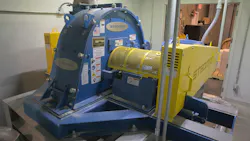
Bulk solids processors face many options when purchasing a size-reduction machine. Determining the best machine for the specific size-reduction needs requires up-front research and a clear idea of the objectives. Various crusher types, including cage mills, hammer mills, and lump breakers all reduce the particle size of bulk solid materials, but selecting the right option for the specific product takes careful consideration of the application variables.
Several important product and operational details can help to narrow the selection process. Before purchasing a machine, be sure to answer the following five questions:
1. What is the particle size of the feed material?
The particle size of the feed material determines the machine size. Whether the material is biosolids, fibrous sugar cane, solid agglomerations, sticky resins, or dry powders, it needs to flow easily and consistently into the machines. Clogs due to irregularly sized particles larger than the crusher intake create operational problems. Communicate with the crusher manufacturer regarding the conveyance system and the crusher opening size. The feed arrangement limits all feed entering cage mills, hammer mills, and lump breakers. It is key to define the feed size range before selecting a crusher.
2. How friable is the material?
Friability is another important consideration when selecting a size reduction machine. Does the material crumble when compressed by hand, or will a few whacks with a hammer do the trick? Friable material breaks more uniformly. For example, minerals such as sodium chloride are more friable than coarse aggregate. The material's inherent fissures determine the force required to reduce the particles to the desired size. Friability also determines the crusher’s required speed and configuration. Non-friable material will need to be processed longer than friable material in a crusher to achieve the desired particle size, which in turn requires more energy.
3. What is the material’s moisture content?
As a material’s moisture content increases, it can become sticky, leading to buildup and caking on the crusher’s internal surfaces and crushing mechanisms. Also, the more moisture in the feed, the greater the material's plasticity. Lump breakers move caked or clumped materials through the machine at a lower speed and higher torque, allowing wet materials to break apart. Some hammer mills can handle moist materials because the machine’s hammers scrape and push the material through the screens. Also, some cage mills with more open, flared chambers provide the appropriate housing design to minimize material buildup.
4. What is the required throughput?
Conveying material into a crusher may seem straightforward. However, maintaining a consistent material flow through the crusher minimizes wear on wear parts while delivering a uniform particle size. A steady, continuous feed is important, as overloading a crusher chamber increases wear on internal components that are not normally exposed, and the material has difficulty passing through the machine. Also, the extended residence time in the crusher results in more size reduction than intended. It is critical to know how many tons-per-hour or pounds-per-hour are required to help select the proper machine for the application.
5. What is the final particle size target?
The desired final particle size determines the best crusher and configuration. Required particle size defines the number of pins, pin spacing, hammers, screen mesh, rotor speed, and other crusher features and parameters. Crushing efficiencies are built into the process once an ideal particle size is established and components such as rotors, cages, hammers, and screens can be fine-tuned.
Crusher basics: Cage mills, hammer mills, and lump breakers
While cage mills, hammer mills, and lump breakers all crush material, each machine has pros and cons, and different features are more or less important depending on the application. Knowing each machine’s characteristics, capabilities, and functionalities helps to inform your decision to select one crusher over another. The following describes the basics of cage mills, hammer mills, and lump breakers and what to consider when choosing each crusher type.
Cage mills: Size reduction workhorses
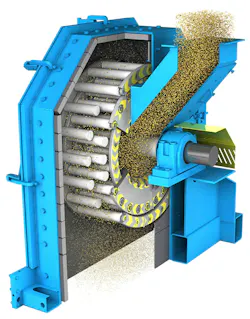
Multi-row cage mills normally consist of an even number of cages: two, four, or six. The cages are arranged concentrically with each cage spinning in the opposite direction as the adjacent cage. A multi-row cage mill employs multiple stages of selective impact reduction. The feed material drops into the center of the innermost cage, where the massive spinning pins strike and distribute the material 360 degrees around the cage. Centrifugal force and the impact of the pins reduce the material to smaller particles and force the particles through the cage and into the next cage’s pins, which are spinning in the opposite direction.
Cage mills are ideal for large-scale size reduction. The cage mill crushes up to 240 tons of material per hour and is the workhorse of any facility.
Hammer mills: Versatile and adjustable
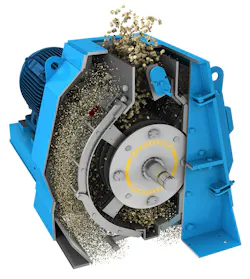
A hammer mill employs an array of rectangular metal bars, called hammers, mounted to a rotor that spins at high speed inside a chamber to shatter and disintegrate a variety of materials. A perforated screen or grate allows on-size particles to exit the mill. Hammer mills produce a finished particle size depending on the:
- Size of the openings in the perforated screens or grate bars
- The number, size, and type of hammers
- The setting of the adjustable grinding plate
- The rotor speed
There are three options when selecting a hammer mill: up-running, down-running, and air-swept. The initial feed material determines the rotor construction. The up-running hammer mill uses perforated screens or grate bars at the bottom of the machine for reducing soft to medium-hard materials.
The down-running hammer mill uses specially designed heavy, reversible hammers working in conjunction with an adjustable breaker plate to produce uniform particles. These hammer mills are most suitable for fibrous materials due to the high concentration of shearing action within the unit.
The air-swept hammer mill is a fully reversible mill that targets a finer end product while increasing production capacity. It is ideal for a wide variety of industries requiring smaller particle sizes than provided by a standard hammer mill. This variation offers 360 degrees of shearing to reduce material.
Lump breakers: Lower speed, higher torque
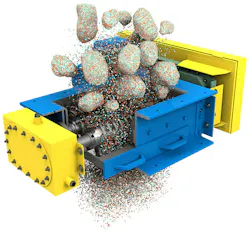
This size-reduction machine comprises interlocking single or multiple rotors that circulate shearing teeth with stationary combs to break apart lumpy or agglomerated material that settles during storage or transportation. Clumped material pushes through the tooth-and-comb slits and falls through the bottom of the lump breaker. The lump breaker reduces more friable materials.
Selecting the right crusher is not about forcing a fit. Knowing the right questions to ask will help direct you to the right machine for the job. Every situation is different, and machine and product characteristics will determine the most compatible solution. Crusher suppliers have teams that are trained to help guide decision-making. The right crusher is out there, and by answering the five questions discussed in this article, you’ll be well on your way to selecting the ideal processing machine.
About the Author
 Colby Bowman
Colby Bowman
Colby Bowman is the Business Development Manager of Stedman Machine Company. Bowman leads Stedman’s marketing efforts internally and with Stedman’s external marketing partners. Bowman and his staff also support Stedman’s sales departments and improve the customer experience through operational excellence. A Miami University (Ohio) graduate, Bowman joined Stedman in 2016 as an outside parts salesperson. Bowman lives in Harrison, Ohio, with his wife and two children.