How inline blending improves glycol production
Key Highlights
- Inline blending continuously meters and combines ingredients, reducing manual handling and transfer steps compared to batch processes.
- Automated control systems with PLCs and HMI interfaces enable precise formulation management and real-time process monitoring.
- Proper equipment selection and process design are crucial, especially when dealing with complex formulations containing multiple glycols or immiscible components.
- Inline blending offers benefits such as shorter cycle times, improved consistency, and easier integration with downstream operations.
- Considerations like fluid properties, flow rates, and plant utilities are essential for optimizing glycol solution production.
Glycol solutions are used across a range of industrial processes, including heat-transfer systems, cooling applications, freeze protection, chemical processing and formulated products. Producing these solutions consistently requires accurate control of the glycol-to-water ratio and thorough blending of all ingredients.
Traditional batch mixing can accomplish this, but it often involves multiple material transfers, manual measurements and extended processing times. Inline blending offers an alternative by continuously metering and combining glycol, water, solvents or other liquid ingredients as they move through the system.
Challenges with batch glycol mixing
In a conventional batch process, water is typically transferred into a tank before glycol and any additional ingredients are added. The materials are then mixed for a set period before the completed solution is transferred to a downstream tank or process.
This approach can create several operational challenges:
- Multiple transfers of water and raw materials
- Dependence on manual weighing or volume measurements
- Variations between batches
- Longer production cycles
- Additional tank-cleaning requirements
- Increased operator involvement
- Greater potential for ingredient-ratio errors
Moving large volumes of water into a batch tank and then transferring the finished mixture downstream can also add unnecessary handling. The effectiveness of the process depends heavily on the accuracy of each addition and the ability of the mixing equipment to produce a uniform solution.
How inline glycol blending works
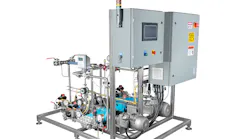
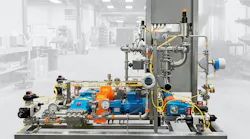
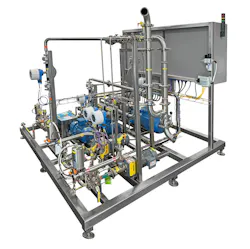
An inline glycol blending system draws each liquid ingredient directly from its storage source. Positive displacement pumps and flowmeters control the amount of glycol, water, solvent or other raw material entering the process.
Each ingredient stream is continuously measured and adjusted to maintain the programmed formulation. The streams are then combined through an inline mixing device before the finished solution moves to a hold tank, break tank, packaging line or another production process.
A typical system may include:
- Positive displacement pumps
- Mass or volumetric flowmeters
- Variable frequency drives
- Automated valves
- Inline mixing equipment
- PLC controls
- PID flow-control loops
- HMI recipe management
- Pressure and temperature instrumentation
This arrangement allows glycol solutions to be produced continuously at low or high overall flow rates without first preparing a complete batch in a large tank.
Maintaining accurate blend ratios
The concentration of a glycol solution can affect its freeze protection, viscosity, density, heat-transfer performance and suitability for the intended application. Accurate ratio control is therefore an important part of the blending process.
In an automated inline system, flowmeters continuously measure each ingredient stream. The PLC compares those readings with the programmed recipe and adjusts the individual pump speeds through PID control. Depending on the selected flowmeter technology, system design, fluid properties and operating range, blend-ratio control may reach approximately 0.25% to 0.35%.
Additional inline instrumentation can also be incorporated to monitor characteristics such as:
- Density
- Viscosity
- Conductivity
- Temperature
- Pressure
- Flow rate
These measurements can help confirm that the solution remains within the required process specifications before it moves downstream.
When is homogenization needed?
Glycol and water are generally miscible, meaning they can usually be combined through controlled metering and inline mixing. In a straightforward glycol-dilution application, precise ingredient control may be more important than high-intensity homogenization.
Additional mixing or homogenization may be required when the formulation contains:
- Multiple glycols with different physical properties
- Concentrated additives
- Suspended solids
- Oils or other immiscible ingredients
- Materials with significantly different viscosities
- Ingredients that are difficult to disperse
- Components requiring a finer particle or droplet distribution
The appropriate equipment depends on the complete formulation and the desired finished-product characteristics. Some applications may only require an inline blender or static mixer, while others may benefit from rotor-stator mixing, homogenization or a combination of technologies.
PLC and HMI process control
Inline glycol blending skids can be equipped with onboard PLC and HMI controls to manage recipes, ingredient ratios, pump speeds, alarms and process conditions.
The HMI allows operators to select an approved formulation and monitor the status of each ingredient stream. The control system then maintains the required flow rates automatically.
Available PLC platforms may include Allen-Bradley Rockwell, Siemens or other systems selected to match existing plant controls and operating standards.
Recipe-management functions can also allow one system to produce multiple glycol formulations. When a different recipe is selected, the control system adjusts the ingredient flow rates according to the stored parameters.
Operational considerations
A glycol blending system should be designed around the properties of the ingredients and the requirements of the facility. Important considerations include:
- Type and concentration of glycol
- Number of liquid ingredients
- Minimum and maximum flow rates
- Fluid viscosity and density
- Operating temperature
- Required ratio accuracy
- Storage tank or tote configuration
- Downstream equipment
- Materials of construction
- Available plant utilities
- Electrical and hazardous-area requirements
- Required level of automation
Pump selection and flowmeter technology are especially important. Equipment that performs accurately at one flow rate or viscosity may not provide the same results across a wide operating range.
Inline blending as an alternative to batch processing
Inline blending can reduce the number of transfers, measurements and tank-related steps required to produce glycol solutions. It also allows the formulation to be created as the ingredients move toward the next stage of production.
For suitable applications, this approach can provide:
- More consistent ingredient ratios
- Reduced manual handling
- Shorter processing cycles
- Improved recipe repeatability
- Fewer batch-tank requirements
- Easier integration with downstream processes
- Greater visibility into real-time process conditions
The best blending method ultimately depends on the formulation, required production rate, available equipment and finished-product specifications. Evaluating these factors helps determine whether batch mixing, inline blending, homogenization or a combination of processes is the most appropriate approach.
About the Author
 Rob Brakeman
Owner/Director of Sonic Corp
Rob Brakeman is the current Owner/Director of Sonic Corp. Rob graduated from Gettysburg College in 1991 and joined the company that summer. His educational background is in business management. Between on-hand experience and a variety of course studies, Rob has amassed engineering knowledge relating to PD pumps, valves, piping systems, process flow, instrumentation and controls.