When advanced control strategies make sense, and when they don’t
Key Highlights
- The control hierarchy progresses from single-loop PID control to multivariable ARC and model-based APC.
- ARC can address interactions and process complexity with tools often available in existing DCS or PLC systems.
- APC is most valuable for interacting variables, long delays, changing dynamics, and operations constrained by equipment limits.
- For multi-product batch plants, modular ISA S88 recipe control is often more suitable than traditional MPC.
- Before adding advanced control, stabilize regulatory loops and ensure the skills and resources needed for ongoing maintenance.

Modern chemical manufacturing relies on automation to ensure safety, quality and profitability. While classical Proportional-Integral-Derivative (PID) loops handle over 90% of regulatory control tasks, complex process dynamics often demand going beyond this de facto standard. To evaluate alternatives, engineers can use the industrial process control hierarchy, which increases in complexity from the bottom layer upward.
- Regulatory control layer: The lowest layer, managing independent single-input single-output (SISO) loops for variables like temperature, pressure, flow and level.
- Advanced regulatory control (ARC): The middle layer, utilizing multiple-input multiple-output (MIMO) schemes. ARC improves upon SISO loops by incorporating additional process variables to mitigate interactions, non-linearities and dead times.
- Advanced process control (APC): The highest layer, leveraging complex mathematical models (most commonly model predictive control, or MPC) to predict future process behavior and manipulate multiple variables simultaneously, keeping the plant running at its economic optimum.
Distributed control systems (DCS) and programmable logic controllers (PLC) serve as the foundation of chemical manufacturing facilities. While regulatory and ARC function blocks are generally available within these systems without extra cost, APC layer licensing typically requires additional software fees. Implementing ARC or APC requires deeper process knowledge, operational constraint mapping, significant capital, specialized engineering skills and ongoing maintenance. Consequently, automation engineers must balance technological capability against practical asset economics, regulatory guidelines like GAMP5 (Good Automated Manufacturing Practice) and international ISA standards.
Deployment prerequisites
Before selecting a control strategy, engineers must evaluate the operational state of the facility and the nature of the manufacturing process:
- New projects vs. operational facilities: For new projects, engineers can analyze process characteristics and integrate appropriate regulatory, ARC or APC layers directly into the design phase. For running facilities, engineers must rely on operational experience and control loop audits. Auditing identifies loops operating frequently in manual mode — provided there are no base level issues such as improper tuning, instrument malfunctions or valve malfunctions, such loops indicate unsatisfactory automated performance and are candidates for advanced strategies.
- Continuous vs. batch processes: While all three hierarchical control layers apply directly to continuous processes, the inherently transient nature of batch processing requires special variations. In batch manufacturing, “advanced control” often pivots away from traditional continuous algorithms toward structured procedural automation.
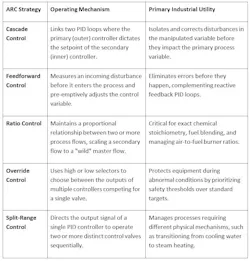
Key ARC strategies
Before deploying complex APC strategies, engineers should consider ARC methods. They are less complex, easier to configure and natively available within the DCS.
When APC makes sense
APC delivers substantial value under specific technical conditions and economically constrained environments:
- Interacting MIMO dynamics: In many chemical units, changing one input alters multiple outputs, causing traditional, independent PID loops to fight one another. APC mathematically decouples these interactions to stabilize the unit.
- Long time delays: Standard PID controllers react poorly to large dead times, frequently causing severe process oscillations. For example, high-purity distillation towers feature large liquid hold-ups where a reboiler adjustment takes a long time to alter top composition. APC uses dynamic matrix models to predict future compositions based on past moves, acting pre-emptively.
- Highly variable processes requiring adaptive control: Certain processes experience massive shifts in process gain or time constants due to environmental variations or changing operational states. Where standard PID fails because the underlying process physics change drastically, adaptive control techniques modify parameters in real-time to provide consistent response.
- Constraint-based operations: Maximum profitability usually occurs at the intersection of equipment constraints, such as compressor speeds, hydraulic limits or metallurgical temperature ceilings. While PID loops control to a fixed setpoint, APC operates within a constraint window, using optimization programming to ride the plant directly against its mechanical limits to maximize throughput or minimize energy consumption.
The batch processing paradigm: ISA S88 Overrides APC
In the specialty chemical, pharmaceutical and consumer product sectors, advanced control does not always mean deploying MPC. In high-productivity, multi-product plants manufacturing dozens of different formulas, mathematical models fail because the process and materials change with every recipe switch.
Instead, advanced control is achieved by applying structured procedural control under the ISA S88 standard. By building highly modular software architectures that separate physical equipment capabilities from product recipe procedures, operators can change products quickly, safely and economically without rewriting code.
When advanced control strategies do not make sense
Deploying APC in the wrong environment leads to abandoned software, wasted capital and frustrated operations teams. Advanced control should be avoided under the following scenarios:
- Poorly maintained regulatory control: An APC system relies entirely on the underlying DCS or PLC layer to execute its higher-level commands. If a plant suffers from sticky control valves, improperly sized bypasses or untuned PID loops, adding an APC layer magnifies the instability.
- Lack of skilled resources: If a facility lacks the specialized engineering staff required to monitor, update and maintain complex models over time, the APC system will quickly degrade in performance.
- Frequent unit modifications: Small units, batch or frequently reconfigured units benefit more from relatively simpler control strategies than from complex model-based APC that would require constant recalibration.
- Highly non-linear process dynamics: Standard industrial MPC relies on linear empirical models, such as step-response matrices. High-pressure polymerization reactors or pH neutralization systems exhibit extreme non-linearities. In such scenarios, gain-scheduling PID, override control or cascade controls are safer, more robust and easier for the plant floor to maintain.
Conclusion
APC is a powerful tool for continuous, constraint-limited chemical manufacturing units like petroleum refineries or petrochemical distillation trains, providing measurable reductions in energy use and gains in throughput. However, it is an optimizing layer, not a replacement for fundamental process and process control engineering and robust mechanical maintenance. Conversely, for specialty chemical and pharmaceutical batch operations, advanced control is best achieved by implementing structured, validated ISA S88 recipe control. Automation engineers must always prioritize baseline regulatory stability, loop performance, process safety and lifecycle compliance before moving up the process control pyramid.
About the Author
 Madhav Kane
Madhav Kane is a chemical process and control engineering professional with more than 40 years of experience spanning process engineering, process control and industrial automation. An M.E. in Chemical Engineering from the Indian Institute of Science (IISc), Bengaluru, he has worked across chemical, petrochemical, pharmaceutical, biotech, food and other process industries, with experience ranging from process design and control strategy development to automation implementation and plant performance improvement. Since 1998, he has worked as an independent consulting engineer, advising process-industry clients on engineering, automation and operational improvement projects. Kane is a Life Member of the International Society of Automation (ISA) and the Indian Institute of Chemical Engineers (IIChE).