Vortex flowmeters: From the beginning
Key Highlights
- Leonardo da Vinci first documented vortex phenomena in water flow, laying early groundwork for understanding swirling fluid structures.
- The concepts of vortex shedding and the von Kármán street were developed through research by Strouhal and von Kármán, providing theoretical foundations for vortex flowmeters.
- Vortex flowmeters operate by detecting pressure fluctuations caused by vortices shed from a bluff body, with sensors translating these into flow rate measurements.
- Major companies like Yokogawa and Eastech pioneered early vortex flowmeter designs, with Yokogawa releasing the first inline vortex meter in 1979.
- The development of multivariable vortex meters in the 1990s allowed for more comprehensive process measurements, including mass flow, enhancing efficiency in industrial applications.
Though vortex flowmeters were brought to market in 1969, it is difficult to assign one person as the “inventor” of vortex meters. Instead, the concepts underlying vortex meters evolved over several centuries, as multiple people contributed to their creation by noticing and documenting different phenomena that would later become part of vortex meters.
In the late 1960s and early 1970s, these phenomena came together and vortex flowmeters were created. This discussion looks at the early contributors, and discusses who worked to create vortex flowmeters in the early days.
Leonardo da Vinci was the first person known to notice and document the existence of vortices. He drew swirling wakes behand obstacles in his notebooks on water flow, and showed that fluid motion could form repeating, organized structures instead of random turbulence. However, he did not relate this phenomenon to measurement, or quantify the frequency of vortices. He related these to the flow of blood to the heart, and also drew detailed pictures of internal blood flow to the heart. He drew his notebooks from the mid-1480s until 1519, long before modern imaging equipment was invented.
In the late 1800s, Vincent Strouhal analyzed the tones produced by wires in airflow. He discovered that the sound frequency depended on object size and flow velocity. This led to what is now called the Strouhal number: St = (fxD)/v
Here
- ƒ = vortex shedding frequency
- D = width of the bluff body
- v = flow velocity
In 1912, Theodore von Kármán studied vortex shedding and explained why vortices shed alternately. He showed why the wake is stable only under certain conditions. This phenomenon is a repeated pattern of swirling vortices, and occurs only at certain Reynolds numbers. This pattern of vortices is known as the von Kármán street. It is called a vortex street because the pattern of swirling vortices form a street-like pattern. Von Kármán’s work gave vortex shedding a theoretical foundation and limits of applicability.
How they work
Vortex flowmeters operate on a principle called the von Kármán effect. This principle concerns the behavior of fluids when an obstacle called a bluff body is placed in the path of flow. Because the flow cannot remain attached, it sheds a series of vortices alternately from each side called the von Kármán street. This phenomenon occurs in liquid, gas and steam, and has been observed in many diverse contexts including cloud layers passing an island and whitewater rapids.
A vortex flowmeter does not measure pressure drop, force or momentum directly. Instead, it measures the frequency of vortices generated by an obstacle in the flowstream called a bluff body that is mounted in the flow. In vortex flowmeters, the bluff body takes the form of an object with a broad, flat front. It is mounted at right angles to the flowstream.
As vortices shed, they create alternating pressure fluctuations, which are detected by a sensor. Common sensor types include piezoelectric, capacitive, ultrasonic and pressure. Each vortex pair corresponds to one oscillation. Counting oscillations over time gives frequency.
Frequency of vortices is proportional to velocity, yielding the relationship: v = K x f. The calibration constant K is determined by meter bore, bluff body geometry and installation conditions. Volumetric flow Q is calculated by multiplying the velocity of the flow times the area of the pipe, so Q = A x v.
In summary, vortex flowmeters operate by placing a bluff body in the flow path, causing the fluid to shed vortices alternately from each side. The resulting pressure fluctuations occur at a frequency that is proportional to flow velocity over a defined Reynolds-number range. Sensors detect this vortex shedding frequency, which is converted to volumetric flowrate using calibration constants. Because the measurement is based on velocity rather than inertial mass, vortex flowmeters are volumetric devices whose accuracy depends on stable flow conditions, sufficient turbulence and well-defined velocity profiles.
Modern history
The history of vortex meters played out both in the United States and Japan. Some articles and patents relating to vortex appeared in the 1950s and 1960s, but the most serious early work on vortex flowmeters occurred in the late 1960s and early 1970s involving Eastech and Yokogawa. Tokyo-based Yokogawa was first on the market in 1969 with an insertion vortex flowmeter designed for flare stacks.
Eastech, founded as a corporation in New Jersey in 1968, became a Delaware corporation in 1969. Its officers were Douglas White, Alan E. Rodely and Charles McMurtrie. Eastech held early patents by Alan E. Rodely and Theodore Fussell. Rodely received a German vortex patent in 1968, but it didn’t apply in the United States. Rodely’s U.S. vortex patent, applied for in 1969, was granted in 1971. In 1974, Fussell received a patent for a bluff body flowmeter with an internal sensor. However, the extent to which Eastech commercialized those patents is unclear.
In 1976, Eastech, Inc. was sold to Neptune International and began operating as Neptune Eastech. At this point, Douglas White retired as president and was succeeded by Douglas Brooks, who served until his retirement in 1979. The company continued operating as Neptune Eastech for many years.
Two owners from South New Jersey later purchased Neptune Eastech from Neptune International and continued manufacturing vortex flowmeters under the name Eastech Vortex. In 2000, Frank Sinclair bought Eastech Vortex from these two owners and subsequently retired the vortex product line in 2001. At the same time, Sinclair acquired the ultrasonic product line from Badger Meter (originally founded in 1972) and unified the two acquisitions under the name Eastech Flow Controls. With the vortex product line retired, this is all that remains of the name “Eastech.”
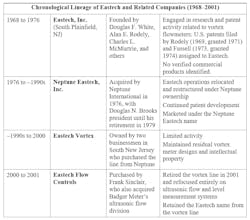
The Eastech Flow Controls website, archived in 2007 but visible with the Wayback Machine, summarized the transition: “Eastech Flow Controls is a leading manufacturer of ultrasonic flow and level measurement products. Founded in 1972 as a division of Badger Meter Inc., the Company was sold to Eastech Flow Controls in 2001 and now operates as an independent high technology group specializing in ultrasonic flow measurement.”
Yokogawa
In the meantime, Yokogawa developed its own vortex flowmeter and introduced it in 1969. The Yokogawa meter was an insertion vortex meter designed for flare stacks. The development of Yokogawa’s vortex meter mostly occurred in Japan, and was in part based on university and academic publications. However, there is some evidence that Yokogawa’s developers were aware in the 1970s of the Eastech patents.
It seems clear that Yokogawa was first to market with an insertion vortex flowmeter. Before commercializing the YEWFLO, Yokogawa conducted research and performed various experiments. Yokogawa’s YEWFLO line, which included inline meters, came out in 1979. While there is no evidence that Eastech commercialized inline vortex meters in the 1970s, someone who commissioned Eastech meters in 1979 and 1980 stated that they were insertion meters. There is no available evidence that Eastech commercialized inline vortex meters before 1979. What is clear is that Yokogawa’s release of its YEWFLO line in 1979 included inline vortex meters.
The following graphic shows the development of Yokogawa’s vortex flowmeters from 1969 to 2022. In 2022, the company brought out a new line of vortex flowmeters called the VY Series.
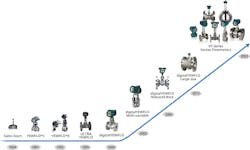
Since 2001, other major suppliers have come into the market, including Endress+Hauser and Emerson. Other companies with a significant market presence in vortex, besides Yokogawa, include KROHNE and ABB.
Like many other flowmeters, vortex meters experienced application issues early in their development. One problem for vortex meters was the effects of vibration, which tended to create false readings. Suppliers created software to deal with vibration issues, and this proved to be an effective solution.
The origin of multivariable vortex flowmeters
The origin of the multivariable vortex meter goes back to VorTek Instruments. In 1994, Jim Storer was working for EMCO Flow Systems. At that time, EMCO was selling vortex flowmeters along with pressure and temperature sensors and sending the values to a flow computer to calculate mass flow. Storer had the idea of consolidating all these measurements in a single unit to create a multivariable vortex meter. In 1995, he left EMCO to found VorTek Instruments in Longmont, Colorado, where he began the design of the multivariable vortex flowmeter.
While Storer invented multivariable vortex flowmeters, he lacked a distribution channel. For this purpose, he formed a joint venture with Sierra Instruments in Monterey, California. According to the terms of the agreement, VorTek retained the rights to and would manufacture the insertion multivariable vortex, while Sierra would own and manufacture the inline version. However, Sierra would be allowed to market both meters under its brand name. This arrangement lasted for several years until VorTek developed a second-generation multivariable vortex flowmeter, which Sierra also sold under its brand name. This arrangement continued until 2014, when Sierra decided to manufacture its own vortex meter. Even after this, Sierra continued to sell VorTek meters under its own name. In 2017, Storer retired from VorTek and turned the reins of the company over to Eric Sanford, who served as president until February 2025.
Beginning in late 2012, VorTek Instruments was a subsidiary of Azbil North America, a wholly owned subsidiary of the Japan-based azbil Group. On January 22, 2024 Azbil Corporation announced that it had transferred the Colorado-based Azbil VorTek to Sierra Instruments, now a company in the TASi Measurement portfolio.
Since multivariable vortex meters were first introduced, a number of other companies have come out with their own multivariable vortex flowmeters. While multivariable flowmeters are somewhat more expensive than their single-variable counterparts, they enable users to obtain significantly more information about the process than a single-variable volumetric meter. This additional information can result in increased efficiencies that more than make up for the additional cost of the multivariable flowmeter. Multivariable vortex flowmeters also have the capability of measuring mass flow, and this makes them attractive, especially for steam and gas flow measurement.
The development of vortex flowmeters spans many centuries. While they did not appear on the market as a measuring instrument until 1969, Leonardo da Vinci, Vincent Strouha, and Theodore von Kármán all made important contributions that helped make their later development possible. There have been many technological developments in the past 20 years in addition to the development of multivariable flowmeters. Even so, vortex flowmeters still have medium accuracy, and their primary application is steam flow.
About the Author
Jesse Yoder
Jesse Yoder, Ph.D., is president of Flow Research Inc. He has 30 years of experience as an analyst and writer in instrumentation. Yoder holds two U.S. patents on a dual-tube meter design and is the author of "The Tao of Measurement," published by ISA. He may be reached at [email protected]. Find more information on the latest study from Flow Research, "The World Market for Gas Flow Measurement, 4th Edition," at www.gasflows.com.