World’s first PEX magmeter liner improves operations
Key Highlights
- Magnetic flowmeters are highly versatile, suitable for dirty fluids, slurries, and bidirectional flow measurement with minimal pressure loss.
- The introduction of PEX liners offers a PFAS-free alternative to PTFE, with high chemical and abrasion resistance, suitable for water, wastewater, and mining applications.
- PEX liners demonstrate excellent durability, with significantly less erosion compared to traditional materials, extending flowmeter lifespan and reducing maintenance costs.
- While PTFE handles higher temperatures and more extreme chemicals, PEX provides a cost-effective, environmentally friendly option for many process conditions.
- Ongoing developments aim to expand PEX liner sizes beyond 8 inches, broadening its application scope in various industries.
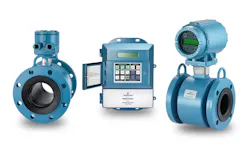
Within the process instrumentation toolbox, magnetic flowmeters (magmeters) remain one of the most versatile technologies for measuring volumetric flow of conductive liquids. Process engineers have known this for many years and existing capabilities have led to a large installed base of magmeters across multiple applications, but new developments have added a major improvement.
Before we discuss the newest developments, let’s review the existing capabilities of magmeters in a wide range of applications. Key advantages include:
- No internal flow obstructions or choke points that can accumulate debris. This makes them practical for measuring dirty flows and slurries.
- Do not create pressure losses.
- Flow can be bidirectional.
- Straight pipe requirement of five diameters upstream and two diameters downstream is a standard installation and allows tighter piping configurations than most differential pressure designs.
- Reduced straight run installations. Zero straight run installations are also possible based on flowmeter orientation, resulting in a slight decrease in accuracy, but repeatability can remain very high when selected from the right manufacturer.
The main constraint is that the fluid must be a conductive liquid, making magmeters incompatible for hydrocarbon or gas applications.
A major advance
To ensure proper functioning, it is important that the only conductive material touching the process flow are the measurement sensors, referred to as electrodes. This calls for a non-conductive liner along the interior body of the magmeter, and all wetted materials must be compatible with the process fluid. An ideal liner would thus have:
- Wide range of chemical resistance.
- High abrasion resistance.
- Wide operating temperature range.
- Easily formable to the required shape
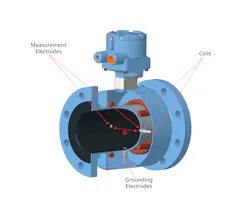
Consequently, the flowmeter’s liner (shown in black in the Figure 1 diagram) must be nonconductive, so a high-durability polymer is generally used. The liner itself is usually formed from a segment of tubing, so the ends must be flared to 90 degrees to lie flat on the flange face. Some materials, like PTFE, tend to return to their original shape if the unit is stored without the flanges covered, which can cause maintenance issues.
PTFE has long been the primary choice for many manufacturers since it covers those requirements effectively. However, fluorocarbon polymers, including PTFE, contain various per- and polyfluoroalkyl substances (PFAS, commonly known as “forever chemicals”). These have received increasing attention over recent years, with growing public awareness and concern about the negative impacts that these substances have on human health and the environment. This is particularly an issue for contact with products that people will eat and drink, or are released into the environment, calling for removal of equipment using PTFE and other fluoropolymers.
When one class of products is being phased out, something else must satisfy those same functional requirements. Fluoropolymers are highly valued thanks to their wide range of chemical resistance, high temperature limits and abrasion resistance, and a replacement liner should have similar capability expectations. The problem is, there has not been a suitable replacement solution, until now.
- Polyethylene versatility
- Polyethylene (PE) is commonly used for plastic bags, but it comes in a variety of forms:
- Low density (LDPE) — clear plastic bags, films and contains
- High density (HDPE) — milk jugs and opaque colored plastic bottles
- High density cross linked (PEX, aka XPE or XLPE) — piping and storage tanks
- Ultra-high molecular weight (UHMWPE) — bearings, rollers, liners and the bottom of skis
These are used for an enormous range of applications, frequently in packaging. One very critical aspect is that PE does not involve PFAS in its processing and it does not release PFAS after manufacture, which is why it is common in food packaging.
In the context of replacing PTFE as a common liner material in magnetic flowmeters, PEX stands out because of its:
- Wide chemical resistance.
- High impact strength at low temperatures.
- High resistance to stress cracking.
- High abrasion resistance.
- Strong thermal stability.
Appreciation for PEX is not new as it is widely used in plumbing applications to replace PVC, and even copper. These capabilities led Emerson to select PEX as a PFAS-free alternative to PTFE for liners in many of its Rosemount Magnetic Flowmeters. Emerson is the only supplier offering PEX liners in its products, although PTFE will remain available for those extreme chemical processing applications beyond PEX’s limitations.
Practical considerations
Many companies understand they must eliminate PFAS wherever possible but are not fully convinced there is a viable replacement. How well does PEX work, and what can users expect? The same characteristics that make PEX suitable for water and chemical piping apply for magmeter liner use:
- Higher abrasion resistance to PTFE, up to four-times more abrasion resistant than carbon steel pipe (Figure 2).
- NSF/ANSI/CAN 61 approval for drinking water applications.
- Chemical resistance similar to PTFE but covering a wider range of conductive chemicals, so PEX liners can often cover a facility’s entire range of applications, unlike PTFE.
- Process flow temperature range between 0° to 203°F (-18° to 95°C).
- Maximum standard pipe size is currently 8-inch, although larger sizes are under development.
- PEX liners are typically lower cost and have faster delivery than PTFE.
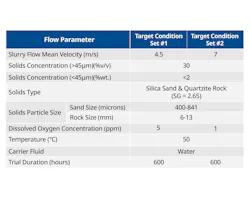
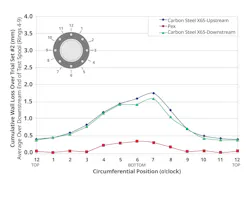
As depicted in Figure 2, there were two operating sessions of 600 hours each, first with a flow velocity of 4.5 m/s and second at 7 m/s. After 1,200 hours, measurements using ultrasonic thickness instruments were taken to determine the amount of material loss. The PEX liner (red line) suffered less than 0.5 mm loss at the worst point, and barely any erosion around half the perimeter. Carbon steel erosion was far worse around every corresponding position on the perimeter.
PEX performance
There are some applications where PEX-lined magmeters are exceptionally applicable due to PEX’s high abrasion resistance, PFAS free composition and affordability. These use cases are some of the leading candidates for PEX adoption.
Water treatment plants — Freshwater processing for drinking water distribution can take a variety of forms, depending on the source and the degree of processing required. Water treatment plants are concerned about PFAS because conventional purification technologies do not remove them, and the treatment plants do not want to be responsible for increasing them due to fluoropolymers in their processing equipment. Reverse osmosis (RO) treatment can remove PFAS, but such installations are rare in North America. PEX-lined magmeters address these and other related issues in these applications.
Wastewater utilities — Magmeters are widely used in wastewater treatment plants (Figure 3) thanks to their high free passage and abrasion resistance, necessary because of the high solids and gritty character of raw sewage. Applications of Rosemount 8750W Magnetic Flowmeters in these facilities typically include measurement of waste activated sludge and return activated sludge, along with other ancillary measurement points. Where RO systems are in use, magmeters are frequently built into membrane defouling/descaling systems. Emerson’s Rosemount 8705 Flanged Magnetic Flowmeter Sensors with PEX liners conform with NSF requirements for PFAS protection and meet higher accuracy requirements needed for these applications, while handling the lower conductivity of the process media. Since PEX liners do not add PFAS to the discharge, there are no releases to the surrounding environment.

Water utilities — A company does not need to be a water treatment plant to care about PFAS. Water utility lines exist in everything from food production factories to chemicals plants to commercial buildings, and those water lines usually deploy magmeters. PEX enables those utility lines to become PFAS free, without compromising material compatibility or durability.
Metals and mining — These applications are notorious for wearing out flowmeters due to high abrasive solids content. Magmeters are ideal in these applications because they have no internal choke points where deposits can accumulate. Magmeters, especially the Rosemount MS Magnetic Flowmeter, reduce operating costs and complexity because they work even with high solids content. The addition of PEX on the MS sensor increases the meter’s capabilities even more in high particulate applications.
Most ore processing involves a continuous series of processing steps (Figure 4), so maintaining efficiency requires measuring water and slurry volumes at strategic points to balance throughput, including:
- Acid distribution across large heap leaching piles.
- Slurry flow at hydrocyclone inlets.
- Slurry flow at froth flotation tanks.
- Water supply spray nozzles at the flocculant tanks.
- Tailing flow to a radial thickener.
- Flow to the tailing pond.

The right combination of features
Emerson’s wide range of magmeters has proven the technology’s versatility and accuracy, while maintaining an affordable price compared to some other measurement technologies. Adding a PEX liner option builds on this foundation, extending the range of practical applications where PFAS requirements are a constraint. PEX does have limitations, so it may not be the choice for every situation, for example PTFE can handle higher temperatures and more extreme chemicals.
Today the pipe size limit is 8 inches but work is ongoing to expand to larger line sizes. Where process requirements fall within the capabilities, PEX can deliver exceptional service life, and often with surprising budgetary benefits.
About the Author
 Laura Chemler
Laura Chemler
Product manager for Rosemount Magnetic Flowmeters and Vortex Flowmeters at Emerson
Laura Chemler is a product manager for Rosemount Magnetic Flowmeters and Vortex Flowmeters at Emerson. She has over 12 years of instrumentation and industry application experience. She holds a Bachelor of Science degree in Mechanical Engineering from Purdue University.