Advanced pressure transmitters provide switching capabilities with no additional hardware
Key Highlights
- Pressure is the most commonly measured variable in industrial applications, essential for monitoring and controlling processes involving gases and liquids.
- Modern pressure transmitters can include integrated relays, allowing for direct control of equipment without additional hardware like PLCs, simplifying system design.
- The Rosemount 4051S offers dual relay switches with configurable setpoints, enabling applications such as pump control, overpressure safety, and level management.
- Pressure switches and transmitters are vital for safety, efficiency, and automation in industries like oil & gas, chemical processing, and water treatment.
- Configurable setpoints and diagnostics in advanced transmitters improve reliability, facilitate remote monitoring, and support safety instrumented systems (SIS).

Of all the variables measured in industrial applications, it is safe to say that pressure is likely the most common, particularly if one includes the multitude of pressure gauges found in countless facilities. The reason is the necessity of knowing gauge pressure in so many applications, but also the number of processes that pressure regulates.
An air compressor is certainly a common example. Most units have a pressure switch that turns a motor on and off, or opens and closes an unloader. This keeps the pressure range within limits automatically. This concept can be extended to all manner of gas and liquid handling systems. The pressure measurement does two things: first, it monitors and indicates system pressure so operators and maintenance teams know what it is, and second, it uses a switch, pump or valve to trigger some control function. Let’s look more closely at how this works.
A pressure measuring and indicating device can be a simple mechanical gauge, all the way to a sophisticated electronic pressure transmitter (Figure 1) suitable for interfacing with a large automation system. There are countless possibilities in between, but the common denominator is that they simply report the condition, visually and/or electronically. They don’t control anything directly.
When a local control function is required, the typical approach is applying a pressure switch, a mechanical device that uses a pressure-sensing element — such as a bellows or diaphragm — and a spring-loaded switch mechanism. As pressure increases and decreases, the sensing element responds accordingly to actuate the switch at a predetermined setpoint. This setpoint can be adjusted to change the pressure at which the switch reacts, but a conventional pressure switch does not provide a continuous pressure measurement or indication.
Naturally, some mechanical devices can handle both indicating and switch functions, but they are typically separate. In some cases where a pressure transmitter is in use, its signal can be fed to a control device, such as a simple programmable logic controller (PLC), programmed to trigger a relay for whatever required function, while also passing the variable reading to a larger automation system. This calls for an additional piece of hardware with suitable programming, but now there is a better approach.
Simplifying challenging applications
The most complex applications require the kind of data provided by an electronic transmitter. Such transmitters are highly accurate and exceptionally reliable. They are found throughout oil refineries, chemical plants and other critical manufacturing environments to measure dynamic pressure, differential pressure (DP) level and DP flow. The electronics in these transmitters and the capabilities they provide have been improving regularly year after year in recent decades. At Emerson, a request we frequently receive from end users is, “Could you put a switch into your pressure transmitter? We want the ability to control ancillary devices without having to add a PLC or having to incorporate simple functions into the larger automation host system.”
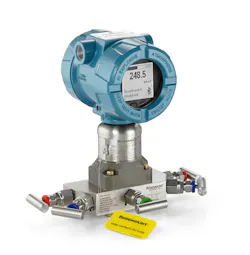
This desire has been realized with Emerson’s new Rosemount 4051S Pressure Transmitter (Figure 2). In addition to all its sophisticated pressure measurement capabilities, it also includes two integral high-voltage, high-current independent relay switches built into the transmitter. Adding this pressure switch functionality provides the ability to perform a host of actions that would normally require additional hardware, and in some cases an additional process penetration for another measurement device, such as a pressure switch. Additionally, the internal diagnostic capabilities of this transmitter extend to the relay function, helping operators and reliability teams verify performance and reliability of the switches.
Let’s look at applications where this capability delivers significant value.
The versatility of pressure transmitters
The first thing to remember is how many different functions a pressure transmitter can perform:
- Gauge pressure readings of gases and liquids in an enclosed system, such as piping or a vessel. This is its most basic function.
- DP to determine the pressure difference between two process points to compare system conditions.
- Hydrostatic pressure of a liquid in a vented tank. When fluid density is known, this pressure can be directly correlated to level.
- Level measurement in pressurized vessels using differential pressure.
- DP across a known obstruction in a pipe, such as an orifice plate, indicates flow of gas or liquid.
Multiplying all those uses with the additional ability to control external devices using the internal relay functionality yields a variety of applications.
Understanding configurability
Solving process problems requires understanding the transmitter’s functionality. The switching capability in this context is strictly binary, so it’s either on or off. The two relays are totally separate. Each has two sets of contacts: normally open, and normally closed (NO and NC respectively, Figure 3). This configuration is similar to most discrete pressure switches.
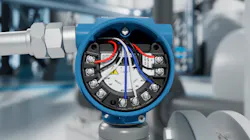
Relay ratings are:
- Power: 21.5-60 VDC or 20-264 VAC 50/60 Hz
- Switching voltage: 20-60 VDC or 20-250 VAC 50/60 Hz
- Switching current: 5 A maximum resistive load
The point at which each relay triggers is configured using the transmitter’s process alerts functionality. Process alerts, and thus each relay’s setpoint, can be set to activate based on user defined thresholds for any of the dynamic variables measured by the device, including pressure, level, volume, flow rate, totalized flow or module temperature, which approximates ambient temperature.
These settings can be made via menus on a HART communicator or on any device with Bluetooth technology capability, such as a smartphone or a tablet. Where an automation host is HART-enabled, the status of both relays in real time can be indicated in the control room. Since everything is built into the transmitter, the relays offer the same high response speed, reliability and precision as the transmitter itself.
A wide range of use cases
Pumps — Pressure switches are used for automatic pump control based on system pressure. When pressure drops below a setpoint, the switch starts the pump, and when the desired pressure is reached, it shuts the pump off. This functionality is often used in conjunction with a storage tank to stabilize the supply of fluids, while improving efficiency and reducing unnecessary pump wear.
Compressors — For air compressor systems, a pressure switch regulates tank pressure by controlling motor operation or activating an unloader. The switch turns the compressor off or activates an unloader when the maximum pressure is reached and restarts it when pressure falls. This prevents over-pressurization, while maintaining a stable and reliable supply.
Overpressure protection — Pressure switches perform critical safety functions in industrial systems such as hydraulics, pneumatics and boilers. They detect abnormal pressure conditions and can trigger alarms or system shutdowns to prevent equipment damage or hazards. This improves overall system reliability and protects both personnel and machinery.
Pipelines — In oil and gas, and other heavy process industries, pressure transmitters monitor pressure in pipelines and process systems. A properly configured pressure switch function helps operations stay within safe pressure limits by triggering an alarm or shutdown if unsafe conditions occur. This helps prevent leaks, equipment failures and environmental risks.
Remote installations — Pressure switches embedded in transmitters are ideal for remote or standalone installations where a PLC or control system isn’t available. They provide the necessary on/off signal that can directly control equipment or trigger alarms without requiring complex automation. This makes them a cost-effective and reliable solution for wellheads, remote pumping stations and basic field installations.
Level and overfill control — A DP transmitter measuring hydrostatic tank pressure is a common approach for tank level measurement. Pressure switch functions can be programmed to respond to level reaching high and low limits, either halting or starting filling operations. This approach is commonly used in open and closed tanks, boiler drums and process vessels where reliable level indication and alarm are required. Since the Rosemount 4051S is certified for SIL 2/3 applications, this function can be part of a larger safety instrumented system (SIS) protecting the facility.
Temperature monitoring — Pressure transmitters can provide an internal temperature variable that may be used for monitoring environmental conditions and controlling heat tracing systems. When temperature drops below a defined setpoint, the switch can activate heat tracing to prevent freezing in pipes or instrumentation. This provides a simple, reliable control method for remote and/or hazardous areas, without requiring a PLC or adding more functions to a central control system.
Flowmeter monitoring — For DP flowmeters, a pressure switch can respond to process changes causing an exceptionally high or low DP reading. This enables simple detection of low flow, no flow or abnormal flow conditions for pump protection, blockage detection and system assurance.
The sophistication of today’s transmitter electronics has improved reliability, extended service life and increased the capabilities of diagnostics. The ability to have the measurement capabilities of a truly world-class pressure transmitter combined with pressure switch functionality can improve and simplify a wide range of common applications across many industrial segments.
About the Author
 Connor Oberle
Connor Oberle
Global pressure product manager for Emerson’s Automation Solutions business
Connor Oberle is a global pressure product manager with Emerson, where he is responsible for the Rosemount 4051S platform of products. In this role, he works to implement product solutions that improve plant safety, increase process efficiency, and enhance process insight. Connor holds a B.S. in Mechanical Engineering from the University of North Dakota and an MBA from the University of St. Thomas.