Processing Q&A: The case for multicomponent solutions in industrial connectors
Key Highlights
- Connector reliability is crucial as digitalization and sensor networks expand, directly impacting operational uptime and efficiency.
- Increasing automation, robotics, and AI-driven hardware exponentially raise the number of connections, heightening failure risks.
- Sensors provide real-time data essential for smart factories, but their growth complicates connector design and reliability requirements.
- High-performance connectors must withstand repeated mating cycles, harsh conditions, and material stresses, demanding advanced manufacturing standards.
- Multicomponent molding offers superior sealing, durability, and design flexibility, but requires specialized expertise to execute effectively.
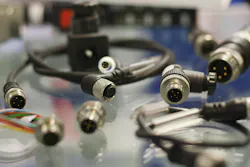
In this Processing Q&A, Pascal Freund, Global Segment Manager Manufacturing & Automation at Trelleborg Sealing Solutions, shares his perspective on why connector reliability has become one of the most critical challenges facing modern manufacturers, and what it takes to solve it.
Q: Connectors and sensors aren't typically the first thing people think of when they talk about industrial innovation. Why should they be?
These components sit at the foundation of everything manufacturers are trying to achieve, yet they rarely get the attention they deserve until something goes wrong.
Manufacturers are digitizing operations, deploying robotics, building out sensor networks and investing heavily in data-driven decision making. All of that relies on the integrity of its physical, electrical and communication connection links between devices, systems and machines. If those connections aren't reliable, none of the innovative technology built for these systems works as intended.
A single compromised connector, whether from a corroded pin or a hidden internal short, can halt a machine entirely. And because many failures aren't immediately visible, troubleshooting can take hours of tracing signals through extensive cable runs. That turns a small component into a high-risk failure point with real operational and financial consequences.
Q: How have the demands placed on industrial connectors changed in recent years?
Connectors have always needed to perform in challenging conditions: constant vibration, harsh temperatures, exposure to oils, coolants, chemicals, moisture and dust, as well as electrical noise and physical strain from repeated reconnections. These requirements have become more demanding as equipment operates faster and more continuously.
What's changed most is the sheer volume of connections required. Automation is growing at roughly nine to ten percent annually1, robotics at close to 20 percent2 and AI-enabling hardware at close to 30 percent3. Every new sensor or computing node added to a facility floor drives a nonlinear increase in connectors. The expansion isn't one-for-one; it's exponential.
As more devices transmit more data across more pathways, the performance expectations for each individual connector rise. There's less tolerance for failure because the systems they support have become more interdependent.
Q: You mentioned sensors specifically. What role do they play in driving connector complexity?
Sensors deliver the real-time intelligence that powers automation, robotics, predictive maintenance, equipment monitoring and digital twin applications. Without reliable sensor data, smart factories simply don't function the way they're designed to.
As sensor networks expand so does the volume of electrical and communication connections needed to power and integrate them. Every sensor requires a connector. Every additional data point requires a pathway. The more sophisticated the facility, the more connections it depends on.
This creates a compounding challenge. More connections mean more potential failure points. More failure points mean greater pressure on connector reliability. And greater pressure on reliability means the industry needs components built to a higher standard than many legacy designs can deliver.
Q: What does "higher standard" mean in practical terms? What are manufacturers actually looking for?
OEMs need connectors that can survive repeated mating cycles without degradation. They need higher sealing performance to protect against harsh chemicals, heat, vibration and moisture. They need materials that hold up across the full operational life of the equipment. And they need manufacturing partners who can deliver all of that at the volumes industrial applications require, without sacrificing precision.
That last point is important. Many large connector producers optimize for extremely high-volume, single-product manufacturing. They're built for scale, not flexibility. Industrial applications often require runs of 50,000 to 200,000 units, with complex geometries, specialized materials and tighter tolerances. That's a space many high-volume manufacturers aren't well positioned to serve.
The result is a clear market need for manufacturing partners who specialize in flexible, precision production at medium volumes.
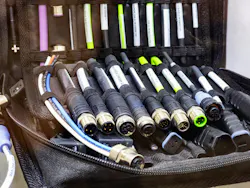
Q: Where does multicomponent molding fit into this picture?
Multicomponent molding is one of the most significant advances in connector design for demanding industrial environments.
Traditional connectors often rely on discrete O-Rings or manually assembled plastic and rubber components. These seals can shift, wear or detach over repeated connection cycles compromising the integrity of the connector over time. In a facility environment where connectors are mated and unmated frequently, that's a real vulnerability.
Multicomponent molding integrates plastic and elastomer elements into a single, tightly bonded structure. It delivers measurable improvements across several performance areas. Sealing is more robust, with no risk of components shifting or falling out of place during use. Connectors also achieve a higher insertion-cycle life compared to discrete-seal designs, making them better suited to high-frequency mating environments. Performance holds up well in demanding conditions, including exposure to chemicals, moisture and thermal stress. From a manufacturing perspective, integrating materials into a single structure reduces assembly errors and process variation. It also allows for greater design freedom, enabling more complex geometries and the use of hybrid materials where needed.
High-performance plastics such as polyether ether ketone (PEEK) provide thermal stability and electrical insulation, while elastomers such as liquid silicone rubber (LSR) create durable, high-precision sealing elements. Together, they produce connectors capable of withstanding the rigorous conditions and high cycle demands of modern industrial environments.
Q: Is multicomponent molding technically difficult to execute well?
It requires real expertise, and not every manufacturer has it. The materials behave differently under heat and pressure. The geometries can be highly complex. The bonding between plastic and elastomer must be precise and consistent to deliver the sealing performance the design specifies.
Getting it right demands deep knowledge of material science, tooling design and process control. That's why not all connector manufacturers can support multicomponent design. The capability gap is part of why there's such a strong market opportunity for partners who have developed genuine expertise in this area.
At Trelleborg Sealing Solutions, we've built in-house capabilities that span thermoplastic production, overmolding and inspection. Our experience with high-complexity geometries and specialized materials, including niche polymers that many manufacturers won't work with, positions us to solve the connector challenges that others find too difficult to address.
Q: How should manufacturers think about the supply chain implications of this shift?
As production sites add more sensors, controls and digital capabilities, the supporting infrastructure must evolve alongside them. Manufacturers who treat connectors as a commodity procurement decision are taking on risk they may not fully appreciate. A connector that fails in the field doesn't just represent the cost of the part. It represents the cost of the downtime, the troubleshooting, the disruption to production targets and, in some cases, the damage to downstream supply chains.
Choosing the right manufacturing partner for connector components means evaluating capability, not just price. Can they support medium-volume, high-precision runs? Do they have in-house expertise in multicomponent design? Can they work with the materials your application requires? Do they offer inspection and quality assurance processes that match the reliability standards your equipment demands?
These questions matter more as the complexity of facility environments grows.
Q: What's the core message you want engineers, designers and procurement teams to take away from this?
As the number of sensors in manufacturing environments grows, so does the number of electronic connections required to support them. More connections mean greater complexity and a heightened demand for high-reliability, multicomponent solutions. That's not a trend that's going to slow down.
Connectors may be physically small, but they sit at the heart of some of the most significant transformations happening in industry today. The reliability of each connection is critical to maintaining uptime, enabling digital manufacturing and realizing the full value of investment in automation and smart facility capabilities.
For organizations designing or sourcing connectors for demanding industrial environments, the question isn't whether multicomponent solutions are worth considering. The question is whether you have the right partner to deliver them.