Advancing hygienic product transfer in modern food and beverage processing
Key Highlights
- Eccentric disc pumps provide nearly pulse-free, stable flow, essential for accurate filling and maintaining product texture, especially for shear-sensitive formulations.
- Their seal-less, hygienic design reduces contamination risks and simplifies cleaning, supporting compliance with strict food safety standards like FDA and EHEDG.
- With broad viscosity handling and high suction capabilities, these pumps offer application flexibility across various food and beverage processes, from dairy to viscous pastes.
- The simplified, low-maintenance construction minimizes downtime and operational costs, enhancing overall process reliability and efficiency.
- Their dry-run capability and effective line stripping help maximize product recovery, reduce waste, and improve yield in high-volume production environments.
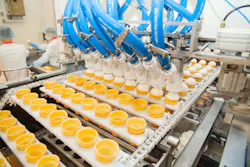
In modern food and beverage processing, product transfer is not a secondary consideration. It is a critical process that directly influences product quality, hygienic safety, application efficiency and overall yield. Pumping systems operate at the center of this process, moving liquids and semi-solids through every stage of production, from raw ingredient intake to final packaging. Despite being indispensable equipment, the impact of pumps can often be underestimated until performance issues begin to affect the entire operation.
Variations in flow stability, suction performance or proper sanitation can introduce process disruptions. Product shear may alter texture or damage particulates. Pulsation can affect dosing accuracy. Incomplete evacuation of product from lines can reduce yield. Poor hygienic design can complicate cleaning requirements. These effects rarely remain isolated. Instead, they trickle throughout the production line. Ultimately, they contribute to reduced throughput, increased waste and higher operational costs. In more serious cases, they can increase the risk of contamination, leading to costly recalls that damage consumer trust. However, now more than ever, as product formulations continue to become more complex and production demands increase, the role of pump technology has become even more crucial.
This article explores the challenges of modern food and beverage processing, how pump technology plays a pivotal part and why many operators rely on eccentric disc pumps to address key operational challenges in an evolving industry that must remain agile and precise to satisfy the ever-shifting taste buds of its consumers.
Industry snapshot and emerging trends
Food and beverage processing has historically developed alongside progress in food science and changing consumer tastes. That pattern continues, but at an accelerated pace. Global demand for processed foods continues to grow while product formulations become increasingly specialized and structurally complex.
According to Mordor Intelligence, the global food and beverage market reached approximately $9.8 trillion in 2026, up from $9.4 trillion in 2025, and is projected to reach $11.8 trillion by 2031, reflecting a compound annual growth rate of about 3.75%. Growth at this scale places increasing pressure on processing systems to handle higher volumes while maintaining consistent product quality, safety and efficiency.
At the same time, the materials moving through production lines are changing. Manufacturers are processing more viscous products such as chocolate, nut pastes, dairy formulations and plant-based emulsions. These products require greater transfer force but are also more sensitive to shear and flow instability, which can affect texture, structure and stability. Operational efficiency is also under greater scrutiny. Even small losses during processing can accumulate into significant cost in high-volume environments. Product loss, process inefficiencies and equipment limitations all contribute to reduced yield, while pump failures or maintenance events can disrupt production and lead to costly downtime.
Together, these factors have elevated the role of pump technology. Pumps are no longer limited to basic product transfer; they must also support product integrity, hygienic operation, uptime and yield under increasingly demanding processing conditions.
Key challenges: Where flow meets friction
From raw-ingredient transfer to filling and packaging, pumps are trusted to provide the performance required to safeguard the product. However, because of the wide range of product characteristics common in food and beverage processing, these pumps must be able to address the following operational conditions and requirements that are both sensitive and complex.
Achieving low-shear, non-pulsing flow
Many food products rely on delicate internal structures such as protein networks, particulates and emulsions. Excessive shear during pumping can disrupt these structures, altering texture, stability and appearance. Pulsation in positive displacement pumps adds another layer of risk. Pressure oscillations can affect flowmeters, dosing systems and filling equipment. In precision applications such as yogurt filling or confectionery depositing, even minor flow instability can result in underfilled or overfilled packages. For operators, these issues show up as product defects, inconsistent fills and cumulative product loss. Maintaining continuous, low-shear, non-pulsing flow is therefore essential for both product integrity and stable operation.
Maintaining high volumetric efficiency in variable viscosity media
When product viscosity varies, internal slip becomes a primary limitation. At low viscosities, product leaks backward through pump clearances instead of moving forward, reducing flow consistency and overall efficiency. In applications with shear-thinning fluids (viscosity decreasing with shear), such as chocolate or nut pastes, increased slip forces higher pump speeds to maintain throughput. This introduces additional shear, heat and mechanical wear, further destabilizing the process. Changing back pressure from filtration systems, heat exchangers or long transfer lines adds another challenge. Pumps that cannot maintain sealing under these conditions experience fluctuating flow rates. Sustaining volumetric efficiency across varying viscosities and pressures is critical to maintaining stable throughput and process control.
Maximizing product recovery and yield
Residual product left in pumps and piping is a direct and often overlooked source of loss. The amount retained depends heavily on pump design, with some configurations trapping product in internal cavities or dead zones. In high-volume operations, even tiny retained volumes per batch can accumulate up to significant losses. For example, a few pounds of unrecovered product per cycle can add up, representing substantial lost revenue. Improving drainability and reducing internal hold-up volume allows more product to reach packaging, directly increasing yield and reducing waste.
Securing seal reliability and minimizing contamination risk
Pump seals are a common failure point in hygienic systems. When seals degrade, they can allow product leakage, introduce contaminants or permit cleaning fluids to enter the product stream. These failures often require production to stop for maintenance and sanitation, impacting uptime. That is the best-case scenario when considering the alternative: the impact of overlooked contamination, which can pose harmful food risks to consumers and erode the reputation of operations. Additionally, food safety standards, such as those outlined by the FDA and EHEDG, emphasize prevention of contamination, making seal reliability not only a maintenance concern but also a key factor in both food safety and operational continuity.
Strengthening clean-in-place (CIP) and sanitize-in-place (SIP) capability
Effective cleaning depends on pump designs that allow full fluid circulation and complete drainage. Dead zones or poor drainability can trap residues, creating conditions for microbial growth. Incomplete evacuation of cleaning fluids can also dilute the product in subsequent runs. For operators, this increases the complexity of cleaning and the risk of contamination. Alternatively, pump designs that promote smooth flow paths and full drainability support more effective CIP cycles, helping maintain hygienic conditions while reducing operational burden.
Evaluating pump technologies
Several pump technologies are commonly used in food and beverage processing environments, each using different operating principles with unique advantages and limitations.
Centrifugal pumps
Centrifugal pumps use a rotating impeller to impart velocity to a fluid and convert it into pressure. They are well-suited for low-viscosity products such as milk, beverages and cleaning solutions, offering simple design and low cost. However, performance declines with viscosity with a low limit, resulting in reduced flow, higher energy use and limited suction capability. As non-positive displacement pumps, they also offer poor product recovery and are less effective in viscous or yield-sensitive applications.
Lobe pumps
Lobe pumps use synchronized rotating lobes to move product through the pump chamber. They provide gentle handling and good cleanability, making them common in dairy and sauce processing. However, their performance can be significantly affected by pressure or viscosity variation, which can affect dosing accuracy. Internal clearances also allow slip in low-viscosity applications, reducing volumetric efficiency.
Progressive cavity pumps
Progressive cavity pumps use a helical rotor within an elastomer stator to form cavities that move product forward. They perform well with viscous materials and deliver smooth, low-pulsation flow. But its design has limitations, including stator wear, inability to dry run, sensitivity to chemical and thermal conditions, and more complex cleaning requirements, which can be a drawback in hygienic environments.
Twin-screw pumps
Twin-screw pumps use intermeshing screws to convey product axially through the pump. They are versatile and can handle both product transfer and CIP processes, making them suitable for multi-use systems. However, they require tight internal tolerances and can introduce shear under certain conditions, which may impact sensitive products. Additionally, the wide variation in absorbed power between the process and CIP phases requires an oversized motor, which is costly.
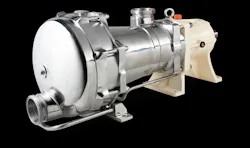
Eccentric disc pumps
Eccentric disc pumps use an off-center rotating disc within a cylindrical chamber to create continuous expansion and contraction of the chamber volume, moving product through the pump. This continuous displacement produces nearly a pulse-free flow, improving dosing stability and reducing system vibration. Close internal tolerances minimize slip, maintaining volumetric efficiency across a wide viscosity range, while the sweeping motion of the disc helps evacuate product and reduce residual hold-up.

How eccentric disc pumps excel in hygienic processing
Across food and beverage processing, eccentric disc pumps are used to protect product integrity, reduce waste and maintain consistent, reliable operation. Their design balances gentle handling with strong performance, making them well-suited for a wide range of hygienic applications
Reduce maintenance with simplified design
In day-to-day operation, fewer components mean fewer things to maintain and fewer opportunities for failure. By eliminating components such as timing gears and mechanical seals, eccentric disc pumps reduce the number of wear points within the system. Fewer moving parts lower maintenance requirements and minimize failure modes, improving uptime in continuous processing environments. Additionally, flexible installation allows integration into existing processing lines.
Improve reliability with seal-less design
Mechanical seals are a common source of maintenance challenges in hygienic pumping. By removing this wear component, eccentric disc pump designs reduce the risk of leaks, product loss and contamination. The multiple-wall stainless steel bellows used in place of seals is engineered to withstand the thermal and chemical stresses of cleaning cycles, supporting longer service life and more consistent performance.
Gain application flexibility with broad operating range
Food and beverage facilities often require a single pump to handle multiple products and varying process conditions. Eccentric disc pumps are capable of managing a wide range of viscosities, from thin liquids to highly viscous or particulate-laden products. Strong suction capability also supports product lift and long transfer distances, increasing flexibility across applications.
Accurately transfer product with stable flow
Flow consistency plays a critical role in maintaining product quality and filling accuracy. The operating principle of eccentric disc pumps creates a continuous, nearly pulse-free flow, minimizing pressure fluctuations throughout the system. This stability is especially valuable in filling and depositing operations, where even small inconsistencies can lead to overfill, underfill or rejected product. The design also maintains consistent volumetric performance over time, supporting reliable throughput across changing conditions.
Enhance process efficiency with dry-run capability
Short interruptions in product flow are common during startup, shutdown or changeovers. Unlike many positive displacement pumps that rely on product lubrication, eccentric disc pumps can operate dry for brief periods without damage. This capability provides greater operational flexibility and reduces the risk of downtime during process transitions.
Protect shear-sensitive products with gentle handling
Maintaining product structure is essential for many food and beverage processing applications. Eccentric disc pumps move product with low internal velocities and minimal turbulence, helping reduce shear. This gentle handling supports the integrity of delicate ingredients such as particulates, emulsions and viscous formulations.
Efficiently strip lines with high suction capability
At the end of a production run, product recovery directly impacts yield. Eccentric disc pumps generate a strong vacuum on suction in combination with high air compression on discharge, allowing them to self-prime and effectively strip product from piping and process vessels. This reduces residual product loss, which is particularly valuable in high-viscosity or high-cost applications.
Minimize contamination risks with hygienic design
Cleaning is a constant concern in food and beverage processing, and pump design affects how easily systems can be sanitized. Eccentric disc pumps are engineered to minimize dead zones and product buildup, allowing cleaning solutions to fully circulate and drain. This supports effective CIP processes, reduces contamination risk and helps maintain compliance with sanitary standards.

Conclusion
Food and beverage processors are operating in an increasingly demanding environment shaped by higher-viscosity products, stricter hygienic requirements and growing pressure to reduce waste. Many traditional pump technologies were not designed to meet these demands simultaneously, leaving facilities with inefficiencies that affect product quality and reduce overall yield.
Eccentric disc pump technology addresses these gaps by combining gentle product handling, stable non-pulsing flow and high volumetric efficiency within a hygienic design. With more than 50 years of proven performance in food and beverage processing applications and tens of thousands of pumps operating worldwide, this technology gives processors the confidence to maintain product integrity, stabilize processes and recover more usable product throughout the production cycle.
As formulations continue to evolve and production expectations increase, pump performance will play a more central role in overall system efficiency. Technologies that support consistent flow, effective cleanability and reliable operation will be critical to maintaining both product quality and operational performance.
About the Author
Paul Cardon
Business Development Manager, PSG
Paul Cardon is Business Development Manager at PSG. He can be reached at [email protected].