The effect of proper bearings and seals on operation longevity
Key Highlights
- Proper material selection, such as stainless steel and specialty coatings, enhances corrosion resistance and durability in aggressive environments.
- Sealing technologies like contact seals and IP69K-rated systems provide vital protection against contaminants during washdowns and in dusty conditions.
- Lubrication strategies, including direct pathways and re-lubrication features, are essential for maintaining bearing performance amid heavy contamination.
- Locking mechanisms should be matched to vibration profiles to ensure secure fitment and reduce fretting or loosening during operation.
- Safety features like shaft caps and low-crevice housings not only protect operators but also support regulatory compliance and equipment integrity.

As people knowledgeable about harsh environments know, bearings and seals are critical components that form the foundation of a good defense against contamination, corrosion and the premature failure of critical components. From washdown-intensive processes to high-vibration duty cycles, the improper selection of bearings and seals can snowball into chronic downtime, rising maintenance costs and safety risks.
The good news is that by pairing the right bearing architecture with appropriate seals — backed by materials and coatings engineered for the environment — you can dramatically extend service life and protect productivity.
Understanding “harsh” (and why it matters)
Harsh environments can mean a variety of conditions particular to their respective environments, but there are some common stressors among many industries that accelerate wear such as:
- Contamination: Dust, fibers, slurry or food particulates infiltrate housings and degrade lubricant.
- Moisture and chemistry: Frequent washdowns, steam or corrosive cleaners attack metals and seals.
- Temperature swings: Thermal expansion and contraction impact fits, clearances and seal effectiveness.
- Vibration and misalignment: Shock loading, shaft runout and frame flexing can loosen locking mechanisms and compromise sealing.
Each of these factors can shorten bearing life unless addressed through material choice, sealing selection, locking methods and lubrication strategies.
Built with more than just dimensions in mind
Selecting a bearing purely on size and load ratings could work in some cases but misses the bigger picture. In these harsh environments, architecture and materials matter just as much. Some important considerations to keep in mind may be:
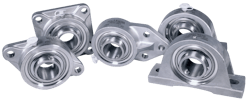
Materials and coatings: Stainless housings and hardened stainless rings resist corrosion without sacrificing strength. Specialty coatings, such as nickel plating, add a durable barrier that protects ferrous components in wet or chemically aggressive environments.
Locking mechanisms:
- Concentric locking provides uniform clamping around the shaft, reducing fretting and improving performance in high-speed, moderate-vibration applications.
- Eccentric collars create a mechanical cam action for secure locking in high-vibration duty.
- Setscrews remain a practical option for commercial shafting; the key is matching the lock style to the vibration profile of your equipment.
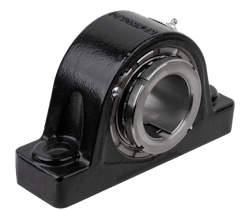
Insert retention and race design: Features such as riveted inserts help prevent outer ring rotation in the housing. Extended inner race designs manage axial stability and improve seal contact. In higher misalignment scenarios, spherical roller bearings with two-piece outer rings ease clearance adjustments and maintain performance despite shaft or frame movement.
The first line of defense through seals
While bearings themselves focus primarily on handling the forces applied to it, seals protect these bearings from the conditions of the environments they are in. In many cases, the sealing system determines whether a bearing lasts a couple of months, or potentially years. A well-designed seal prevents contaminants from entering and keeps lubrication where it belongs, even under these extreme conditions.
In environments exposed to moisture, dust or chemical cleaners, contact seals are often the preferred choice. These seals maintain physical contact with the shaft or race, creating a physical barrier that blocks contaminants and retains lubricants within the bearings. For applications where friction and heat are a concern, clearance seals can also be used while offering slightly less protection against ingress and are typically reserved for cleaner conditions when possible.
Even in linear motion systems or cam followers, sealing technology plays a vital role. Upgrading to components with integrated seals designed for washdown or dusty conditions can significantly extend service life and reduce maintenance intervals, especially in automated packaging or conveying systems.
Sanitation and the effect on your seals
Material selection is equally critical too. High-performance elastomers such as FKM (also known as Viton) provide durability under high temperatures and resist degradation from aggressive cleaning agents. Advanced designs, such as triple-lip seals, help create multiple layers of defense against contaminants. These are often paired with flingers which are metal or polymer components that deflect spray and debris away from the seal interface further reducing the risk of contamination during washdowns or in dusty environments.
For industries that require frequent or rigorous sanitation, notably for food and beverage processing facilities, IP69K-rated sealing systems have become a mandatory gold standard. These seals are engineered to withstand high-pressure, high-temperature washdowns without allowing moisture or chemicals to penetrate. Smooth, low-crevice housings complement these seals by minimizing areas where contaminants could accumulate, making cleaning more effective and significantly reducing the risk of bacterial growth.
Lubrication and maintenance: The hidden differentiator
While seals provide a great deal of defense, lubrication is the essential lifeblood of bearing performance and keeps things running smoothly. The right lubricant not only reduces friction but also helps flush out contaminants that might breach the seal. In food and beverage applications, food-grade grease is essential to maintain compliance and protect product integrity. For other harsh environments, selecting a lubricant that resists water washout and chemical attack is just as important.
Design features that improve lubrication delivery can make a significant difference. Bearings with direct lubrication pathways help ensure grease reaches critical surfaces, refreshing the protective film and extending component life. In environments with heavy contamination, re-lubrication designs allow maintenance teams to purge debris and replenish grease with ease assuming the upkeep is scheduled and maintained. Conversely, sealed-for-life bearings can be advantageous in applications where washdowns are frequent and maintenance access is limited as they reduce ingress risk and simplify the required cleaning.
Keeping safety and compliance in mind
Safety considerations often go hand-in-hand with reliability. Components such as shaft safety caps may seem minor, but they play a critical role in preventing accidental contact with rotating parts around your operation. Beyond protecting operators, these features help maintain compliance with safety regulations and reduce the likelihood of damage caused by unintended interference during any cleaning or operation.
The bottom line
Choosing bearings and seals for harsh environments is not necessarily a one-size-fits-all decision. If given a bit more time and consideration alongside an evaluation of the operating conditions, contamination risks and maintenance capabilities, the longevity of your bearings and equipment can significantly improve. By considering additional factors such as sealing technology, material selection, lubrication strategy and safety features, you set your operation up to benefit from significantly extended equipment life, a reduction in downtime and an overall improvement towards reliability.