Restructured PTFE: The optimal sealing solution for continuous pulp mill digesters
Key Highlights
- Restructured PTFE (rPTFE) offers enhanced mechanical strength, low creep, and excellent torque retention, making it ideal for demanding sealing applications in pulp mills.
- Rigorous testing shows rPTFE maintains high bolt load over extended periods, reducing the risk of leaks and minimizing downtime.
- Compared to flexible graphite and skived PTFE, rPTFE provides superior flexibility, ease of handling, and the ability to produce seamless, large-diameter gaskets through thermal fusion.
- Field applications demonstrate rPTFE's versatility, allowing for in-situ gasket repairs without removing critical equipment, thereby enhancing operational efficiency.
- Choosing the right gasket material, particularly rPTFE, is crucial for ensuring safety, reliability, and long-term performance in continuous digesters operating under extreme conditions.
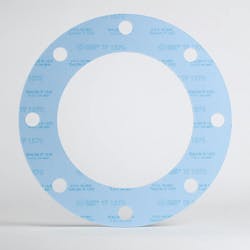
A TEADIT TF1570 gasket used for sealing in pulp and paper continuous digesters.
Continuous pulp mill digesters are critical pieces of equipment in the paper-making process. They operate under extreme conditions such as aggressive chemicals, elevated temperatures, pressure fluctuations, thermal cycling and mechanical vibrations. Failure to seal the top and bottom of these digesters can lead to significant productivity losses, emphasizing the need for robust and reliable gasket materials.
The rigorous testing conducted to assess which gasket material is best suited for use in continuous digesters indicates that there are key properties of restructured PTFE that provide it with distinct advantages over other gasket materials for this critical application.
Gaskets can be manufactured from various materials, such as metals, composites and polymers, which must be carefully selected to meet an application's requirements. Historically, metallic gaskets were the first choice for severe and demanding applications. However, continuous digesters often lack enough bolt load to properly compress a metallic gasket. Non-metallic gaskets, particularly flexible graphite (FG) and polytetrafluoroethylene (PTFE), emerged as alternatives.
Among these, restructured PTFE (rPTFE) has proven to be an excellent sealing material for continuous digesters, offering superior performance, durability and versatility.
Understanding the limitations of traditional materials
PTFE is widely used for industrial sealing applications due to its excellent chemical resistance, electrical properties, non-stick capability, high impact resistance and low coefficient of friction. As different processes require specific types of PTFE resin, several factors, including the molecular weight, average particle size and fibrillation characteristics, are taken into consideration when determining which resin should be employed. The use of different resin qualities and production processes thus results in a wide range of PTFE gasket types, each with unique mechanical characteristics. Additionally, the type of resin and the method of manufacturing the sheets can increase or decrease the stress limit and the creep of the product by up to 70%, as shown by Werner et al.3
For an effective seal, it is essential to choose materials with the following key mechanical properties:
- High torque retention
- Resistance to thermal cycles
- Low creep
- Excellent sealability
While selecting materials with optimal mechanical properties is crucial for effective sealing, it is equally important to understand the limitations of traditional options such as flexible graphite and molded or skived PTFE. These materials, despite their strengths, present challenges that can impact performance and reliability in demanding applications.
Flexible graphite (FG): Flexible graphite gaskets provide a reliable seal, good resistance to chemical attack and excellent thermal degradation properties. However, their fragility makes handling and assembly difficult, particularly in large-diameter applications. Efforts have been made to reinforce flexible graphite sheet gasket material with stainless steel foil, wire or tang. This provides slightly improved rigidity while also exposing the handler of the gasket to sharp gasket edges and potential cuts.
Skived PTFE: Skived PTFE provides excellent chemical resistance. However, its high creep rate under operational stresses — exacerbated by elevated temperatures — limits its suitability for extended campaigns. Adding 25% glass fibers can help slow the creep as compared to virgin, skived PTFE, but not to an acceptable level.
Restructured PTFE (rPTFE): Filled PTFE that has been restructured, overcomes the limitations of both FG and skived PTFE types. Produced through a lamination process which results in excellent fibrillation, rPTFE exhibits superior mechanical strength, low creep and excellent torque retention. Its ability to be thermally fused into seamless, custom-sized gaskets enables reliable sealing in large-diameter applications. It also has superior flexibility, making it easier to safely handle than FG. Additionally, fillers are added directly to the microstructure to improve mechanical and chemical characteristics of the material, as well as adapt rPTFE to the specific requirements of each process.
By addressing the limitations of traditional materials, rPTFE demonstrates its potential as a more reliable sealing solution. To validate its performance, critical testing has been conducted to compare rPTFE with other PTFE variants, providing insight into its enhanced capabilities under real-world conditions.
Critical testing validates rPTFE abilities
Creep and load retention testing
A study compared the performance of rPTFE and skived PTFE under identical conditions. Bolt load retention was monitored after gasket installation, and both were retightened after a four-hour period. The test procedure was as follows:
- Test device: raised-face (RF) NPS 2, Class 300
- Flange surface roughness: 500 μin
- Gasket thickness: 2 mm
- Gasket area: 5.94 in² (3832 mm²)
- Gasket load: 9880 psi (68 MPa)
- Test duration: 20 hours
Findings: The skived PTFE exhibited higher bolt load loss due to its high creep, increasing the likelihood of leaks developing over time. In contrast, rPTFE maintained relatively high bolt load, with minimal load loss due to relaxation, demonstrating its resilience under operational stresses, (Figure 1).
![Figure 1: Bolt load loss [kN] over time [hours] for both types of PTFE: skived and restructured.](https://img.processingmagazine.com/files/base/ebm/pcm/image/2026/01/6977a6efb3a3ebff65c916e6-teadit_chart_1.png?auto=format,compress&fit=max&q=45?w=250&width=250)
Through rigorous testing and real-world applications, rPTFE has demonstrated its ability to minimize downtime, enhance operational efficiency and ensure long-term sealing integrity.
Application case
As has been highlighted, the proper selection of PTFE type and manufacturing method is crucial to ensure the safety and efficiency of flanged joints, minimizing the risk of leaks and enhancing operational reliability. The following real-life example of rPTFE application underscores its importance as a superior material for critical applications.
A pulp and paper plant needed to perform thermal fusion of a gasket on a continuous digester directly in the field. In this case, the gasket needed to be replaced, but it was not feasible to remove the bottom scraper shaft to properly position the gasket.
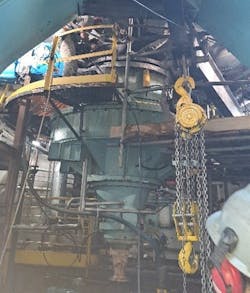
To overcome this challenge, it was necessary to develop tools to perform field thermal fusion with the same quality as that done in a controlled environment.
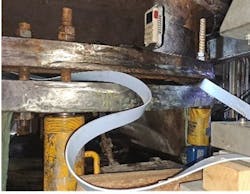
After the gasket segments were thermally fused together, the flange was assembled and the digester started operating without any leaks, highlighting the versatility of rPTFE as a sealing material.
Final thoughts
Restructured PTFE has redefined gasket performance in the pulp and paper industry. Its mechanical properties, thermal fusion capability and field-proven reliability make it the optimal choice for continuous digesters.
Key advantages of rPTFE for digesters
- High torque retention: The fibrillated structure of rPTFE ensures excellent load retention, even under extreme conditions.
- Low creep: Reduced material deformation minimizes the need for retightening and enhances long-term sealability.
- Chemical and thermal stability: rPTFE maintains its properties across a wide range of temperatures and chemical exposures.
- Custom sizing: Thermal fusion technology allows the production of large-diameter, seamless gaskets tailored to specific applications.
- Ease of handling: Resilient and user-friendly, rPTFE gaskets are ideal for field installations.
Any dimension: rPTFE permits production of one-piece gaskets which are more reliable and extremely important for longer campaigns.
When sealing critical equipment such as digesters, selecting rPTFE gaskets will provide the most versatile and reliable solution.
References
1. VEIGA, José Carlos. Juntas industriais/Jose Carlos Veiga – 8th Edition – Rio de Janeiro, RJ: June, 2019. Teadit industry and commerce.
2. FLUOROPRODUCTS, DuPont. Teflon® ptfe fluoropolymer resin: properties handbook. DuPont Fluoroproducts: Wilmington, NC, USA, 1996.
3. SILVA, Ana C.; WERNER, Florian; XAVIER, Lucas. The influence of elevated temperature in creep relaxation of various PTFE gaskets production methods. In: Pressure Vessels and Piping Conference. American Society of Mechanical Engineers, 2018. p. V002T02A018.