Key Highlights
- Seals are small components but play a crucial role in preventing leaks and ensuring equipment performance.
- Factors such as compression, groove dimensions, and surface finish significantly influence seal effectiveness.
- Manufacturing details, like print patterns in 3D-printed parts, can create channels that lead to leaks, which can often be fixed with process adjustments.
- Hardware redesign may be necessary for complex or large assemblies, especially when manufacturing constraints limit modifications.
- Selecting the appropriate seal material requires considering temperature, pressure, media compatibility, and cost to optimize performance and durability.
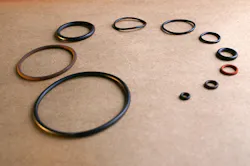
In many equipment designs, engineering teams tend to give little thought to one of the smallest parts in the assembly: the seal. When a machine is finally assembled and begins leaking fluid or gas, the root cause often leads back to that small component. The O-ring plays a critical role in whether a system performs as intended.
Engineers may assume the sealing component is straightforward and instead focus their efforts on the hardware. While seals are usually accounted for in some way, the detailed interaction between the seal and the surrounding hardware is not always fully understood. That oversight can lead to leakage once the system is assembled.
Seal performance
Several design factors influence how well a seal performs. Among the most important are the compression of the seal, the dimensions of the groove in which it sits and the finish of the sealing surfaces. Each of these elements can determine whether the seal functions properly or fails.
Compression is one of the most critical variables. In many applications, seals must be compressed within a certain range to perform correctly. Too little compression allows fluid or gas to slip past the seal. Too much compression can cause the surrounding hardware to warp or deform, which can also create pathways for leakage.
When manufacturing details cause leaks
Even small details in manufacturing can have a significant effect on sealing performance. In one case, a customer was working with a 3D-printed assembly that used an O-ring to seal a circular groove. The system experienced persistent leakage, and the team attempted to compensate by injecting an expanding foam into the assembly to fill any gaps. Unfortunately, this created a new problem. The foam expanded unpredictably, often spilling over the edges of the hardware and creating a difficult cleanup process.
A closer inspection revealed that the issue was not the seal itself but the way the groove had been printed. The internal print pattern ran radially, from the center of the circular groove outward. This created a series of tiny ridges and valleys that effectively formed channels beneath the O-ring, allowing fluid to flow along those paths.
Changing the printing strategy solved the problem. Instead of printing radially, the manufacturer adjusted the printer to follow the groove in a circular path, creating concentric layers. These layers formed small ridges that acted like barriers against the O-ring, preventing fluid from traveling underneath it. In this case, a relatively simple adjustment to the manufacturing pattern eliminated the leak.
Hardware
Not every sealing problem can be solved so easily, however. In some situations, the only solution is to redesign the surrounding hardware. In low-volume or specialized applications, changing the hardware may be feasible. When production volumes are small, engineers may be able to adjust groove dimensions or modify components so that a standard seal can be used.
High-volume production presents a different challenge. When the hardware is already tooled for mass manufacturing, redesigning it may be impractical or prohibitively expensive. In these cases, engineers often explore custom sealing solutions. That might involve specifying an O-ring with a custom diameter or cross section, or switching to alternative shapes depending on the demands of the application.
Seal selection
Selecting the right sealing approach ultimately depends on the conditions the seal must withstand. Temperature, pressure and the type of fluid or gas being sealed typically guide that decision.
Temperature is often the first consideration. Most rubber sealing materials operate within a defined temperature window. Standard rubber materials generally perform up to around 400° Fahrenheit, while specialized materials such as FFKM can operate at temperatures approaching 600° Fahrenheit. When temperatures exceed that range, metal seals may become necessary. At the opposite extreme, materials such as fluorosilicone can function at temperatures as low as negative 100° Fahrenheit. Beyond that lower limit, metal seals may again be required.
Temperature fluctuations can also influence sealing performance over time. When seals repeatedly heat up and cool down, the material expands and contracts. Over many cycles, the seal may lose its elasticity in a process known as compression set. As the seal loses its ability to rebound, its ability to maintain a tight seal gradually diminishes.
Pressure conditions also play a major role in seal performance. One key property in this context is durometer, which measures the hardness of a rubber material. Harder materials tend to resist deformation better under high pressure, making them more suitable for demanding applications. In higher-pressure systems, engineers may incorporate backup rings, which are harder support rings placed behind the O-ring to prevent it from deforming excessively. At very high pressures, engineers may need to consider alternative materials altogether.
Pressure considerations also extend to vacuum environments. In vacuum applications, permeation becomes important. Rubber materials allow small amounts of gas to pass through them over time, a phenomenon that becomes more noticeable as vacuum levels increase. Metal seals offer a significant advantage in these situations because gas permeates through metal far more slowly than through rubber.
The third major consideration is the fluid or gas being sealed. Different materials interact with fluids and gases in different ways, so the compatibility between the seal material and the media is critical. There are roughly ten major classifications of O-ring materials. Each material offers advantages depending on the specific application.
Cost is also important in material selection. Some materials are considerably more expensive than others. Fluorocarbon materials typically fall toward the higher end of the price range, while fully fluorinated materials such as FFKM are among the most expensive options available. These materials provide exceptional chemical resistance and are often considered highly inert, but they may be unnecessary for many applications. Selecting a material that exceeds the requirements of the system can drive up costs without providing meaningful benefits.
Sealing problems
Even with careful design, sealing challenges can still arise in large or complex assemblies. One semiconductor manufacturer encountered this issue when installing a large rectangular seal around the frame of a machine. The seal measured roughly eight feet by four feet and was designed as a hollow O-ring that fit into a groove around the frame. Despite the engineering effort behind the design, the system continued to leak after installation.
The investigation revealed that the hardware itself was slightly warping due to its size. This distortion prevented the seal from being compressed evenly along the entire perimeter. Engineers confirmed the problem by placing pressure-sensitive film between the mating surfaces of the hardware. In several locations near the center of the frame, there had been no contact at all.
Pressure-sensitive film was used in this situation because it allowed engineers to visualize compression across the entire sealing surface. By identifying the areas where the seal was not being compressed properly, the team could better understand the source of the leakage.
Designing early
These kinds of scenarios highlight an important lesson in engineering design. Seals may be among the smallest components in a system, but their performance depends on a wide range of interacting factors. Addressing sealing requirements early in the design process can prevent significant problems down the road.
When engineers consider temperature, pressure, media compatibility, compression requirements and hardware geometry in the beginning, they greatly improve the chances that the final system will perform reliably. In many cases, giving proper attention to a small component like an O-ring can make the difference between a successful product and a costly redesign.
Valin Corporation
About the Author
Kyle Timm
Technical Sales Engineer at Valin Corporation
Kyle Timm is a Technical Sales Engineer at Valin Corporation.
Valin Corporation, a subsidiary of Graybar, is the leading technical solutions provider for the technology, energy, life sciences, natural resources, and transportation industries. For 50 years, Valin has offered personalized order management, on-site field support, comprehensive training, and applied expert engineering services utilizing automation, fluid management, precision measurement, process heating, and filtration products.