Bearing seal evolution: How the bearing isolator became the gamechanger for the pump and motor industry
Key Highlights
- Bearings are critical components in industrial pumps and motors, with seal technology playing a vital role in preventing failures caused by contamination and lubricant loss.
- The invention of the bearing isolator in 1975 marked a significant milestone, offering a non-contact, durable solution that outperformed traditional lip seals and reduced wear.
- Industry adoption of bearing isolators increased after OEMs recognized their benefits for extending equipment life, lowering maintenance costs, and improving total cost of ownership.
- Ongoing research and development continue to refine bearing seal designs, incorporating features like vapor protection and smaller geometries for diverse applications.
- Future innovations may include active sealing systems that further enhance reliability, reduce maintenance, and support next-generation industrial equipment.
For the pumps and motors used in industrial rotating equipment, there is one incontrovertible truth: bearing failure equals equipment failure.
Considering that the difference between efficient, reliable operation and a catastrophic breakdown can come down to a single part, bearings are among the most important components in a given operation. Without an effective bearing seal to retain lubrication and prevent moisture and contaminants from entering the bearings and degrading the lubricant, even the most robust rotating equipment can prematurely reach a costly failure point.
While bearings enable the essential operation of heavy-duty pumps and motors, it is the seals that deliver the critical protection needed for long service life. And, like many other industrial components, sealing technology has significantly improved with each iteration of the part.
In the last 50 years, bearing seals have evolved from a key maintenance accessory to a critical reliability component for operations.
Evolution of bearing seals
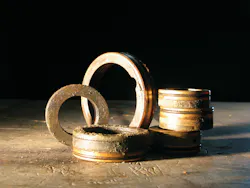
The earliest bearing seals were lip seals typically crafted from leather. While these components were adequate at the time, they contacted the shaft causing wear and required constant lubrication to function. By the early 1940s, technology evolved to allow manufacturers to develop more effective bearing seals. Rubber compounds allowed manufacturers to create tighter, more resilient lip seals, enabling longer lasting performance in rotating equipment.
While contact seals could handle positive pressures and static lubricant levels, as their name indicates, they operated in direct contact with the shaft and led to increased wear and a shorter service life. Lubricant leakage and contamination became common problems across various applications, resulting in bearing seizures and equipment breakdowns.
By the early 1970s, the industry-wide need for a better bearing seal solution became apparent.
The arrival of the bearing isolator
In February 1975, David Orlowski, a Worthington pump repair shop owner, was called to retrofit more than a dozen API refinery pumps on-site at the Sears (now Willis) Tower in Chicago. Even during the frigid winter, an entire side of the famous building needed to be cooled due to the daytime solar load. Refinery pumps were used in the HVAC system due to their robust design and were equipped with rubber lip seals, a rare combination that was not optimal for the application. The pumps first leaked through the mechanical seals, then past the worn lip seals, allowing water to enter the bearing housing and triggering catastrophic failures that ultimately shut down the cooling system. Once the cooling system failed, the building experienced thermal expansion due to the heat, causing windows to fall to the streets below.
Orlowski retrofitted the pumps with a common rotor and stator seal design that had been used for 30 years on pumps in refineries and petrochemical plants, solving the issue. Encouraged by this success, he became driven to bring a similar technology to process pumps, where rubber lip seals were still standard. He installed this common design on a series of process pumps with mixed results, revealing the need for more research and development.
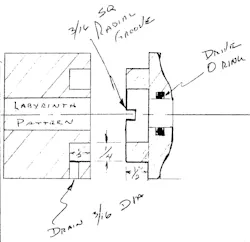
After approximately six months of extensive development and testing, Orlowski and his team perfected a compound labyrinth rotor and stator combination tailored for process pumps. It sealed oil within the bearing housing and prevented contaminants from entering, even under extreme pressure equivalent to a firehose spray.
He named this pioneering component the bearing isolator, a non-contact seal that far outperformed other bearing seals available at the time.
In simple terms, bearing isolators are compound labyrinth seals that use rotor and stator geometry with carefully engineered clearances to create a dynamic labyrinth path. The stator captures oil splash and directs it back to the bearing housing, while the rotor uses centrifugal force and gravity to expel contaminants away from the seal interface before they can reach the bearing cavity. Because the bearing isolator operates without contact, it has no wearing parts, unlike lip seals. In addition, the rotor and drive ring rotate with the shaft, preventing the shaft wear and grooving commonly associated with lip seals.
The first bearing isolators were installed in the summer of 1975 at the Grain Processing Corporation plant in Muscatine, Iowa, which was the world's largest producer of potable ethanol. These seals were used on critical equipment that required an intense spray down each night to remove carbohydrates and mash that would accumulate on the pumps.
With this latest innovation, Orlowski founded Inpro/Seal and a new era in bearing seal technology had begun.
Introducing the gold standard
In 1977, Inpro/Seal officially patented the bearing isolator. From that moment forward, this innovation became a game-changer for industrial process pumps and motors. The advent of the bearing isolator provided OEMs and end-users with a non-contact seal that improved performance life, extended run times, increased maintenance cycles and lowered production costs.
But industry-wide adoption did not happen right away.
Initially, OEMs hesitated due to a lack of clear cost benefits, as a large part (in some cases up to 80%) of their profits at the time came from replacement parts.
Many end-users, however, quickly embraced the new system. They saw that the bearing isolator was ideal for making pumps last longer, run more efficiently and deliver better total cost of ownership (TCO).
In 1978, the industry reached a turning point when a major pump OEM offered the bearing isolator as an upgraded sealing component. Soon, end-users began to request bearing isolators on their newly purchased pumps and OEMs came to realize the benefits the bearing isolator delivered for preventative maintenance programs. More widespread adoption began to take hold, but testing and engineering didn’t stop there.
Inpro/Seal continued to refine the bearing isolator design throughout the 1980s, eventually developing the now-standard VBX Ring for protection against vapor contamination. During this time, they also adapted the technology for other industrial rotating equipment, such as gearboxes, pillow blocks and steam turbines.
In 1994, another significant event occurred when bearing-protection requirements were written into IEEE Standard 841 motor specifications, bringing non-contact labyrinth seals into the mainstream.
Manufacturers began to extend warranties from one year to two and eventually to five, thanks to improved risk management, easier preventive maintenance and significantly longer maintenance cycles. Over the years, new applications, operational processes and expanded requirements across industries demanded continual improvements for bearing sealing. To that end, a slew of new bearing isolator products continued to enter the market throughout the 2000s, including IP66-rated designs, innovative features and smaller geometries to fit a variety of equipment sizes.
But if the last 50 years are any indication, the next advancements in bearing isolators will continue the pathfinding nature that the industry has come to expect.
Looking to the future of bearing seal technology
From the earliest days of leather seals to today's more advanced features and designs, this critical component continues to evolve.
It’s safe to say that in 1977, few could foresee just how much the bearing isolator would change the landscape of the industrial pump and motor industry. At the time, it was certainly a creative innovation. But decades later, through extensive application experience, field testing and an exhaustive development process, the question becomes, “What’s next?”
As the 50th anniversary of the bearing isolator's arrival approaches, Inpro/Seal, a Dover Precision Components brand, continues to answer that question.
One avenue likely to be explored is moving beyond standard or passive sealing to drive innovation toward more active systems. Given the immediate improvement in preventive maintenance that the bearing isolator has delivered from day one, modern design innovations can further develop bearing protection into a critical component of next-generation reliability systems. Ever an evolving part, the bearing isolator continues to undergo design and development enhancements that improve performance, extend warranty and maintenance cycles, and reduce TCO for operators.
About the Author
Rob Dotson
Chief Product Strategist for Inpro/Seal, a Dover Precision Components company
Rob Dotson is Chief Product Strategist for Inpro/Seal, a Dover Precision Components company. He has more than 30 years of experience in industrial equipment and critical facility operations, with a focus on rotating equipment reliability, predictive maintenance, and performance optimization. Dotson began his career with Inpro/Seal as a regional sales manager and now leads product strategy initiatives that support long-term equipment reliability. He holds a degree in engineering from the United States Military Academy at West Point.