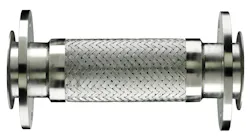
The overlooked component that can shut down your industrial system
Key Highlights
- Flexible hose assemblies and expansion joints are critical yet often overlooked components that can cause system shutdowns if they fail unexpectedly.
- Thermal cycling, misalignment, external damage, and corrosion are primary factors leading to fatigue cracking and premature failure of these components.
- Material selection based on actual temperature profiles and operational conditions is essential for durability and cost-effectiveness.
- Proper system design, including adequate supports and thermal stress analysis, helps accommodate movement and prevent overloads on joints.
- Regular inspection, correct installation, and planned replacement based on fatigue life are key to preventing failures and ensuring continuous operation.
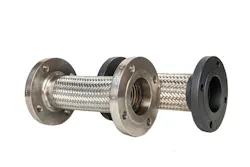
Most reliability programs at chemical plants, power plants, steel mills and other industrial operations focus on the big equipment: compressors, condensers, boilers and heat exchangers. The stakes of getting that wrong are real: Uptime Institute's 2026 outage analysis found that 57% of respondents said their most recent major outage cost more than $100,000, and one in five topped $1 million. That focus on the big equipment makes sense given the capital tied up in that machinery. It also leaves a blind spot. In many facilities, the first point of failure under thermal stress is not the compressor or the condenser at all. It is the flexible hose assembly or expansion joint connecting them to the rest of the system.
These components absorb vibration and compensate for thermal growth in piping runs that would otherwise crack rigid pipe or tear apart welded joints. They do this work quietly, which is part of the problem. A hose assembly or expansion joint rarely gets the scrutiny given to rotating equipment, even though its failure can shut down a line as fast as any compressor trip, and often with less warning.
Why hose assemblies and expansion joints fail first
Extreme temperature service puts these components through a form of stress that rigid piping is largely designed to avoid: repeated expansion and contraction. When a system heats up and cools down, whether through a process cycle, a startup and shutdown, or a batch operation, the piping grows and shrinks along its length. Expansion joints and flexible hose assemblies are built to absorb that movement, but each cycle also flexes the material at the joint's convolutions or the hose's reinforcement layers. Over thousands of cycles, that flexing produces fatigue cracking in much the same way that repeatedly bending a paperclip eventually snaps it.
Temperature extremes compound the effect. High heat accelerates the chemical breakdown of elastomers and softens the mechanical properties of some polymers, while very low temperatures in cryogenic service can make certain materials brittle and prone to cracking under the same movement they would otherwise tolerate. A joint or hose rated correctly for pressure and diameter can still fail well ahead of schedule if the temperature profile it actually sees in service exceeds what the material was selected for.
Beyond thermal cycling itself, several conditions tend to appear together in the failure reports for these components. For expansion joints, misalignment during installation puts uneven load on convolutions that were designed for axial movement, not lateral or torsional stress. Undersized or oversized joints, installed to save cost or because the wrong catalog part was specified, absorb more movement per cycle than they were engineered for. External damage from foot traffic, dropped tools or nearby hot work introduces a stress concentration point that becomes the origin of a crack. And corrosion, whether from process chemistry, cooling water treatment or simple atmospheric exposure, thins the material from the outside while thermal cycling works it from within.
The result is a component that can look fine on a walk-down inspection and still be close to the end of its service life. Unlike a bearing that gives off heat or vibration before it fails, a fatigued bellows or a degrading hose liner frequently gives little external warning until it lets go.
Material selection for high-heat environments
Getting material selection right is the first line of defense, and the most effective one. It starts with an honest look at the application's actual temperature profile, not the nameplate rating of the equipment it serves.
Metal expansion joints and hose assemblies are typically fabricated from stainless steel or nickel alloys. They offer the highest temperature capability of the common options and are the standard choice for high-heat process piping and power generation applications. Depending on the alloy, service temperatures can run from roughly 1,000°F for standard stainless grades to well over 1,500°F for nickel-based alloys like Inconel. That strength comes at a cost: less flexibility per convolution than rubber. Designs generally need more careful stress analysis to confirm they accommodate the expected movement.
PTFE bellows and liners hold up well against aggressive chemicals and can handle moderately high heat, typically up to around 500°F depending on the specific compound and reinforcement. They resist the chemical attack that would degrade rubber or corrode certain metals. That combination makes PTFE a common choice in chemical transfer and semiconductor manufacturing, where corrosion resistance matters as much as heat resistance.
Getting this choice wrong carries real cost. Chemical processing sees some of the most expensive industrial failures of any sector: the U.S. Chemical Safety and Hazard Investigation Board's third volume of 2025 incident reports documented 30 serious chemical incidents, resulting in two fatalities, 25 serious injuries and roughly $1.8 billion in property damage. Not every incident traces back to a seal or joint failure, but the total puts a hard number on what is at stake when material selection goes wrong in these settings.
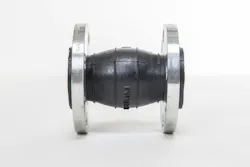
Rubber expansion joints remain the most economical and flexible option for moderate-temperature service. They generally top out well below the range where metal or PTFE take over. They excel at absorbing vibration and noise in HVAC and general utility piping. Pushed above their temperature rating, though, rubber degrades fast: it loses elasticity and starts to crack.
Composite and fabric expansion joints are often built from layers of engineered textiles with elastomeric or PTFE coatings. They are frequently the right answer for large-diameter, low-pressure ductwork carrying hot gas, such as exhaust and flue gas systems in power generation and pulp and paper operations, where a metal bellows of the same diameter would be heavy and costly.
None of these categories is universally correct. The right material depends on the interaction of temperature, pressure, chemical exposure, movement requirements, operational environment conditions and cost. Getting that interaction wrong is one of the more common root causes behind premature failure.
Design considerations and thermal stress analysis fundamentals
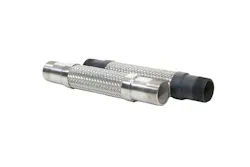
Selecting the right material only pays off if the surrounding system is designed to work with it. Piping systems expand and contract as a function of temperature change, length and the coefficient of thermal expansion of the pipe material, and that movement has to go somewhere. Anchors, guides and supports are used throughout a piping run to direct that movement toward the expansion joint or flexible connector rather than letting it load a flange, a nozzle or a piece of rotating equipment.
A properly engineered system accounts for the full range of anticipated movement, including axial, lateral and angular components, and specifies a joint or hose with enough travel to absorb that movement without exceeding the manufacturer's rated limits. Thermal stress analysis, whether done with simplified calculations for straightforward runs or full computer modeling for complex piping, confirms that the loads transmitted to anchors and connected equipment stay within acceptable limits across the full operating temperature range, not just at steady state.
Two design mistakes show up repeatedly in failure investigations. The first is treating the expansion joint or hose as a flexible fix for a piping layout problem rather than as an engineered component with its own limits. The second is failing to account for the full thermal cycle, including startup and shutdown transients, which can impose more severe movement and stress than the steady-state operating condition the system was designed around. A joint specified only for the pipe's normal operating temperature may see far more movement, and far more fatigue, during the repeated startups and shutdowns typical of batch or seasonal operations.
Maintenance protocols and failure prevention
Because thermal fatigue accumulates gradually and often invisibly, an inspection program built around visible leaks or obvious damage catches problems too late to prevent unplanned downtime. That approach generally includes a few core practices. Facilities benefit from maintaining an inventory of installed hose assemblies and expansion joints, including material, size, rated temperature and pressure, and installation date, so that age and duty cycle can be tracked. Scheduled visual inspections should look specifically for early indicators of fatigue and degradation: surface cracking at convolution roots, cover wear or delamination on hose assemblies, external corrosion and signs of misalignment or restrained movement such as witness marks on adjacent structures. Where duty cycles are severe, or the consequence of failure is high, some facilities supplement visual inspection with periodic thickness measurement or more advanced nondestructive testing to catch subsurface degradation before it becomes visible.
Installation practices matter as much as the inspection program that follows. Expansion joints and hose assemblies installed out of alignment, or without the specified live-loading on flanged connections, start their service life at a disadvantage that no amount of later inspection can fully offset. Hose assemblies should not be torqued or twisted during the installation process. Confirming proper installation at commissioning, and again after any process upset or maintenance activity that involved disturbing the piping, closes a gap that otherwise persists for the life of the component. Proper handling is also critical prior to installation. Hoses should be properly supported during the installation process to prevent undue stress on individual components and to prevent abrasion damage from nearby equipment.
Finally, replacement planning should be driven by expected fatigue life and actual operating history rather than by a failure. Components operating at or near their temperature and movement limits, or those that have accumulated many thermal cycles relative to their rated fatigue life, are reasonable candidates for planned replacement during a scheduled outage rather than being left in service until they fail during a run.
A component worth the attention
Compressors and condensers earn their reputation as critical equipment because their failure modes are well understood and closely tracked. Flexible hose assemblies and expansion joints deserve the same level of attention, not because they cost more, but because the consequences of overlooking them, unplanned downtime, safety incidents and environmental releases among them, can be just as severe. A maintenance strategy that accounts for material limits, design fundamentals and fatigue life closes a gap that too many facilities do not know they have until it costs them a shutdown.
About the Author
 Trey Travis
Vice president of operations at Southeastern Hose, Inc.
Trey Travis is vice president of operations at Southeastern Hose, Inc., a third-generation, family-led manufacturer and fabricator of hose assemblies, expansion joints and related industrial solutions based in Bremen, Georgia. Having grown up in the family business and worked his way from the factory floor into executive leadership, he brings hands-on insight into manufacturing operations, inventory control, client relations and the realities of industrial business leadership. He holds a Bachelor of Business Administration from Auburn University.