Weighing and batching of bulk solids
Key Highlights
- Match weighing technology to required accuracy, material value, and process needs.
- Volumetric feeders work well when bulk density remains consistent and precision is less critical.
- Continuous loss-in-weight feeders provide the highest accuracy for critical or expensive ingredients.
- Combining multiple weighing methods can optimize both process performance and equipment costs.

Bulk solids are a critical ingredient in most of the products we all buy and use. In manufacturing processes, dry ingredients are often weighed and combined in the correct proportion with the other ingredients. This article will describe the various techniques for weighing and batching solid ingredients in your process.
Volumetric feeding: When simple dispensing is enough
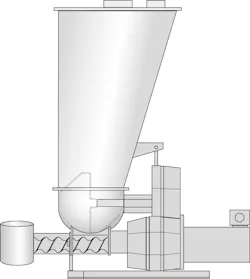
The simplest method of dispensing bulk solid ingredients uses a volumetric feeding device, such as a screw feeder (Figure 1) or rotary valve, that dispenses a certain volume of material without weighing it. The dispensing rate of a volumetric feeder is determined by its size and rotation speed. Volumetric feeders are simple and low-cost because they don’t have any controls other than a Variable Frequency Drive (VFD) to adjust the motor's rotational speed.
Volumetric feeders can be calibrated by catching and weighing a sample of material for a measured amount of time and adjusting the speed accordingly. They can be reliable and consistent as long as the properties of the material being fed, especially its bulk density, remain consistent. Production plants use volumetric feeders when the material is fairly consistent, a high level of accuracy is not required, and an accurate accounting record of the material use is not necessary. For example, volumetric feeders are often used to feed regrind or reprocessed material into a mixer or extruder when the exact rate is not critical.
Several factors can cause material changes that affect accuracy. For example, powders might flow consistently into the feeder on a dry day but less consistently when the air is humid. In addition, aeration and fluidization can reduce the bulk density of many powders. Another factor is consolidation weight, where material in the top of the hopper pushes down on the material at the bottom of the hopper, increasing its bulk density. Any factor that changes the bulk density of the material will change the weight output of a volumetric feeder.
Load cells improve weighing accuracy
When a simple volumetric feeding device is inadequate, load cells can be added to support the feeding assembly and measure its weight. A load cell is a type of transducer that converts force (weight pushing or pulling on it) into an electrical signal that can be measured and sent to a controller.
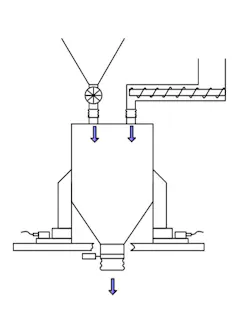
In a simple, common configuration, several load cells are used to support a hopper, as shown in Figure 2. Load cells are rated for the amount of weight they can handle. To obtain the best accuracy, choose the smallest load cells that cover the full weight range of the application. For example, if the total weight will range up to 1,200 lbs., then a good choice would be to support the assembly with three load cells rated at 500 lbs. each, for a total capacity of 1,500 lbs. Also, note that the load cells will support and weigh the entire unit, not just the contents, so the load cells need to be rated for the combined weight of the hopper, its ingredients, and everything attached to the hopper.
Furthermore, the hopper’s support system should be designed so that the only force imparted on the load cells comes from the weight of the vessel and its contents. In other words, the assembly needs unrestrained movement up and down, so that nothing supports it except the load cells. If another device, such as piping, is rigidly attached, it will help support the hopper and take some of the weight off the load cells. That is why inlets and outlets have flexible socks or boots, which keep the material in but do not impart loads on the assembly. The same idea must be used with everything that is connected, including compressed air piping, dust extraction ducting, and even electrical conduit.
Gain-in-weight batching for efficient ingredient loading
As Figure 2 shows, solid ingredients can be loaded into the top of a weigh hopper using different types of feeding devices. These include screw feeders, rotary valves, or even simple open/close knife gates or butterfly valves. Normally, to achieve the best cycle time, the operator will load most of the material quickly at a high fill rate, then, as the fill level approaches the desired weight, the controls will automatically switch from “fast speed” to “dribble speed” to improve accuracy control during the last 5-10% of the weigh cycle.
Additionally, the controller must account for material that is falling but has not yet settled onto the load cells. That is, once the feeder is stopped, some material will still fall from the feeder into the hopper. Therefore, the feeder needs to stop at a “pre-act” point to allow for in-flight material. These factors can be learned during startup and tweaked in the control logic during the system's startup commissioning.
The weighed material sits in the hopper until needed by the process, then the hopper is completely emptied. Since many materials are sticky or tend to bridge, a steep hopper, large discharge opening, or flow aid devices may be needed to ensure complete discharge of the weighed material.
Loss-in-weight batching for controlled discharge
Sometimes, emptying the hopper completely will not work well for the application. In these cases, a loss-in-weight batch hopper can be used, where the hopper is filled first, then the weight is measured as the material discharges. As the loss-in-weight reading approaches the desired amount, the discharge device can again switch from fast speed to dribble speed to achieve better control and accuracy.
Integrating weighing with conveying systems
Frequently, gain-in-weight or loss-in-weight capability can be built into equipment that will be needed anyway, which reduces the system’s capital cost and complexity. For example, a pneumatic conveying system’s destination filter receiver can be placed on load cells so the contents can be weighed. This will not achieve the highest accuracy, but it is often good enough for major ingredients, or it can serve as a check-weigh to make sure everything is working properly.
Continuous weighing improves small ingredient accuracy
The methods described up to this point are appropriate for batch processes in which each ingredient is weighed and then dispensed into the process according to a recipe. For example, a Kansas school cafeteria's favorite cinnamon roll mixture has 100 lbs. of flour, 10 lbs. of brown sugar, 1lb. of butter, 2.5 lbs. of dry milk powder, and 1.25 lbs. of cinnamon. A much less tasty batch of PVC might have 200 lbs. of resin, 30 lbs. of mineral filler, 12 lbs. of stabilizer, and 2 lbs. of stearic acid. Each ingredient is weighed and then dispensed into a mixer.
As these examples show, most recipes call for a large range of ingredient weights. The scaling methods previously described provide acceptable accuracy for large amounts but may not be adequate for precise measurement of minor ingredients that are often potent and expensive.
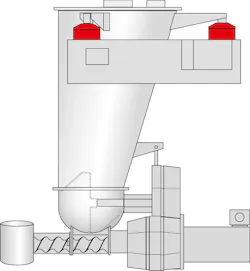
The most sophisticated and expensive weighing feeders use a feeding device such as a screw auger attached to the bottom of a hopper of material. The entire assembly (feeder, hopper, and its contents) is then weighed by supporting it on load cells, as shown in Figure 3. A sophisticated scaling and process controller is required to measure the weight as material is dispensed over time, adjusting the feeder's speed faster or slower to control the discharge rate. The weighing controls are sensitive and precise enough to weigh even small amounts accurately.
However, when the feeder needs to be refilled while operating, fresh material dropping into the hopper causes the scale reading to jump around. Moreover, material weight is added at the top while simultaneously being dispensed from the bottom, and the controller cannot resolve between the two. Therefore, the controls typically ignore the weight signal during refill, and the screw must temporarily go into volumetric mode rather than gravimetric mode as the hopper refills. It is undesirable to run in volumetric mode for very long, however, so many suppliers require rapid refill and large hoppers, so they don't need to be refilled very often.
Fortunately, controls have improved significantly over the years. For example, instead of just using an average speed when operating in volumetric mode during refill, modern controllers learn how rotation speed changes during each refill and empty cycle. They then use that information to automatically adjust the speed to accommodate for the expected variation as the material height in the hopper changes during the refill cycle. Furthermore, the controls are increasingly able to distinguish between and compensate for regular but undesired inputs such as vibration and the impact of falling material.
Sophisticated controls and drives also allow a large turn-down ratio. That is, they can operate at a fast speed, or very slow speed, or anywhere in between without overheating or stalling.
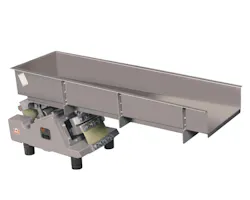
Screw augers are the most common feeding devices used in continuous loss-in-weight feeders. But screws do not work well with all materials, so some feeders use different mechanisms such as vibrating trays instead of screws, as shown in Figure 4.
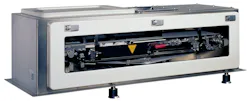
Yet another type of continuous gravimetric feeder uses a conveyor belt to dispense the material. In a continuous weigh-belt feeder, as shown in Figure 5, one section of the belt is supported by load cells. If the weight of the material on the belt and the belt speed are both known, then the two figures are multiplied to derive the gravimetric feed rate. The controller compares this rate to the desired rate and adjusts the belt speed faster or slower to achieve the right throughput.
Selecting the right bulk solids weighing method
This article has described many methods for weighing and batching. But how do you know which one to use? In general, you should choose the least expensive method that meets your accuracy and process requirements. In many cases, this means you will use several different methods within your plant to handle the various materials and process needs.
Finally, if your operation is continuous rather than a batch process, then your materials will need to be fed continuously. Volumetric feeding can be used rather than weighing whenever accuracy and weight recording are not required. Otherwise, you will need continuous feeders such as weigh-belts or continuous loss-in-weight feeders.
The good news is that many options are available, and equipment suppliers are good at helping you choose the best equipment for your application. Furthermore, you can use any combination of methods to achieve the desired result at the lowest cost.
About the Author
 Todd Smith
Todd Smith
Todd Smith is a bulk solids expert who helped manage Kansas State University's Advanced Manufacturing and Bulk Solids Technology Center (BSTC) from 2019 to 2025. The BSTC is the only university-centered facility and staff in North America dedicated to helping industry with bulk solid challenges and education. Previously, Todd spent nearly forty years in industry working with bulk solids — first at four DuPont plants, then at Mac Equipment and Coperion K-Tron.