Emerson and SiMa.ai collaborate to bring advanced AI to industrial edge environments
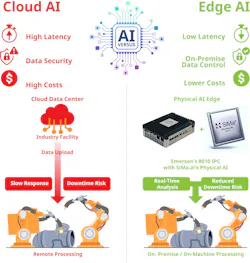
ST. LOUIS (May 26, 2026; Emerson release) – Global automation leader Emerson announced it is collaborating with SiMa.ai, a leader in Physical AI, to deliver advanced AI capabilities for real-time data analysis on Emerson's industrial PCs in the harshest industrial field environments, on the factory floor and at remote sites.
The global industrial AI market reached $43.6 billion in 2024, and according to IOT Analytics, is anticipated to grow at a CAGR of 23% through 2030 to reach $153.9 billion . A key part of this growth will be AI technology at the industrial edge, empowering companies to analyze data and physically intervene instantly – detecting problems, optimizing quality, taking corrective action and engineering autonomous operations – all without relying on cloud connectivity. Workloads that previously required offline engineering studies, dedicated analytics servers or roundtrips to the cloud now run alongside core processes, turning the IPC into an always-on industrial intelligence platform.
“As operations teams leverage Physical AI at the edge, they move beyond simple monitoring to closed-loop autonomy where they can adjust processes in real time – minimizing product defects early in the production phase, reducing waste and increasing production efficiency,” said Krishna Rangasayee, SiMa.ai. chief executive officer.
SiMa.ai's MLSoCTM (Machine Learning System on Chip) provides the high-performance compute and industry-leading power efficiency necessary for Emerson's industrial PCs to support Physical AI workloads in real time. By maximizing throughput while maintaining a low thermal footprint, the technology allows for faster decision making and robust security, keeping sensitive proprietary data secure and on-premise across vital operations.
Benefits include:
- Autonomous safety: Detect gas and liquid leaks, fire and smoke, unauthorized access and equipment anomalies in real time and in harsh environments where high-speed vision inspection has not been possible.
- Increased productivity: Enjoy higher overall equipment effectiveness (OEE) by continuously improving uptime, performance and quality.
- Enhanced reliability: Ensure operational continuity in mission-critical systems in remote locations (like upstream oil and gas or mines) with limited connectivity.
- Improved product quality: Detect defects during inline product quality inspections during production and adjust parameters instantly to prevent waste.
- Reduced CapEx: Identify equipment degradation before failures occur, minimizing costly downtime and capital expenditures for new equipment.
- Optimized resources: Continuously improve energy use, compressed air systems and material efficiency to reduce the need for human supervision in unsafe environments.
- Air-gapped installations: Provide autonomous AI capabilities in critical air-gapped infrastructures using highly secure industrial control systems in industries like nuclear, power, water and other mission-critical installations.
"As organizations accelerate their journey toward autonomous operations, the ability to deploy intelligent capabilities at the edge with industrial-grade reliability and security is essential," said Ram Krishnan, chief operating officer of Emerson. "Our partnership with SiMa.ai brings specialized AI computing technology to our industrial PCs that – combined with our integrated sensor technology, edge software and enterprise analytics – delivers the complete AI solution industrial organizations need not just to compete today, but also to thrive well into the future."
Emerson is the only provider offering an integrated, end-to-end technology stack for industrial AI across the enterprise – including smart sensors delivering performance data for AI analysis and on-device edge computing; IIoT-ready SCADA/HMI platform and software that routes intelligence for quick interventions; and enterprise analytics for optimizing operations.
Emerson’s industrial PCs with SiMa.ai technology deliver high performance and AI-accelerated computing power in a compact, ruggedized platform that can withstand high vibration and shock and temperatures ranging from -40 degrees Fahrenheit to 140 degrees F (-40 degrees to 70 degrees Celsius). They also enable practical AI applications across both discrete and process industries including compressed air and energy usage optimization, waste management, packaging, automotive machine efficiency, semiconductor manufacturing and oil and gas applications such as wellhead management and flare monitoring.