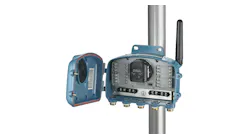
Beyond the control room: How WirelessHART expanded operational intelligence at SRF
Key Highlights
- WirelessHART monitors nitrogen, instrument air, cooling water, chilled water, storage areas and tank farms.
- SRF tested reliable communications at distances up to 1.5 km from the control room.
- The self-organizing, self-healing mesh supports resilient connectivity across a large chemical manufacturing site.
- Wireless data informs condition monitoring, equipment health analytics, alerts and maintenance planning.
- SRF is expanding wireless data integration as part of its broader IIoT and digital operations strategy.

At SRF’s specialty chemical processing facility in Dahej, Gujarat, India, a particular focus has been the practical deployment of wireless technologies to improve operational visibility in areas where traditional wired instrumentation would be difficult, expensive or impractical to install. Rather than adding large numbers of monitoring points directly into core automation systems, SRF has used WirelessHART to extend operational intelligence across utility systems, remote storage areas and tank farm applications throughout the facility.
Today, WirelessHART is primarily used for remote monitoring applications including nitrogen, instrument air, cooling water and chilled water utility systems, along with instrumentation installed in tank farms located hundreds of meters away from primary process units. These deployments provide operations and maintenance teams with real-time visibility into remote assets while reducing manual data collection and minimizing infrastructure costs associated with traditional wired installations.
The technology has also enabled SRF to support broader monitoring, asset management and operational optimization initiatives by providing reliable access to field data from previously difficult-to-monitor locations. Its self-organizing and self-healing mesh network architecture has proven particularly valuable in maintaining reliable communications across large chemical manufacturing environments, including installations with communication distances approaching 1.5 kilometers from the control room.
Building operational intelligence across a large manufacturing site
The SRF Dahej facility produces a wide range of specialty chemical products including fluorochemicals, chemical intermediates, pharmaceutical intermediates and agrichemical treatments across the 300-acre site. Within SRF’s global manufacturing network, Dahej is among the company’s most technologically advanced facilities and frequently serves as a development location for automation strategies and operational technologies later deployed across other plants.
Typically, Dahej has three to four products actively being produced at any given time, with some operating on a long-term basis and others through shorter production campaigns. Maintaining efficient turnaround sequences and operational flexibility is critical to sustaining profitability. Intelligent field devices play a central role in improving both operational performance and plant safety.
Across the site’s 30 production and utility units, more than 70,000 field instruments are deployed, including over 40,000 smart devices communicating through HART, WirelessHART and FOUNDATION Fieldbus technologies. This infrastructure supports advanced diagnostics, IIoT initiatives and extensive operational data gathering while reflecting more than 15 years of continuous modernization.
Within this broader digital infrastructure strategy, WirelessHART has become an important technology for extending operational visibility beyond traditional process instrumentation.
Solving remote monitoring challenges
SRF’s operations include both fixed and multipurpose chemical plants where process conditions and production requirements can change frequently. In these environments, flexibility is essential. The company continuously looks for practical ways to improve monitoring coverage, reduce manual intervention and safely collect operational data from areas where traditional wired instrumentation would be difficult or impractical to install.
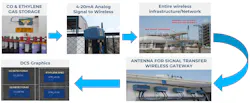
One project that demonstrated the strength of the technology involved an ethylene storage area located more than 1.4 kilometers from the main control room. During implementation, the team tested WirelessHART communication distances up to 1.5 kilometers and achieved highly reliable performance without signal loss or communication instability.
For remote monitoring applications, this provided a practical alternative to costly wired infrastructure while significantly improving operational visibility. The ability to economically deploy monitoring points in difficult-to-access locations has become one of the major operational advantages of WirelessHART at SRF facilities.
Measurable operational benefits
Over the past decade, SRF’s WirelessHART deployments have steadily evolved from targeted remote monitoring projects into a broader operational intelligence platform supporting safety, maintenance, productivity and digitalization initiatives across the facility.
The operational benefits have extended well beyond instrumentation connectivity alone. According to SRF’s operational improvement initiatives, WirelessHART-enabled applications have contributed to:
- Improved worker tracking and workforce visibility in remote operating areas
- Enhanced plant safety through improved monitoring coverage and faster access to operational information
- Productivity improvements approaching 30% in selected operations and maintenance workflows
- Cost savings of approximately 11% through reduced infrastructure requirements, improved maintenance planning and minimized manual intervention
- Faster project startup and commissioning activities, with some deployments reducing startup-related effort by nearly 70%
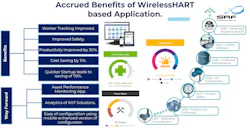
These benefits have accumulated progressively as SRF expanded WirelessHART deployments across utilities, remote storage areas, tank farms and asset monitoring applications. The company’s implementation roadmap has evolved from early capex savings and quicker startup initiatives into broader reliability improvement, predictive maintenance, worker safety and IIoT enablement programs.
Today, WirelessHART data also supports plant-wide operational intelligence applications including condition monitoring dashboards, equipment health analytics, critical alert management and integrated computerized maintenance management system (CMMS) initiatives.
Building reliability through mesh networking
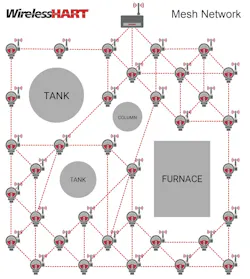
One of the most significant advantages SRF has experienced with WirelessHART is its self-organizing and self-healing mesh network architecture. In chemical manufacturing environments where communication reliability is essential, the network becomes more robust as additional devices are added.
If an individual transmitter experiences a battery issue or temporarily goes offline, the remaining network continues operating without interruption. This resilience is particularly valuable in process manufacturing operations where operational visibility directly impacts both plant safety and uptime.
Another significant advantage of adopting WirelessHART is that it is an open international standard (IEC 62591) maintained by the FieldComm Group. Its vendor-independent architecture enables seamless interoperability with automation systems from multiple suppliers. This allows SRF to continue its multi-vendor automation strategy while implementing a common, standardized approach to wireless instrumentation, asset monitoring and diagnostics across different plants and applications.
WirelessHART’s standardized approach also supports SRF’s broader asset management initiatives. Using Emerson AMS and HART-enabled diagnostics, instrumentation teams can remotely monitor device health, battery condition, configuration status and communication quality. This enables proactive maintenance practices while simplifying device management activities across the plant.
From a workforce perspective, adoption has also been straightforward. Because HART is already widely established throughout the process industries, training requirements have remained relatively minimal in comparison with introducing entirely new technologies. Technicians are already familiar with the tools, diagnostics and configuration methods, helping accelerate deployment, commissioning and troubleshooting activities.
Engineering considerations
As with any industrial wireless technology, successful implementation requires proper engineering practices. Site studies for metal obstructions, network layout, line-of-sight considerations, update rates and coexistence with other wireless systems must all be carefully evaluated during design and commissioning.
At SRF, update rates are determined based on application requirements to balance responsiveness with battery life. Slower-moving tank level applications may use longer update intervals, while utility pressure monitoring applications often require more frequent updates.
Currently, most WirelessHART deployments at SRF are focused on monitoring and indication applications rather than closed-loop control. However, the company continues evaluating future opportunities where wireless feedback and control functionality may support additional operational improvements.
The way forward
Looking ahead, SRF continues expanding the role of WirelessHART as part of a broader IIoT and operational intelligence strategy. Future initiatives include expanded asset performance monitoring applications, broader analytics platforms for IIoT-based operational insights and simplified mobile-enabled device configuration tools that improve field usability and technician efficiency.
The company also continues integrating WirelessHART data into predictive maintenance systems, centralized monitoring applications and future CMMS and digital operations initiatives designed to improve reliability, maintenance planning and operational responsiveness.
As SRF evaluates future technologies such as Ethernet-APL and next-generation digital infrastructure, WirelessHART remains a practical and proven foundation for rapidly extending operational intelligence throughout the facility while supporting long-term digital transformation objectives.
About the Author
 Dr. Jagdish Pranami
Associate vice president at SRF Limited
Dr. Jagdish Pranami is an associate vice president at SRF Limited. He leads engineering, maintenance, project execution and digitalization initiatives across more than 25 manufacturing plants, overseeing over 120,000 assets and driving large-scale adoption of Industry 4.0 and IIoT technologies. Dr. Pranami is also a member of the Board of Governance of Automation Expo, and a recognized digital transformation thought leader who has spoken at more than 20 national and international conferences.