Mastering flow measurement technologies in interactive plant environments
Key Highlights
- IPEs offer a safe, operational environment for hands-on training in flow measurement technologies, bridging the gap between classroom theory and field application.
- Students gain practical experience with five core flow technologies, learning to select, configure, and troubleshoot instruments like DP, vortex, Coriolis, magmeters, and ultrasonic flowmeters.
- Real-world troubleshooting exercises in IPEs help trainees develop critical problem-solving skills, preparing them for live plant challenges with minimal risk.
- The immersive environment promotes collaborative learning among diverse experience levels, enhancing knowledge sharing and workforce development.
- Modern training tools like IPEs are essential for evolving industry needs, reducing risks, and accelerating workforce competency in increasingly sophisticated process plants.
As seasoned engineers, technicians and operators retire in droves, the process industries must continue finding effective ways to capture and build on their invaluable and hard-earned expertise to maintain industrywide progress. Simultaneously, plants are adopting increasingly sophisticated technologies that improve measurement accuracy and processing capabilities, but these advancements can also introduce new complexities.
As discussed in the previous article in this two-part series, this convergence of factors has created a palpable skills gap. While teaching foundational skills — such as how to read a piping and instrumentation diagram (P&ID), calculate process values based on electronic signals and specify optimal instruments for a specific process — in a classroom is important, it can never match the effectiveness of lessons learned on-the-job. However, interactive plant environments (IPEs) address this limitation.
By offering fully operational, pilot-scale process plant environments designed exclusively for training, an IPE provides a controlled atmosphere, without the safety and financial liabilities found in live facilities. This follow-up article installment delves into five widely applicable flow technologies that students can master in these dynamic environments, and it provides real-world user attestations describing how IPEs have benefited their teams.
Five core flow measurement technologies
Inside an IPE, attendees from end user, system integrator and engineering companies roll up their sleeves to gain practical experience with some of the process industries’ most pervasive measurement and control technologies, and flow is one of the most nuanced variables to master. Emerson’s Boulder, Colorado, IPE gives students the opportunity to experiment with five flow instrument variants, helping them glean not only how flow meters work in theory, but how to effectively select, configure and troubleshoot different types in the field.
Differential pressure (DP) flowmeters
The first differential pressure flowmeter was invented in the 18th century before most of today’s process industries even existed. These instruments operate using Bernoulli’s principle, which describes the inverse relationship between fluid velocity and pressure. By placing a restriction — such as an orifice plate — inside a pipe, the meter creates an intentional pressure drop, and the pressures measured immediately upstream and downstream of the restriction are used to determine the flow rate.
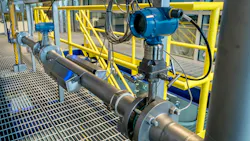
Working with DP meters in the IPE, trainees quickly discover the configuration flexibility, high reliability, cost efficiency and minimal calibration requirements of this technology. However, they also experience DP meters’ physical constraints, such as their restriction on measuring fluids with entrained gases (Figure 1).
While the minor flow and pressure impedance caused by a DP meter’s obstruction is not suitable in some sensitive and high-precision applications, this method provides a simple and reliable means of measuring flow in many environments.
Vortex flowmeters
Vortex flowmeters are a frequent choice in utility applications, particularly for measuring steam. These instruments leverage the Von Karman Effect, whereby a repeating pattern of swirling and alternating vortices are shed downstream of an intentionally placed obstruction in the process stream. The sensor measures the frequency of these vortices, which is directly proportional to the process media’s velocity, and this figure is converted to flow rate based on pipe dimensions (Figure 2).
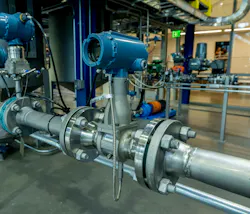
In the IPE, operators become familiar with a vortex flowmeter's robust ability to measure gases, liquids and steam at high temperatures. Because these instruments have no moving parts, they are easy to install, often functioning as low-power 2-wire devices. However, vortex meters are limited to unidirectional flow measurement, and their accuracy decreases when measuring highly viscous fluids.
Coriolis flowmeters
When accuracy is a critical priority, system designers often specify Coriolis flowmeters for their applications, which measure tube oscillations to calculate flow. As process media moves through the flow tubes of a Coriolis meter, it creates an oscillatory phase shift that corresponds to mass flow, while the frequency of oscillation indicates its density.
Trainees observe Coriolis meters’ best-in-class measurement firsthand. These instruments require minimal maintenance, and no straight pipe runs are needed upstream and downstream of the meter. They also excel at measuring flow with entrained gas (Figure 3).
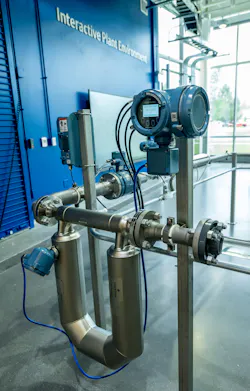
However, these instruments can be a bit bulky, they are not typically suited for pipes larger than 16 inches in diameter and some designs also cause pressure drops. Because of their pinpoint precision, Coriolis flowmeters are frequently installed in custody transfer and batching applications.
Electromagnetic flowmeters
Electromagnetic flowmeters (magmeters) utilize Faraday’s Law of Electromagnetic Induction, whereby a magnetic field is applied across the metering tube to induce voltage as conductive process media moves through it. The voltage magnitude is measured, which is directly proportional to the fluid's velocity through the pipe (Figure 4).
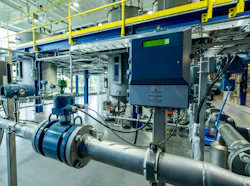
Magmeters offer versatility in processes with conductive process media, hence their popularity in water treatment and chemical metering applications. However, nonconductive or variable conductivity process media cannot be accurately measured using magmeters.
Non-intrusive, clamp-on ultrasonic flowmeters
Installing most flowmeters requires making mechanical modifications to a pipe, which is especially prohibitive when retrofitting existing applications. Non-intrusive clamp-on ultrasonic flowmeters directly address these sorts of scenarios.
Ultrasonic flow measurement uses the transit time difference method, in which two or more ultrasonic sensor pairs act alternately as transmitters and receivers. The ultrasonic signal is accelerated when traveling in the direction of the flow and slowed when moving opposite the flow, and the time difference between these two signals is proportional to the flow velocity.
Because there is no direct contact between sensor and process media, this non-contact method increases safety, particularly in applications with corrosive or toxic fluids, leakage risks and high pressures. However, their position outside the pipe can limit the accuracy of some models by a small factor compared to other technologies, and internal pipe buildup and certain liner materials can disturb the signal (Figure 5).
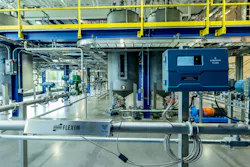
These flowmeters are common in data center process cooling applications with numerous measuring points because they are versatile over a wide range of fluids and pipe sizes, and they support retrofits without needing to cease operations.
Real-world troubleshooting in a safe setting
In an IPE, students familiarize themselves with these and many other common plant assets in a hands-on environment where training is conducted actively. Unlike traditional classroom settings where learning ends when the lecture concludes, IPEs provide an engaging "break it, then fix it" methodology.
Trainees begin in a traditional classroom where they establish theoretical foundations, but they quickly step out onto the fully operational pilot plant floor. With the process actively running — circulating air and water through the piping loops — the instructor intentionally breaks the system or alters parameters to emulate problems that often occur in live plant settings, which trainees must troubleshoot and resolve.
Students are then handed a work order and tasked with diagnosing and repairing the issue. For instance, water might clearly be flowing through the pipes, but no flow displays on the human-machine interface (HMI) (Figure 6). Is the instrument powered? Is there a bad wiring connection? Is the low-flow cutoff set too high in the transmitter's configuration? The trainees must investigate and find the answers.
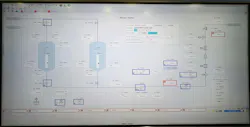
By using traditional tools and Emerson’s Plantweb Insight app to interface directly with both instruments and final control elements, such as control valves and pumps, trainees systematically trace issues from the physical pipe, through the instrument and into the control system architecture. This equips operators, technicians and engineers with troubleshooting experience in a controlled environment where mistakes are inconsequential, preparing them for live plant settings with much higher stakes.
In Emerson’s Boulder IPE, plant managers regularly note how fulfilling it is to see seasoned engineers pass around instruments and share contextual knowledge with new engineers on the IPE floor. One user noted that despite having a wide mix of experience levels represented in a course, every participant found immense value in collectively commissioning and troubleshooting the different instrument types. Additionally, these hands-on courses often demonstrate to individuals the depth of what they still can learn, prompting new advanced curriculums.
One systems integration firm recently shared that "the interactive plant provides a safe place to practice troubleshooting and configuration of different flow and measurement technologies. It is helpful to see the flowmeters installed as they would be used in the field and experience them in this interactive environment, not just on a piping and instrumentation diagram."
Users cover the entire real-world automation gamut in an IPE, starting with the field instruments and final control elements touching the process, moving to host controllers that collect and process electronic inputs and outputs, and wrapping up in real-time visual control interfaces and reporting dashboards.
Tailored learning for the modern workforce
The tools used in the process industries to train the workforce must evolve with changes in the industrial landscape. IPEs help move the industry away from siloed training toward holistic and immersive educational experiences, which are especially useful for improving literacy and comfortability around complex topics, such as flow measurement specification, installation and configuration.
These programs offer a plethora of structured courses, along with the ability for end users to design custom curriculums from numerous a la carte options. With an environment featuring the majority of modern instrumentation technologies deployed in today’s process plants, IPE training is a strategic investment that mitigates risk, accelerates competency, empowers the workforce and maximizes process efficiency.
About the Author
 Anthony Gentile
 Anthony Gentile
Customer experience manager at Emerson
Anthony Gentile is a customer experience manager at Emerson, with 21 years of expertise in Coriolis flow measurement. He holds a Bachelor of Science degree in Chemical Engineering and Petroleum Refining from Colorado School of Mines, and an MBA from Regis University.