How to prevent cavitation in hygienic pumps
Key Highlights
- Cavitation produces sharp, percussive noises indicating severe damage risk.
- Signs include flow fluctuations, suction-side vibration and visible pitting on wetted surfaces during teardown.
- Prevent cavitation by shortening and straightening suction lines, oversizing the inlet and maintaining clear strainers.
- Operating pumps at the lowest effective RPM reduces vapor bubble formation and prolongs pump life.
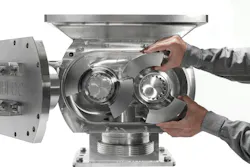
A cavitating pump tells you it is failing before the maintenance log does. The sound is unmistakable; the damage compounds quickly, and on a hygienic processing line, the consequences extend beyond the pump itself.
Cavitation is preventable. It starts with understanding what is happening inside the pump cavity, recognizing which type of cavitation is occurring and correcting the conditions that caused it.
What is cavitation and what problems does it cause?
Cavitation is the formation and collapse of vapor bubbles inside a pump, caused by the suction-side pressure dropping below the liquid vapor pressure. Bubbles form on the low-pressure side, travel into a higher-pressure region of the pump and collapse violently. Each implosion produces a microscopic shockwave that hits metal.
The damage compounds quickly. Pitting and erosion appear on rotors, gears, casings and seal faces. Flow and head drop, and the pump curve becomes unstable. Bearings and seals fail prematurely from the sustained vibration. Furthermore, in hygienic processing applications, the eroded surfaces become points where bacteria can collect and become a foreign-material risk, which elevates cavitation from a maintenance issue to a food safety issue with USDA and FSMA implications.
Frequently asked questions
What happens when a pump cavitates?
Vapor bubbles collapse inside the pump cavity, and each implosion sends a microscopic shockwave into metal surfaces. Over time, this causes pitting and erosion on rotors, gears, casings and seal faces, unstable flow and head, and premature bearing and seal failure from sustained vibration.
What is cavitation in a pump?
Cavitation is the formation and collapse of vapor bubbles inside a pump, caused by suction-side pressure dropping below the liquid's vapor pressure. Bubbles form on the low-pressure side, travel into a higher-pressure zone and collapse violently, sending microscopic shockwaves into metal surfaces. In hygienic processing, pitting caused by this activity can also create bacteria-harboring surfaces.
To avoid it, protect the suction side: shorten and straighten the suction line, oversize it relative to discharge, flood the pump inlet and run the pump at the lowest RPM the application allows.
Why is my pump losing flow?
Falling flow at rated RPM is one of the clearest signs of cavitation. As vapor bubbles form and collapse inside the pump, flow and head become unstable and discharge pressure fluctuates. Common root causes include high product temperature, undersized or long suction lines, clogged strainers and excessive suction lift. Adjusting length and size of the suction line and lowering pump RPM often addresses the issue effectively.
Does cavitation reduce pump efficiency?
Yes, cavitation reduces pump efficiency. It destabilizes the pump curve, causing flow and head to drop below rated performance. But the damage isn't limited to the impeller (rotor); the vibration and bubble-collapse energy travels through the shaft, pitting the seal faces (the polished rings that seal the shaft against leakage) and bearings as well. This damage compounds over time, further degrading pump efficiency, while also leading to unplanned downtime and a subsequent rise in maintenance costs.
How long can a pump run with cavitation?
A pump cannot run long with cavitation without consequence. Cavitation damage compounds quickly, and continued operation accelerates pitting, seal and bearing failure, and unstable flow. In hygienic processing, eroded surfaces also become a foreign-material and food safety risk.
What are the signs that your pump is cavitating?
Cavitation announces itself, and operators learn to recognize it within seconds. The most reliable signs are:
- It sounds like gravel running through the pump, or a jackhammer when it is really severe. The noise is sharp, percussive and rhythmic, not the smooth hum of a healthy pump.
- Suction-side vibration that travels back through the piping.
- Erratic discharge pressure and fluctuating flow.
- Lower-than-expected flow at rated RPM.
- Pitting on wetted surfaces visible at teardown.
- Premature seal and bearing failure
- Gear pumps are susceptible at high speeds and with thinner liquids but carry lower NPSHr than centrifugal designs at comparable duty.
- Lobe pumps are less susceptible than gear pumps at typical hygienic operating speeds. Larger pumping cavities, slower RPM, and the positive-displacement principle all help.
- Twin screw pumps are the most resistant of the rotary technologies. Smooth axial flow, large internal volumes and low pulsation produce a low NPSHr at the inlet, which makes twin screw a natural choice for low-NPSHr applications and products near their vapor pressure.
- AODD pumps do not cavitate in the classical sense. They suffer suction starvation instead — a different failure mode with similar root causes.
When an operator describes the sound as a jackhammer, the cavitation is intense enough that damage is already accumulating.
Three types of cavitation in hygienic positive displacement pumps
Cavitation can have several distinct forms. Three apply directly to the positive displacement pumps used in hygienic processing. Recognizing the type tells you where to look for the fix.
Vapor cavitation. This is the classic cavitation mode. Vapor cavitation occurs when the suction-side pressure drops below the liquid's vapor pressure, causing the product to flash into vapor inside the pump cavity. Common causes include high product temperature, long or undersized suction lines, clogged strainers, excessive suction lift and pumps running faster than the application allows. The jackhammer sound and pitting on the suction side of rotors or gears are signatures of vapor cavitation.
Air aspiration cavitation. This is caused if air enters the pump through a leak on the suction side, a low liquid level in a supply tank or a damaged shaft seal. The air bubbles behave like vapor bubbles inside the pump and collapse with the same destructive effect. In hygienic operations, this type often shows up during clean-in-place (CIP) transitions, tank changeovers and product run-out, when the suction line briefly draws air instead of product.
Turbulence cavitation. Turbulence cavitation is caused by sharp transitions, partially closed valves or restrictive fittings on the suction line that create local low-pressure zones inside the flow stream. The product turns turbulent enough to flash into vapor before it reaches the pump.
How to prevent cavitation
Most cavitation problems can be solved on the system side.
- Shorten and straighten the suction line.
- Oversize the suction relative to the discharge.
- Reduce fittings, especially elbows and partially closed valves.
- Flood the suction side by installing the pump below the inlet line.
- Maintain strainers and clear filters before they restrict flow.
- Hunt down suction-side air leaks aggressively, including past worn shaft seals.
- Size suction conditions for the hottest operating temperature: Higher temperature raises vapor pressure, which lowers available net positive suction head (NPSHa) and shrinks its margin over the pump's required NPSH (NPSHr), increasing cavitation risk.
The often-overlooked prevention strategy involves pump operation. Run the pump at the lowest RPM the application allows. Lower speed reduces NPSHr and gives the suction side more margin. In addition, specify a pump with documented low NPSHr at the operating point. Shear-sensitive, viscous, hot or particulate-laden products are usually better served by positive displacement pump technology than by centrifugal designs, which are most vulnerable to vapor cavitation under hygienic operating conditions.
About the Author
Calle Danielsson
Engineer with Unibloc Hygienic Technologies
Calle Danielsson is a sales engineer with Unibloc Hygienic Technologies, a manufacturer focused on sanitary pumps for food and beverage, pharmaceutical, bakery and confection, meat and poultry, brewery and transportation environments. He specializes in helping customers select the ideal pump for an application.