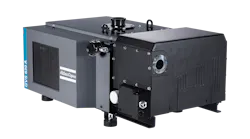
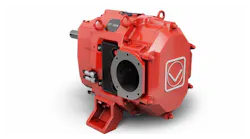
Rotary vane vacuum pumps: How they work and why they matter
Key Highlights
- A rotor and sliding vanes trap, compress, and expel gas to create a steady vacuum.
- Oil-sealed pumps offer deep vacuum and reliable operation, while dry-running models avoid oil contamination.
- Pump selection involves balancing vacuum performance, maintenance needs, operating costs, and process cleanliness.
- Applications include laboratory equipment, heat treating, medical devices, food packaging, HVAC, and aerospace.
- Compact design, dependable performance, and cost-effectiveness have made rotary vane pumps a long-standing vacuum technology.
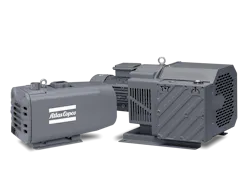
In the world of vacuum technology, there are only a few components that are as resourceful and widely used as the rotary vane vacuum pump. From laboratories to industrial manufacturing lines, these devices silently power processes that rely on a controlled, reduced-pressure environment. But how exactly do rotary vane vacuum pumps work, and why have they remained a core in so many industries for over a century? In this article, we will explore the inner workings, applications and advantages of these essential machines.
What is a rotary vane vacuum pump?
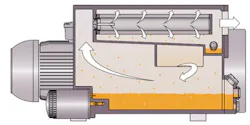
At its core, a rotary vane vacuum pump is a type of positive displacement pump. It works by trapping a volume of gas and mechanically reducing its volume to expel it from an exhaust port, creating a vacuum. The name “rotary vane” comes from the key components of the design: vanes mounted in a rotating rotor that moves inside a cavity.
This simple mechanism offers surprising power and consistency. Rotary vane pumps can achieve vacuum levels down to 0.1 mbar (millibar) or even lower in some oil-sealed configurations, making them suitable for a wide range of applications.
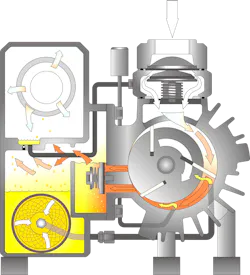
The mechanics: how it works
To understand how a rotary vane vacuum pump functions, it helps to picture its internal components:
- Cylindrical housing (stator): This is the stationary chamber inside which the pumping action occurs.
- Rotor: Offset from the center of the cylindrical housing, the rotor spins at high speed.
- Vaned blades: These typically slide freely in slots within the rotor, and they press outward against the housing walls due to centrifugal force.
- Inlet and outlet ports: These allow air or gas to enter and exit the pumping chamber.
Here is a simplified step-by-step of what happens during one full rotation:
- As the rotor spins, the vanes extend outward, maintaining contact with the inner walls of the chamber.
- This action creates a series of variable-volume compartments between the rotor, the vanes and the stator.
- When a compartment aligns with the inlet port, it expands, drawing in gas from the application area (the vacuum chamber).
- As the rotor continues to spin, the compartment is sealed off from the inlet and its volume decreases.
- The trapped gas is compressed until it reaches the outlet port, where it is expelled against atmospheric pressure.
This continuous process results in a steady suction at the inlet, creating and maintaining a vacuum in the connected system.
Oil-sealed vs. dry rotary vane pumps
Rotary vane vacuum pumps come in two main types: oil-sealed and dry-running. Each has its own advantages depending on the application.
Oil-sealed pumps
These are the most common type and are favored for their high vacuum performance and reliability. The oil serves several purposes:
- Lubrication: Reduces friction and wear on moving parts.
- Sealing: Improves the airtightness of the rotor-chamber interface.
- Cooling: Dissipates heat generated during compression.
- Corrosion protection: The oil coats internal components, shielding them from reactive or corrosive gases that might otherwise cause damage to metal surfaces.
The downside is that oil needs regular maintenance and can become contaminated if the pumped gas contains reactive or particulate matter.
Dry-running pumps
In dry rotary vane pumps, no oil enters the pumping chamber. Instead, materials such as carbon or high-grade plastics are used for the vanes, which require minimal lubrication. These are ideal for applications where oil contamination must be avoided, such as in pharmaceutical production or certain lab procedures. However, they typically do not reach as deep a vacuum as oil-sealed models and may wear faster in harsh environments.
Oil-sealed rotary vane pumps typically have lower upfront costs and are well-established for applications needing deep vacuum. However, they incur higher life cycle costs due to:
- Regular oil changes and disposal
- Maintenance of seals and filters
- Downtime from contamination or oil back streaming
Dry rotary vane pumps, while more expensive initially, often result in lower life cycle costs because they:
- Eliminate oil-related maintenance and disposal
- Have fewer consumables
- Provide cleaner operation in sensitive environments
Applications across industries
Rotary vane vacuum pumps are universal because they offer a balance of performance, simplicity and cost-effectiveness. Here are just a few industries where they play a critical role:
- Laboratory and research: Used in vacuum ovens, freeze dryers, glove boxes and mass spectrometers.
- Heat treating: Used for vacuum furnaces, oil quenching, load lock chambers and degassing steps.
- Medical and healthcare: Found in suction devices, sterilization systems, and vacuum-assisted biopsy machines.
- Food and beverage: Employed in vacuum packaging, degassing liquids and freeze drying.
- HVAC and refrigeration: Used to evacuate air and moisture from systems before charging with refrigerant.
- Automotive and aerospace: Vacuum forming of composite materials and leak testing components.
Their ability to handle continuous operation and moderate gas loads makes them especially suited for semi-continuous and batch processes.
Advantages of rotary vane vacuum pumps
Why choose a rotary vane pump over other types of vacuum pumps such as diaphragm, scroll, or piston pumps? Here are some of the advantages:
- Reliable performance: Time-tested technology with consistent vacuum levels.
- Compact design: High vacuum in a relatively small footprint.
- Cost-effective: Lower capital and maintenance costs compared to many high-vacuum alternatives.
- Quiet operation: Especially with newer models designed for low-noise environments.
- Versatility: Suitable for both high- and low-flow applications.
Conclusion: A foundation of modern vacuum technology
Though they may not be the flashiest components in a high-tech system, rotary vane vacuum pumps are truly the unsung heroes of modern industry and research. Their mechanical design, balance of performance and cost, and broad applicability make them a foundational technology in vacuum science.
Whether you are a lab technician, a process engineer or a maintenance worker, understanding the principles behind rotary vane pumps gives you a greater appreciation of the complex systems we often take for granted. In a world increasingly dependent on precise environments, from semiconductors to spacecraft, these simple pumps continue to prove that great things often start in a vacuum.
About the Author
 Jon Mavrick
Territory Manager at Anderson Process
Jon Mavrick is a Territory Manager at Anderson Process, serving Northern Indiana. With over 20 years of experience in fluid handling equipment and applications, he offers deep industry knowledge and practical expertise. His background includes a strong focus on vacuum pump technology and wastewater applications. Jon can be reached directly at [email protected]. For more information on Anderson Process, please visit andersonprocess.com