Enterprise-wide industrial reliability: An advantage enabled by AI
Key Highlights
- AI-enabled APM provides a holistic view of operations, allowing companies to proactively manage the entire enterprise's asset health.
- Integration with ERP and EAM systems ensures accurate data-driven decision-making and scalable deployment across thousands of assets.
- Automation of workflows and alarm management reduces operator overload, enabling faster response times and more precise maintenance planning.
- The shift to enterprise-wide reliability requires cultural change, governance, training, and focus on key performance indicators (KPIs).
- Scaling predictive models and automating data preprocessing help organizations anticipate failures, optimize maintenance, and improve profitability.
For industrial companies, the process of maintaining critical equipment and facilities can often feel like fighting a losing battle — constantly trying to stay ahead of the next potential issue — while also maintaining peak production, quality and safety in day-to-day operations. To address these and related issues, many companies have implemented predictive maintenance technology that uses artificial intelligence (AI) agents to detect anomalies and warn of failures in advance.
Unplanned shutdowns cost U.S. manufacturers an estimated $50 billion annually, so this type of technology is absolutely critical for modern industrial operations. And it is one area where AI is already making financial improvements.
However, there exists an even greater opportunity, as AI is unlocking a new era of industrial reliability — the ability to look ahead and proactively manage not just one asset or system, but the operational health of the entire enterprise. This technology is empowering organizations to plan maintenance in the context of the entire business, changing reliability programs into a strategy that delivers competitive advantage. In fact, McKinsey found that by reducing unplanned outages and boosting maintenance-labor productivity, technology-driven reliability programs have the potential to increase profitability by 4-10%. It is an investment that pays off many times over when done right.
Moving to enterprise-wide reliability is a cultural shift that requires ownership, governance, processes, training, organizational change, focused key performance indicators (KPIs) and cybersecurity — along with AI-powered software dedicated to asset performance management (APM). This technology takes a holistic view of the operation, starting with a comprehensive APM readiness assessment based on enterprise-wide data availability. From there, it leverages AI to build a next-generation reliability solution that can seamlessly scale from a single asset to the entire business.
Evolving from maintenance to reliability
Annual maintenance costs can run into the hundreds of millions of dollars for large companies, and without the support of dedicated APM software, organizations are essentially flying blind. Schedule-based maintenance programs make it difficult to set accurate priorities and can lead to excessive spending on certain key assets while neglecting others. This approach puts the operation at risk of unnecessary equipment failures and operational disruptions, since even inexpensive components can shut down an entire plant when they fail.
A reliability program therefore becomes a source of sustained value not by just looking for catches in certain areas, but by continuously optimizing operations to drive reliability. That is why integration with the enterprise resource planning (ERP) and enterprise asset management (EAM) systems is critical, as is interoperability with existing equipment, data and software. These connections allow the technology to draw on maintenance data, cost history and risk assessments to accurately target improvements, providing three critical elements of creating value through reliability:
- Achieving scale. APM software establishes an operational baseline and develops models that, once validated, can be rapidly replicated across similar equipment and data sets. This enables deployment across thousands of assets within weeks.
- Shifting away from interval and condition-based monitoring practices. The move to enterprise-wide reliability is more than just plugging in new software. It is an investment in cultural change, the introduction of a new way of working that focuses on continuous improvement to drive value. Interoperability is essential so that this change can be driven by maintenance staff and leadership.
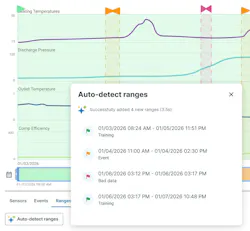
- Enabling efficient user experience through AI automated workflows. By utilizing AI not only for modeling but also for automating workflows such as preprocessing, agent creation and alarm grouping, the technology is more robust and efficient (Figure 1). For example, AI-enabled APM technology can group alarms and provide recommendations on what to do next. This minimizes information overload for operators that may be facing hundreds of alarms at once by instead providing prioritized and actionable guidance.
By acting as the eyes of the operation, AI-powered APM technology can quickly guide teams toward the most likely failure scenarios and the appropriate responses. It also empowers companies to prioritize maintenance based on business impact, considering factors such as risk, criticality and potential consequences.
In addition, the software can help create smarter designs because it highlights where to invest in redundancies and other reliability‑enhancing strategies. Ultimately, it drives operational efficiency and faster resolutions by working across the entire reliability loop — from detection and diagnosis to prioritization, dispatch, verification and continuous learning.
Path to value
Visibility across thousands of assets means operators can create predictive models that incorporate both operational data and domain knowledge. These models continuously learn and refine themselves as the assets change behavior over time, allowing operators to accurately schedule maintenance activities when they make the most sense for the business.
By incorporating automatic processes for model building and deployment, the technology performs consistently regardless of who is using it. Automation and simplicity of use make these capabilities available to the broader organization, so even new workers can quickly start utilizing them to accelerate time-to-value.
By creating monitoring strategies that draw on asset characteristics, failure histories, templates and models, operators can accurately determine where to begin, how to extend coverage and how to create the greatest value. AI can also automate the preprocessing of data and alarms, eliminating the errors caused by sensor faults, shutdowns or process control changes.
The capabilities go even further: alarm grouping streamlines the diagnosis of underlying issues, while root cause analytics can help operators identify the most likely failure causes and the repair actions they need to take. Large language models can sift through large volumes of repair documentation and operating data to determine the best course of action. As the solution is scaled, the opportunities become greater.
Reliability programs that once covered fewer than 100 assets can now seamlessly scale to thousands of assets, empowering companies to optimize maintenance investments and reduce unplanned downtime. Operators now have the insights to anticipate issues, plan strategic interventions and resolve problems within broader business objectives. Through direct integration with equipment, systems and operations, AI-powered APM technology elevates reliability from a maintenance discipline to a strategic enterprise imperative that drives sustainable value.
About the Author
 Heiko Claussen
 Heiko Claussen
Chief technologist at Emerson's Aspen Technology business
Dr. Heiko Claussen is chief technologist at Emerson's Aspen Technology business, leading its AI organization encompassing the Asset Performance Management (APM) product suite, the AI shared services research organization supporting all product areas, and the AI R&D organization focused on developing novel cross-functional AI products such as AspenTech AVA. Moreover, Heiko is defining and executing AspenTech’s AI strategy, driving innovation across industries including energy, chemical, subsurface engineering, and electric power grid.
Prior to Aspen Technology, Heiko was head of autonomous machines and principal key expert of AI at Siemens and led initiatives to enable autonomous machine applications for factory automation. During his 15-year tenure at Siemens, where he was ‘Inventor of the Year’ twice, Heiko worked in many areas related to AI and digitization, including remote monitoring, machine learning, robotics, pattern recognition and statistical signal processing. Heiko is a recipient of numerous technical awards and recognitions and is the author of over 100 registered inventions with 67 granted/published patents.
Heiko holds a Ph.D. degree in electrical engineering from the University of Southampton, UK; a master’s degree in electrical engineering from the University of Ulster, UK; and a Dipl.-Ing degree in electrical engineering from the University of Applied Sciences Kempten, Germany.