What PACK EXPO exhibitors are saying about the challenges facing processors in 2026
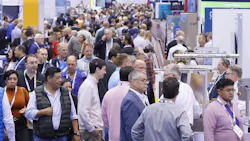
PACK EXPO International allows attendees to see the latest packaging and processing equipment and technologies up close and in person. But the show also provides an opportunity to take a broader look at the challenges and trends impacting the industry.
With that in mind, Processing reached out to PACK EXPO exhibitors about the biggest processing or operational challenges their customers are facing today. Their responses indicate that, while individual machines and technologies will still be an important aspect of the show, numerous factors are forcing processors to change the way they think about equipment purchases and how they engineer their processes.
According to Doan Pendleton, president of Vac-U-Max, “Manufacturers are being asked to increase throughput with fewer operators while accommodating more products, shorter production runs and increasingly frequent changeovers. At the same time, they must maintain product quality, sanitation and worker safety while controlling operating costs.”
These pressures are forcing processors to think less in terms of a single specification and more in terms of the entire application and lifecycle. “Investment decisions are increasingly based on total cost of ownership rather than capacity alone,” say Dominik Breuherr and Michael Nettinger, of Flottweg SE. “Manufacturers want to understand how a machine will affect product yield, energy use, maintenance costs, equipment availability and process flexibility throughout its operating life.”
Labor pressure is accelerating automation — and simplifying equipment
Multiple exhibitors noted the difficulty processors are having finding and retaining skilled workers for operations, maintenance, and sanitation, leading suppliers to highlight solutions that minimize manual handling, automate repetitive tasks, and simplify operation and cleaning. Unibloc Hygienic Technologies, for example, will be demonstrating tear downs of its hygienic lobe and AODD pumps, which feature patented QuickStrip and One-Nut designs that reduce cleaning and maintenance cycles from hours to minutes.
Increasingly, automation is becoming more about leveraging a limited workforce than about increasing production speed. Equipment that is easier to operate, maintain, and clean allows processors to maintain production with fewer highly trained workers.
According to Ryan Long, director of sales, Americas, at Akona Process Solutions, “Processors are looking beyond headline production speeds and considering the total cost of ownership, including cleaning time, maintenance, energy consumption and product loss. This is driving the development of simpler, more efficient equipment that delivers consistent performance while reducing the operational demands on production teams.”
Flexibility is becoming a core equipment requirement
Flexibility is becoming a core equipment requirement as well, as SKUs multiply, formulations and changeovers increase, production volumes and raw materials vary, and hygiene requirements strengthen. Processors need to be able to adapt to changing production demands without incurring excessive downtime or capital costs.
Breuherr and Nettinger note that manufacturers are “looking for modular technologies that can be adapted as raw materials, recipes, production volumes and hygiene requirements evolve” and explain that the design of Flottweg’s new FW400 Decanter allows processors to upgrade in response to changing production requirements without replacing the entire machine.
Growth in high-protein, plant-based, functional, and shelf-stable products is driving APV, a division of ITT, to design systems capable of handling wider viscosity ranges, heat-sensitive products, more complex formulations, faster changeovers, recipe flexibility, and greater process control.
Tom Koshy, sales director for Mettler Toledo Product Inspection Group, emphasizes that process flexibility does not mean sacrificing efficiency or compliance and that the priorities of today’s equipment buyers are “pushing equipment design toward systems that are easier to operate, integrate, maintain, and adapt as production needs change.”
Equipment integration is replacing the “standalone machine” mindset
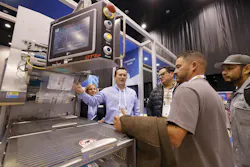
Several exhibitors noted the importance of evaluating equipment as part of the overall process rather than as an isolated operation. This means considering how a machine will integrate and communicate with upstream and downstream equipment to maintain production efficiency and process visibility.
“By considering how materials are received, conveyed, weighed, mixed and discharged,” says Long, “manufacturers can identify bottlenecks and develop an integrated solution that delivers better performance than addressing each stage in isolation.”
Pendleton notes that packaging machine performance depends heavily on a consistent material feed. “Vac-U-Max vacuum conveying systems automate this transfer,” he says. “Level controls can signal the conveying system to deliver material when the packaging machine requires it, helping maintain the appropriate amount of product in the hopper without overfilling it.”
The key takeaway is that a high-quality machine can still lead to an underperforming process if it isn’t properly integrated into the system.
Sanitation, quality, and process visibility are driving equipment design
Exhibitors also discussed how sanitation and quality requirements are influencing equipment design.
“The challenges we hear most come down to visibility and verification under tightening compliance,” says John Giordano, director of sales at LJ Star. “Our food, beverage and pharmaceutical customers are under real pressure from FSMA and USP requirements to prove what is happening inside a closed process, not assume it.”
Hygienic design features, simplified disassembly, and automatic clean-in-place functionality help ensure reliable cleaning without adding excessive downtime, while precise process control helps to protect product quality and consistency.
The ROI conversation is expanding beyond throughput
Suppliers consistently described how buyers are looking beyond the sticker price and considering a machine’s cost — or savings — over the course of its operating life. These calculations may include factors such as labor requirements, downtime, product yield/loss, energy and water consumption, maintenance and cleaning time, future adaptability, and aftermarket service and support.
“Successful food and beverage manufacturers know that investment and continual process improvement is essential for continued success and growth,” says Matt Hale, global business development director for HRS Heat Exchangers. “They are therefore looking for efficient solutions which offer real return on investment over the operating life, including features such as energy efficiency and reuse, reliability, longevity, and ease of use and maintenance.”
Getting the most from PACK EXPO
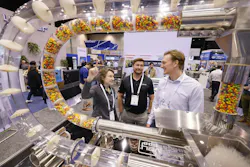
- What specific process problem does this equipment solve?
- How will it handle product or formulation changes?
- How easy is it to operate, clean, and maintain?
- How well can it be integrated into my process?
- Is application testing available before purchase?
- Is it easy to upgrade or modify if needed?
- What measurable impacts will it have on yield, uptime, energy use, etc.?
Also, the best machine is not necessarily the best machine for your application. Equipment selection begins with the material and the process parameters, not with equipment specifications.
Chris Waibel, product manager at Industrial Magnetics puts it this way: “Placement and application design matter more than magnet strength alone. The right magnet in the right spot, engineered for your specific process, will consistently outperform simply reaching for a ‘stronger’ magnet.”
The most valuable conversations you can have at PACK EXPO are not focused just on what a technology can do but on how that technology fits with your material, process, workforce, and long-term goals.