Ask a Powder Pro: How do material properties impact pneumatic conveying system design?
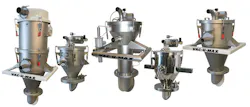
Determining the material’s properties is one of the most important starting points in pneumatic conveying system design. The same vacuum conveyor that works beautifully with free-flowing plastic pellets may struggle with a cohesive food powder, damage a friable ingredient, or wear prematurely when handling an abrasive mineral. For that reason, good pneumatic conveying system design begins with the material, not the equipment.
The first property to understand is bulk density. Bulk density affects how much material is being moved through the conveying line by volume, not just by weight. A light, fluffy powder may require more air volume to suspend and move the material, while a dense powder may require more vacuum, more careful pickup design, or a different line size to maintain the desired transfer rate. This directly affects the vacuum producer, conveying-line diameter, receiver size, filter area, and discharge valve selection.
Particle size and particle shape are also critical. Granules, flakes, powders, fibers, and pellets each behave differently in a conveying line. Fine powders can become airborne easily, which is useful for conveying but may create dust-control, filtration, or combustible dust concerns. Larger particles may require higher conveying velocities or larger line diameters. Irregular particles may interlock, bridge, or resist flow at the pickup point.
Flowability is often where applications become more complex. Materials that are cohesive, sticky, hygroscopic, oily, or prone to compacting may not feed consistently into a pickup wand, bag dump station, bulk bag unloader, or process hopper. In those cases, the system may require agitation, vibration, fluidizing pads, specialized pickup tools, or hopper modifications. Many apparent conveying issues are actually feeding issues. If the material cannot enter the conveying stream consistently, the best vacuum conveyor in the world will not deliver consistent performance.
Another important consideration is friability. Some ingredients, such as fragile food inclusions, tablets, capsules, crystals, or certain pharmaceutical and chemical materials, can degrade if conveyed too aggressively. For these products, the design must balance transfer rate with product integrity. The goal is not simply to move the material; it is to move it without creating excessive fines, dust, or product damage.
Abrasiveness affects equipment life. Materials such as minerals, certain chemicals, glass-filled resins, metal powders, or coarse granular products can wear elbows, conveying lines, valves, and receiver components. In abrasive applications, system designers may recommend wear-resistant elbows, heavier-wall tubing, reduced bends, specialty materials of construction, or layout changes that reduce impact points.
Moisture content and environmental sensitivity also influence design. Hygroscopic powders can absorb moisture from the air, which may lead to clumping, buildup, or poor discharge from the receiver. Some materials are temperature-sensitive, static-sensitive, reactive, or require sanitary design. Food, nutraceutical, chemical, plastics, additive manufacturing, and battery materials all bring different handling requirements.
From Vac-U-Max’s perspective, vacuum conveying is particularly useful because it allows powders and bulk solids to be transferred from common sources such as bags, drums, totes, bulk bags, gaylords, hoppers, or process equipment, into mixers, blenders, feeders, reactors, screeners, packaging machines, or other process equipment with less manual handling. Because the system operates under negative pressure, any small leak in the conveying line tends to draw air inward rather than push dust outward into the plant.
For combustible, toxic, allergenic, or nuisance dusts, that containment advantage can be significant. However, material hazards must be identified early. Combustible dust characteristics, static concerns, minimum ignition energy, reactivity, toxicity, and housekeeping requirements should all be reviewed as part of the design process.
The best practice is to share as much material data as possible before the system is specified. A material safety data sheet is helpful, but it rarely tells the whole material handling story. Bulk density, particle size distribution, moisture content, flow characteristics, temperature, required rate, conveying distance, number of elbows, pickup source, discharge destination, cleaning needs, and plant environment all matter.
When the material is unusual or difficult, testing is strongly recommended. Lab testing can confirm pickup behavior, conveying rate, filter performance, discharge characteristics, product degradation, and whether the proposed system layout is realistic.
In pneumatic conveying, there is no one-size-fits-all answer. Material properties determine the air volume, vacuum level, line size, receiver geometry, filtration, controls, construction materials, and overall system approach. A successful system is designed around how the material actually behaves, not how everyone hopes it will behave.
About the Author
 Doan Pendleton
Doan Pendleton
Doan Pendleton is President of Vac-U-Max.