Controlling nuisance dust Part 1: Why fugitive dust is more than a housekeeping problem
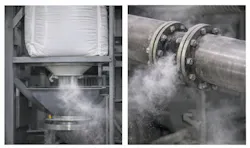
Industrial facilities across a wide range of sectors — from chemicals and pharmaceuticals to food, agriculture, minerals, and metals — generate dust as a natural byproduct of handling bulk solids. Often termed “nuisance dust” or “fugitive dust,” these fine particles are sometimes viewed as merely a cosmetic or housekeeping issue: dirty equipment, extra cleanup, an untidy plant floor. In practice, however, nuisance dust is frequently a symptom of deeper process and safety challenges that, if left unaddressed, can escalate into health hazards, product quality issues, or even serious safety risks.
Understanding where nuisance dust originates and why it persists is the first step toward effective control. This article examines the causes of fugitive dust, the risks it presents, and the common process operations where dust generation occurs. In Part 2 of this series, we will explore engineering strategies and best practices for containing and controlling dust at the source.
Understanding nuisance dust and why it persists
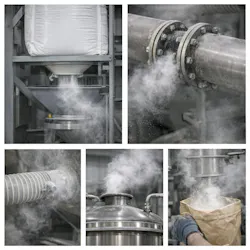
Nuisance dust generally refers to fine particulate material that escapes intended containment during processing and handling. (Technically, a bulk solid material is classified as dust when its particle size falls below 500 microns in diameter.) These fine particles may be generated intentionally — such as through grinding, milling, or size reduction — or unintentionally through attrition, product degradation, or mechanical agitation. Common sources of nuisance dust include pneumatic and mechanical conveying systems, filling and emptying operations, bag and bulk bag handling, and other activities such as screening or blending.
Dust persists because many industrial processes inherently rely on gravity, airflow, or open transfer points to move material efficiently. Even well-designed “closed” systems tend to develop minor leakage points over time. Gaskets and seals degrade, flexible connectors fatigue or crack, filter elements clog, and even raw material characteristics can vary from batch to batch in ways that promote dustiness.
Additionally, dust particles are often extremely fine and light — often smaller than the human eye can easily see when airborne. This means facilities may underestimate how much dust is being released until it visibly accumulates on surfaces or equipment. By the time a layer of powder is noticed on floors or rafters, a far greater quantity of dust may already have been dispersed into the air.
Dust is more than a housekeeping issue
Once nuisance dust is in circulation, its impacts extend well beyond an untidy workspace. Fugitive dust affects cleanliness, health, process safety, and combustible dust explosion risk in significant ways:
Cleanliness and product integrity: Accumulated dust can compromise plant cleanliness and even product quality. Dust settling on equipment, structural supports, conduits, and control panels can be easily dislodged by vibrations, normal air currents, or foot traffic, sending it airborne repeatedly. In multipurpose or multi-product facilities, this raises the risk of cross-contamination between different products, especially during changeovers or maintenance. While regulated industries such as food and pharmaceuticals explicitly monitor dust for contamination control, the issue is equally relevant in specialty chemicals, polymers, and pigments where even small inclusions of foreign material (dust from another process) can affect product performance or consistency.
Occupational health and exposure: From an occupational health standpoint, nuisance dust can represent a chronic inhalation and exposure hazard. Fine particulates that remain suspended in air for extended periods are easily breathed into the respiratory tract. Even if the material is “non-toxic,” long-term exposure to any fine dust can lead to respiratory irritation or more serious conditions (e.g., pneumoconiosis or dust-related lung disease) depending on the dust’s composition and concentration. Many dusts carry regulatory exposure limits (such as OSHA or ACGIH permissible exposure levels) that necessitate engineering controls or personal protective equipment. Uncontrolled fugitive dust contributes to workers potentially exceeding those exposure limits, emphasizing that dust control is as much an industrial hygiene concern as an operational one.
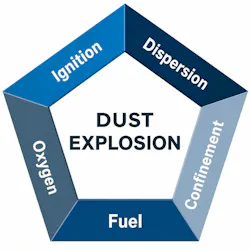
Process safety and combustible dust hazards: Dust accumulations pose fire and explosion risks if the material is combustible. The dust explosion pentagon teaches that five elements — fuel (the dust itself), oxygen (air), an ignition source, dispersion, and confinement — must coincide for a deflagration to occur. In many routine operations (such as open bag dumping), the element of confinement may be absent, meaning a true explosion is unlikely; however, without full confinement, a dust cloud can ignite into a dangerous flash fire. More critically, dust that settles and accumulates in hidden areas (on beams, ductwork, or inside equipment) can become the fuel for a catastrophic secondary explosion if disturbed by a primary fire or blast.
History has shown that even facilities with good housekeeping can experience devastating dust explosions when a small incident lofts dust layers into the air. So, controlling nuisance dust is not just about tidiness, it is a preventative safety measure. Proper ventilation, spark control, and housekeeping all help remove one or more elements of the explosion pentagon (for instance, preventing the formation of combustible dust clouds or eliminating ignition sources).
To learn more and see real life examples of how this can happen, visit the U.S. Chemical Safety Board website.
Common dust-generating operations and scenarios
Understanding where and how dust is generated in a facility is the first step toward controlling it. Several common operations tend to produce nuisance dust:
Conveying systems: Bulk material conveying — whether via mechanical means (screw conveyors, bucket elevators, belt conveyors) or pneumatic systems (vacuum or pressure conveying) — can release dust even though these systems are largely enclosed. Mechanical conveyors introduce multiple potential leak points at transfer chutes, loading/unloading points, and through shaft seals or bearings. Fine powder can escape through any small gap or worn seal along the conveying route. Pneumatic conveyors (especially positive-pressure dilute phase systems) can push dust out through even pinhole leaks or imperfect connections, given the slight positive pressure in the lines. Moreover, high-velocity conveying often causes particle attrition: as particles collide with each other and equipment surfaces, they break into finer dust. This means the material exiting a conveyor can actually contain more fines than it started with, compounding dust issues if any connections or discharge points are not tightly sealed. Even vacuum (negative pressure) conveying systems, which inherently draw air inward if a leak occurs (a containment advantage), will still emit dust at the feed points or if the receiving vessel is not properly vented.
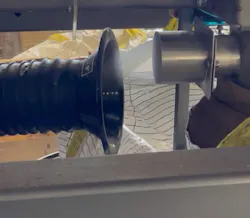
Filling operations (charging vessels or containers): Whenever bulk solids are poured or conveyed into a vessel, silo, or container, an equal volume of air or gas must leave that space. This displaced air often entrains fine particles and carries them out as dust if not properly managed. High filling rates, long “free-fall” drop distances, or rapid dump operations can exacerbate dust liberation as the incoming solids displace air forcefully. If a filling point lacks a vent line or filter sized to handle the displaced airflow, dust will force its way out via any available gap (a loose manway, unsealed lid, vent valve, or even small agitator shaft seals).
For example, consider a vacuum conveying system transferring powder into a reactor or mixer. Such systems often use pressurized air or inert gas “blow-through” to discharge the powder quickly and keep the conveying line clear. Without an adequately sized vent filter on the receiving vessel, the combination of displaced air and purge gas can overwhelm the vessel’s breathing capacity, causing dust to leak out around mixer seals or gasketed joints. Ensuring a dedicated, adequately sized vent path for displaced air (with appropriate filtration or dust collection) is essential in any filling operation to contain the dust at its source.

Emptying bags and bulk containers: Manual bag dumping (e.g., emptying 50 lb. sacks into a feed hopper) and unloading of bulk bags (FIBCs or “super sacks”) are notoriously dust-prone tasks. When operators cut open bags or untie large bag spouts, entrained fine particles readily puff out. Even with bag dump stations that have partial enclosures or down-draft ventilation, each bag handling introduces a burst of dust. In bulk bag unloading, the sheer quantity of material and the flexible nature of the bags pose challenges to achieving a tight seal. Features such as bag spout clamping devices and enclosed untie cabinets help, but careful operation is needed to minimize dust release when the flow starts and when an empty bag is removed.
Additionally, flow surges can occur during these emptying processes. For instance, if a stagnant mass of powder suddenly collapses (such as a rathole or bridging chunk breaking free inside a bulk bag or hopper), a large volume of material (and trapped air) can rush out at once. Such surges will momentarily overwhelm local dust extraction capacity, resulting in a visible dust cloud escaping the equipment. Designing bulk unloading stations with surge capacity (e.g., adequate hopper volume, fast-acting valves, or containment doors) and controlled discharge mechanisms can mitigate these sudden releases.
Other routine activities, such as open screening operations, mixing/blending in unenclosed equipment, or even the act of scooping material from containers, can also produce nuisance dust. Figure 2 shows examples of how bulk solids may behave when discharging from a hopper or storage bin. In the two scenarios on the right — ratholing and arching/bridging — stagnant powder may suddenly collapse, potentially creating significant dust generation.

Identifying dust sources before implementing controls
Fugitive dust should not be viewed simply as a housekeeping concern. In many facilities, visible dust is a symptom of underlying process conditions involving material flow, air displacement, equipment design, or containment challenges. If left unaddressed, nuisance dust can affect workplace cleanliness, product quality, employee exposure, and process safety.
The first step toward improvement is understanding where dust is generated and why it escapes containment. Once these sources have been identified, facilities can begin implementing engineering and operational controls that address the problem at its origin.
In Part 2 of this article, we will examine practical methods for controlling dust through source containment, airflow management, filtration, local dust collection, housekeeping, and process design considerations.
About the Author
 Jake Davis
Jake Davis
Jake Davis is a business unit leader for the Powder Handling and Containment product line at De Dietrich USA. He has been with the company since 2015 and has established himself as a trustworthy partner to solve various powder handling problems for a wide range of customers.
De Dietrich USA is a leading provider of process equipment, integrated systems, and engineered solutions to the bulk chemical, fine chemical, and pharmaceutical industries. Specializing in dense phase pneumatic conveying, De Dietrich provides custom engineered solutions to allow for the safe, contained transfer of powders, granules, and other dry bulk materials. For more information visit www.ddpsinc.com.