Ask a Powder Pro: How can I prevent caking, sticking, or buildup inside a rotary dryer?
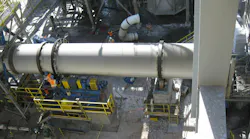
Caking and material buildup are among the most common challenges encountered in rotary dryer operation and can result in several issues, including reduced efficiency, damage to equipment, and lost product.
Although these issues can disrupt production and reduce efficiency, they are often largely preventable. With proper design considerations and operational strategies, both new and existing dryer systems can be configured to significantly reduce the potential for sticking.
Why sticking happens
A material’s tendency to stick or cake on equipment is influenced by its physical and chemical properties; moisture content, particle size distribution, chemical composition, and more, can all make a material more or less likely to cause buildup.
As a result, preventing buildup begins with designing the dryer around the material’s unique qualities. For this, engineers have several tools at their disposal.
Flight configuration
Flights, or material lifters, line the dryer’s interior, facilitating the material showering action responsible for the rotary dryer’s high rate of heat transfer. Flights have a significant impact on the dryer’s overall efficiency and performance.
Sticking is often the result of material with a high moisture content. When a high-moisture material enters the dryer, immediate contact with flights can encourage sticking, because flights are installed at right angles (creating a place for sticky material to settle and accumulate). To prevent this, engineers will often incorporate a “bald” or flightless section at the dryer’s inlet.
A bald section discourages buildup, eliminating corners for material to settle in and stick to. Instead, material experiences a reduction in moisture as it passes through the flightless section, prior to encountering the lifting flights.
Pretreatment
When moisture content is prohibitively high ahead of the drying process, another way to discourage buildup is through pretreatment of the material. Most often, this is carried out through a process known as back-mixing, in which dried material is mixed in with the feedstock to bring down the total moisture content of material entering the dryer. Similarly, processes utilizing a recycle loop can be configured to help reduce the potential for sticking.
Depending on the material, other pretreatment options, such as size reduction, conditioning, or chemical additives, may also be evaluated.
Knocking systems
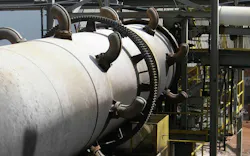
Identifying the most effective strategy to minimize potential buildup often requires testing. Process development work with a qualified OEM or other provider prior to commercial-scale design is invaluable in predicting sticking tendencies and optimizing equipment configuration accordingly.
Managing buildup in existing dryers
While preventing buildup through the initial design is ideal, in-service dryers can experience issues as well. This is especially true because rotary dryers are often in service for decades, experiencing changes in material formulation or feedstock quality over time.
Processors with existing dryers have two options: modify the feedstock or make adjustments to the dryer.
A change in vendor or feed quality specifications may help to bring feedstock back within design parameters to alleviate issues. Where feedstock modification is impractical, plant managers can work with their original equipment manufacturer (OEM) or another qualified provider to make adjustments to the dryer that best suit the altered feed conditions. The options are much the same as with a new dryer:
- Flight design and placement can be reconfigured to discourage sticking, particularly if it’s occurring near the inlet.
- The dryer can be retrofitted with a knocking system to further prevent buildup.
- A pretreatment step such as back mixing dry material can be incorporated.
Start with a process audit
The underlying cause of buildup may not always be clear in operational dryers. Before making modifications to the feedstock or dryer, plant managers should have the OEM or other qualified rotary drum service provider conduct a process audit to determine the root cause and the best course of action for remediation to protect efficiency, uptime, and long-term equipment performance.
About the Author
 Shane Le Capitaine
Process Sales Engineer at FEECO International
Shane Le Capitaine is a Process Sales Engineer at FEECO International, where he specializes in bulk solids drying, fertilizer granulation, and rotary drum applications. Shane received a BS in Chemical Engineering from the University of Wisconsin-Madison and has three decades of experience in his field.
Related

 Dried powder