Processing's Weekly Mixer: How to peacefully coexist with control valves, and more
Recent coverage of the process industries from across EndeavorB2B brands.
March 13, 2026
8 min read

Welcome to the latest installment of Processing's Weekly Mixer, which highlights recent content from EndeavorB2B brands relevant to process manufacturers.

This week's entry features content from Chemical Processing, Food Processing and Automation World, as well as this week's content from Processing.



How to peacefully coexist with control valves

 
Author Shaiq Bashir writes:
 
Control valves are the hands of your control system, yet they operate in a hostile mechanical reality that digital devices never experience. While electronic components hum along in climate-controlled marshalling cabinets, valves battle friction, wear, hysteresis, packing degradation, corrosion, erosion, cavitation, vibration and the brutal physics of process fluids under pressure. A valve with increased friction can destabilize an otherwise stable control loop. A deteriorating seat can introduce leaks that compromise product quality or pose safety hazards. Worn packing can be a source of fugitive emissions.

These mechanical workhorses remain the most expensive and maintenance-intensive components, consuming disproportionate resources and serving as the weakest link in your control loop. Any improvement that enhances their performance and reliability directly improves process control and reduces maintenance costs. That is where the maintenance approach for control valves becomes critical.

Unfortunately, the typical maintenance response to these realities has traditionally been binary: fix it when it breaks (reactive) or fix everything during shutdowns (preventive overkill). Neither approach is sustainable in today's environment of tight margins and operational excellence mandates. The results may include unexpected shutdowns caused by valve failures.

But what if 90% of unexpected valve-related shutdowns could be prevented? What if you could confidently defer two-thirds of your planned valve overhauls, focusing resources only where they're truly needed? The solution isn't revolutionary — it's already sitting dormant in equipment many plants already own.


Preparing chemical facilities for NATECH events

Also from CP: In the latest episode of Process Safety with Trish and Traci, Trish Kerin and Traci Purdum explore NATECH events, where natural hazards collide with industrial risk. Drawing on real incidents including Arkema in Crosby, Texas, BioLab in Lake Charles and the Fukushima disaster, they examine why facilities consistently underestimate natural hazard risk, how to build truly complete ride-out and recovery plans, and why traditional PHAs fall short for NATECH scenarios. Kerin's bottom line: assume the event will happen, and prepare accordingly. Listen below!

eChem Expo 2026 releases full conference program

eChem Expo, the solutions marketplace and technology innovations conference for plant-level processing and manufacturing, has announced the full conference program for eChem Expo 2026, taking place April 8–9, 2026 at the MeadowView Conference Resort & Convention Center in Kingsport, Tennessee.

The two-day conference will bring together plant leaders, engineers, operations teams, and industry stakeholders for expert-led sessions and panels designed to address the operational, reliability, and workforce challenges facing modern processing and manufacturing facilities. The program is built around real purchasing needs and operational priorities identified through stakeholder interviews with professionals across the industry.

The conference program features over 20 hours of accredited education led by industry experts from companies including Mettler-Toledo, KOCH, Protego, IndexAR Solutions, Hargrove, and Endress+Hauser.

Conference Director Damon Bryan Shackelford said, "Amid rapid change and rising performance demands, manufacturing teams need clear, practical guidance top-down and peer-to-peer. eChem Expo is designed to bring the industry together to share proven insights and technologies that help organizations move forward with confidence."

Eight technical tracks aligned with plant priorities

The 2026 conference program is organized into eight focused educational tracks designed to address the operational priorities shaping plant performance, safety, and reliability.

Day 1 tracks (Wednesday, April 8)

  • Capital Effectiveness
  • Operational Excellence
  • Industrial Artificial Intelligence
  • Workforce Development

Day 2 tracks (Thursday, April 9)

  • EHS & Compliance
  • Instrumentation for Process Reliability
  • Accelerating Turnarounds
  • Novel Equipment Design

Across both days, attendees will have access to expert-led presentations, interactive discussions, and real-world case studies designed to provide practical insights that can be applied immediately within plant environments.


How sanitation forms food safety’s foundation

 
Senior editor Andy Hanacek writes:
 
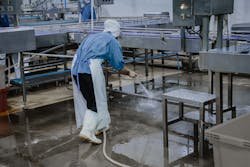
A comprehensive sanitation program remains one of the primary pillars needed to support even the most basic food safety program at food and beverage plants. Yet, even though proper cleaning of equipment and the plant environment might seem elementary, the simple fact is sanitation in an industrial environment requires a tight focus on procedure, training, execution and validation.


How Hormel Foods responds to evolving consumers, protein demand

Also from FP: In the latest episode of the Food for Thought podcast, Jason Baskin, director of Retail Strategy and Business Transformation of Hormel Foods Corporation talks about the ways in which the 135-year-old company continues to evolve and grow. Guided by a tight focus on consumers and on providing what the company calls “real food protein,” Hormel feels well-positioned to move into a new phase of growth.

In addition, Baskin offers insights into some of the trends impacting Hormel’s portfolio — from multicultural food influences to the growing specter of GLP-1 weight-loss drugs — and what Hormel’s approach has been to addressing those trends. Listen below.

Q&A: Network management strategies for today’s connected industry

From Automation World:

Ensuring the scalability and management of control networks has become a manufacturing imperative with the merging of IT and OT networks. This confluence of networks that were once separated means that industrial networks, in addition to managing thousands of connected plant floor devices as they always have, must also connect and coordinate these devices in ways that enhance operations through data sharing while ensuring visibility, often across multiple sites.

This reality is leading manufacturing organizations to use network management tools more commonly used on the IT side of the business. To get insights on what these tools offer to OT, Automation World spoke to Mike Fisher (MF), senior manager of solution architecture at Belden, a supplier of networking and data technologies. 

Read the Q&A here.



Recapping the week on Processing

Articles

Rethinking electrical reliability in food and beverage processing

Interactive plant environments empower the workforce

Corrosion control in closed cooling water systems

Five essential steps to ensure reliable centralized vacuum cleaning performance

Podcast

Autonomous cleaning robots in food processing: How CleanBotix’ Rosie is transforming plant sanitation

CleanBotix’ Matt Hill explains how the Rosie sanitation robot addresses labor shortages, improves cleaning consistency and reduces water and chemical use in food and beverage plants. Listen below.

News

Martin Engineering to introduce air cannon remote-monitoring technology in March 24 webinar

DuPont honored for transformational innovation in industrial water reuse

Fortress Technology to launch Raptor Flex automated checkweigher at Interpack 2026

KROHNE to pre-launch FLEXMAG 6100 single-use electromagnetic flowmeter at INTERPHEX 2026

New Products

ABB launches 500 X pH/ORP sensor for extreme industrial processes

The 500 X pH/ORP sensor is engineered to withstand extreme temperatures and corrosive process environments that quickly damage conventional sensors.

Donaldson launches Ultrapac HL heatless desiccant dryer for compressed air systems in North America

The Ultrapac HL dryer uses dewpoint-controlled regeneration to improve compressed air drying efficiency and reduce operating costs.

WaterSurplus unveils ImpactRO Mobile Reverse Osmosis Solutions

NORD extends IE5+ synchronous motor line

Sign up for our eNewsletters
Get the latest news and updates