Processing's Weekly Mixer: AI, digital twins race to capture vanishing plant expertise, and more
Welcome to the latest installment of Processing's Weekly Mixer, which highlights recent content from EndeavorB2B brands relevant to process manufacturers.
This week's entry features content from Chemical Processing, Pharma Manufacturing, Food Processing and Automation World, as well as this week's content from Processing.

AI and digital twins race to capture vanishing plant expertise
From Chemical Processing: With nearly 1.2 million energy and chemical workers needing upskilling by 2033, producers are deploying video-based training, spatial digital-twin interfaces and AI copilots to transfer veteran operators' know-how before it walks out the door — without letting the technology do the thinking for them.
Jennifer Markarian writes:
It’s no secret that the energy and chemicals sectors are losing plant-floor experience as large numbers of seasoned operators and engineers reach retirement age. The big question: Will they take their operational knowledge with them when they leave, or can organizations transfer that knowledge to the remaining workforce?
Complicating the gray tsunami, today’s younger workers are changing companies more frequently than previous generations, so knowledge transfer is happening at a swifter pace, according to Jon Epstein, COO at digital-twin software company Myrex.
At the same time, operations are becoming more complex as plants become more automated and digital, added Rahul Negi, director, Autonomous and AI, Honeywell Technologies Process Automation. Control room operators are also being given responsibility for performance criteria, such as throughput and yield.
“As a result, training can no longer focus solely on procedures,” explained Negi. “Operators need stronger skills in abnormal situation management, troubleshooting, process understanding and digital tool utilization. The industry also needs to accelerate the path from novice to expert operator.”
Read the entire article HERE.

Adapting biologics manufacturing to a more complex market
From Pharma Manufacturing: The pipeline of biologic products entering the market is becoming increasingly complex, and biomanufacturers are incorporating newer technologies and manufacturing strategies into their processes to meet unique production needs. CDMOs, for example, are developing advanced platforms to improve their adaptability and flexibility as the biologics market continues to grow and evolve.
In the latest episode of Off Script, Pharma Manufacturing spoke with Randal Bass, executive vice president of process design and innovation for Just-Evotec Biologics, a Seattle-based CDMO specializing in the development and manufacturing of biologic products. The conversation explored the challenges of meeting the demands of an expanding but increasingly fragmented biologics market, how single-use and continuous technologies are influencing the industry, and how integrated development strategies can help reduce scale-up risk. Bass also discussed the growing role of AI and machine learning in process development and what could drive broader adoption of advanced biomanufacturing technologies. Listen below.
The ongoing evolution of next-gen inspection and detection
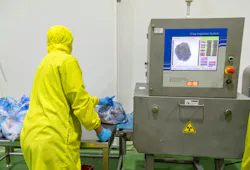
The food & beverage industry continues to battle foreign material contamination of the product stream, and technological innovation continues to feed processors the tools they need to continue to push back the enemy. Even as food & beverage recalls continue to make headlines for foreign material issues, there has been progress toward reducing the risk of product contamination.
“We're moving from reactive to predictive decision-making,” explains Juanfra DeVillena, senior vice president of quality assurance and food safety for chicken processor Wayne-Sanderson Farms. “Digital platforms provide real-time visibility into quality and food safety performance, while AI and machine learning technologies are creating new opportunities throughout our 23-plant operation.”
Many processors have begun to explore new technologies and even incorporate a multi-hurdle approach to finding foreign material and removing that contaminated product from the stream, says Jessica Evans, director of food advisory and training for NSF.
“Throughout the industry, we are seeing many food manufacturers transition from traditional metal detection systems to X-ray inspection technology,” she says. “Some facilities use both technologies, depending on product characteristics, hazard analysis and cost considerations.”

How closed-loop automation turns manufacturing data into better decisions
Manufacturers have never had more information about how their operations perform. Automated equipment can generate data continuously, while production systems record operating conditions, maintenance events, quality results and process deviations. Sensors can spot changes long before a problem becomes an obvious failure. But more information does not automatically lead to better decisions.
If a system detects the same problem repeatedly but nobody changes the process, the organization has collected information without learning from it. If a maintenance team finds a recurring failure, but that knowledge never reaches engineering or production, the same problem may keep returning. And if a process changes but nobody tracks what happens afterward, there is no way to know whether the change worked.
NIST describes smart manufacturing decision systems as using a “data feedback loop” that models, senses, transmits, analyzes, communicates and takes action on data.
After nearly three decades working with industrial equipment and aging infrastructure, I’ve learned that the strength of that loop often matters more than the amount of information an organization collects.