Processing's Weekly Mixer: Why a digital twin is only as useful as the decision it improves, and more

Welcome to the latest installment of Processing's Weekly Mixer, which highlights recent content from EndeavorB2B brands relevant to process manufacturers.
This week's entry features content from Automation World, Chemical Processing, Pharma Manufacturing and Plant Services, as well as this week's content from Processing.

A digital twin is only as useful as the decision it improves
Walk any modern plant floor, and you will find data everywhere. Dashboards glow on control-room monitors. Historians log millions of tags. Reports pile up in inboxes. Yet ask a few pointed questions, and the room often goes quiet: What actually happens if we change the fill sequence on line three? Which step is really capping our throughput? Can we test this PLC change without gambling a full shift of production?
That gap between having data and answering real operating questions is where most digital twin projects lose their way. Teams start shopping for software or chasing a full virtual replica of the plant, then wonder why the effort never pays off. A better starting point is far less glamorous and far more useful: pick one decision worth improving and build only the twin that improves it.

Using AI responsibly in process safety
From Chemical Processing: AI agents are now so easy to build that almost anyone can create one, but easy access doesn't mean blanket permission. In the latest episode of Process Safety w/Trish & Traci, Trish Kerin and Traci Purdum explore how agentic and generative AI can help chemical facilities by gathering data for risk assessments, spotting weak signals in process trends and freeing engineers from administrative work.
They also cover the risks: hallucinated sources, rogue agents and company information leaking into public tools. Trish urges listeners to fix broken processes before automating them, keep risk assessments human-led and verify every output. The goal isn't to fear AI but to use it thoughtfully.
Listen to the episode below.

Life sciences manufacturers adapt investments to a changing industry
Life sciences manufacturers are continuing to invest in their product pipelines and manufacturing capabilities while exploring how advanced technologies can improve efficiency and support growth. At the same time, these investments are taking place amid regulatory uncertainty, geopolitical pressures, and rising costs.
Those are among the key findings of CRB’s Horizons: Life Sciences 2026 report, which draws on insights from more than 400 life sciences companies.
The report found that more companies are “starting, increasing or expanding their pipelines across every modality.” To support this, facility investments are focused not only on capacity, but also on flexibility, location, access to skilled workers, and reliable supply chains. Life sciences companies are also evaluating how emerging technologies like artificial intelligence (AI) and automation can fit into their new or existing workflows.
“Our findings show an industry that is remarkably willing to move forward despite some significant headwinds tied to the supply chain and the rising costs of getting therapies to patients quickly and safely,” said Peter Walters, CRB fellow for advanced Therapies at CRB and a co-author of the report. “Companies are investing in facilities, expanding into new modalities, adopting advanced technologies and developing new workforce strategies. The organizations that succeed will be the ones that can stay agile while building for the long term.”
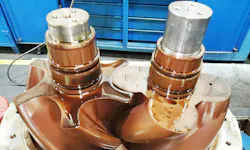
Compressor fluid performance can protect equipment, efficiency and maintenance budgets
I learned a costly lesson while servicing my last riding lawnmower. I decided to skip the recommended maintenance parts and fluids for cheaper generic ones found on the internet. “The description says it’s the same,” I thought with a shrug. Three years later in the hot July heat, the engine seized. The savings? A trivial $100 over the three years. The cost? More than $4,000 for a new lawnmower.
That moment stuck with me—not just as a cautionary tale for lawnmower maintenance, but as a reminder of how critical it is to use the correct parts and fluids for the jobs too. In various environments, air compressors are often the unsung heroes powering everything from assembly lines to roller coasters. And much like that lawnmower, their performance and reliability hinge on something easily overlooked: fluid health.
From energy efficiency and sustainability to long-term reliability and forward-looking innovations, the importance of using the right fluids, specifically OEM-recommended lubricants, in air compressors is the key to keeping operations running smoothly and economically.